Market Analysis March 2026 – 10 Blue-Chip Companies to Research
AI-driven volatility pushes several blue-chip companies toward the lower end of their 52-week ranges.

March volatility narrows valuations across established blue-chip franchises.
Image Source: ChatGPT
Market Analysis March 2026
March market analysis: From enterprise software volatility to valuation compression across established large-cap franchises, this report reviews publicly listed companies drawing attention this month. Educational insights from Trusted Company Reviews.
The Trust Report: Blue-Chips in the AI Volatility Cycle (March 2026)
Written by Deane Biermeier, CFEd · Edited by Paul J. Paquin, Founder & CEO
Market volatility accelerated in late February, particularly across enterprise software and data-centric business models. As the discussion around artificial intelligence evolves, several established large-cap companies moved toward the lower end of their 52-week ranges.
The companies below were reviewed as of March 2, 2026. Valuation data, including price levels, P/E ratios, 18-month midpoint estimates, Financial Strength ratings, and Safety Ranks, are sourced from the Value Line Investment Survey (Feb. 20, 2026 edition) unless otherwise noted.
This report is educational commentary, not a recommendation to buy or sell any security. Our objective is to explain why these companies are in the headlines and how they align with the TCR “Trust Test.”
1. The Market Infrastructure Test: S&P Global (Ticker: SPGI)
The News: S&P Global traded near $437.05 on Mar. 2, 2026, within its 52-week range of $381–$579. Broader weakness in financial data providers has contributed to recent price pressure. – P/E 29.81 or Forward P/E 22.52
Market Context: S&P Global operates within regulated credit ratings and benchmark data infrastructure. Its governance-linked revenue model differs from traditional seat-based software subscriptions. Recent multiple compression has narrowed its valuation relative to prior years, though it continues to trade at a quality premium.
Trust Verdict: Stable Profile – Institutional positioning, recurring revenue, and a top-tier Safety Rank support classification as a Stable Profile during volatility.
2. The CRM Transition Test: Salesforce (Ticker: CRM)
The News: Salesforce traded near $192.98 on Mar. 2, 2026, close to the lower boundary of its 52-week range ($180–$329). The decline reflects debate over how AI may reshape enterprise subscription pricing. – P/E 25.67 or Forward P/E 14.84
Market Context: Salesforce remains the leading cloud-based CRM platform. Its valuation multiple has compressed from 2024 levels, bringing pricing closer to historical norms. The key question is whether AI enhances revenue per client or shifts the model toward usage-based pricing.
Trust Verdict: Under Active Review – Strong franchise positioning remains intact. However, evolving revenue dynamics and competitive pressures warrant continued monitoring.
3. The Creative Workflow Standard Test: Adobe (Ticker: ADBE)
The News: Adobe traded near $260 on Mar. 2, 2026, just above its recent 52-week low of $251. Investor focus centers on whether open-source generative tools narrow creative software barriers. – P/E 15.71 or forward P/E 11.15
Market Context: Adobe’s valuation multiple has contracted materially compared to its five-year average. Despite volatility, it maintains strong Financial Strength and established free cash flow generation.
Trust Verdict: Under Active Review – Workflow dominance and balance sheet strength support operational resilience, though sentiment around AI competition continues to influence price movement.
4. The Enterprise Workflow Test: ServiceNow (Ticker: NOW)
The News: ServiceNow traded near $110 on Mar. 2, 2026, approaching its 52-week range floor of $98–$211. The stock has moved sharply with broader high-multiple software names. – P/E 64.68 or Forward P/E 25.64
Market Context: While valuation has compressed from prior highs, ServiceNow remains priced at a premium relative to broader large caps. Financial Strength remains solid, though historical price volatility is elevated. Recent reporting noted a $3 million insider purchase by CEO William McDermott (Yahoo Finance, Feb. 18, 2026).
Trust Verdict: Under Active Review – Enterprise workflow relevance remains clear, but valuation sensitivity and growth durability remain key evaluation points.
5. The Tax & Records Moat Test: Intuit (Ticker: INTU)
The News: Intuit traded near $420 on Mar. 2, 2026, close to its 52-week low of approximately $375. Software re-rating and AI automation narratives have weighed on sentiment. – P/E 28 or Forward P/E 17.67
Market Context: Intuit maintains one of the highest Earnings Predictability scores within the Value Line universe. Its multiple has compressed relative to prior years, though it remains a system-of-record platform in tax and accounting.
Trust Verdict: Under Active Review – Strong historical earnings consistency supports long-term relevance. Pricing-model shifts tied to AI warrant continued evaluation.
6. The AI Infrastructure Test: Microsoft (Ticker: MSFT)
The News: Microsoft traded near $397.85 on Mar. 2, 2026, marking a pullback from its 52-week high. Investor attention has centered on elevated capital expenditures tied to AI infrastructure expansion. – P/E 24.89
Market Context: Microsoft carries an A++ Financial Strength rating and a top-tier Safety Rank. Its valuation multiple has compressed relative to its five-year average. A February insider purchase by a company director was reported (Yahoo Finance, Feb. 18, 2026).
Trust Verdict: Stable Profile – Diversified revenue streams, enterprise integration, and balance sheet strength support a Stable Profile classification despite margin debates.
7. The Cybersecurity Platform Test: Palo Alto Networks (Ticker: PANW)
The News: Palo Alto Networks traded near $150.15 on Mar. 2, 2026, near the lower end of its 52-week range ($144–$223). The stock has experienced volatility amid platform integration efforts. – PE 82.73 or Forward PE 40.32
Market Context: The company continues consolidating cybersecurity tools into a unified platform. Financial Strength remains solid, though integration costs and acquisition-related dilution contribute to above-average volatility.
Trust Verdict: Strategically Positioned – Expanding enterprise security complexity tied to AI adoption supports strategic positioning, with execution remaining a central monitoring factor.
8. The Global Payments Rail Test: Visa (Ticker: V)
The News: Visa traded near $317 on Mar. 2, 2026, within its 52-week range of $299–$376. Broader market volatility has modestly compressed valuation multiples across payment networks. – P/E 30 or Forward P/E 24.94
Market Context: Visa maintains an A++ Financial Strength rating and a top Safety Rank. Its operating margins and earnings consistency remain among the strongest in large-cap financial services. Structural growth in digital payments continues to support long-term demand.
Trust Verdict: Stable Profile – Network effects, global scale, and balance sheet strength support classification as a Stable Profile during cyclical fluctuations.
9. The AI Implementation Partner Test: Accenture (Ticker: ACN)
The News: Accenture traded near $215 on Mar. 2, 2026, at the lower end of its 52-week range ($211–$390). Consulting-sector sentiment has softened amid slower booking growth.
Market Context: Accenture maintains strong Financial Strength and a high Earnings Predictability profile. Its valuation multiple has contracted from prior averages. Advanced AI project revenue continues to expand, though margin pressures are being monitored.
Trust Verdict: Strategically Positioned – As enterprises invest in AI transformation, Accenture’s implementation role supports strategic positioning, subject to execution and margin stability.
10. The Fintech Re-Rating Test: PayPal (Ticker: PYPL)
The News: PayPal traded near $45 on Mar. 2, 2026, near its 52-week range low of $38–$79. The stock has experienced significant multiple compression compared to prior years. – P/E of 8.54 or Forward P/E 8.73
Market Context: PayPal’s valuation now reflects a lower relative P/E compared to historical growth periods. Operating margins and return on equity have improved in recent years, though competitive pressure from large technology platforms remains a factor.
Trust Verdict: Under Active Review – Operational efficiency trends are improving, but competitive intensity and evolving payment dynamics justify continued evaluation.
How Our Trust Verdict System Works
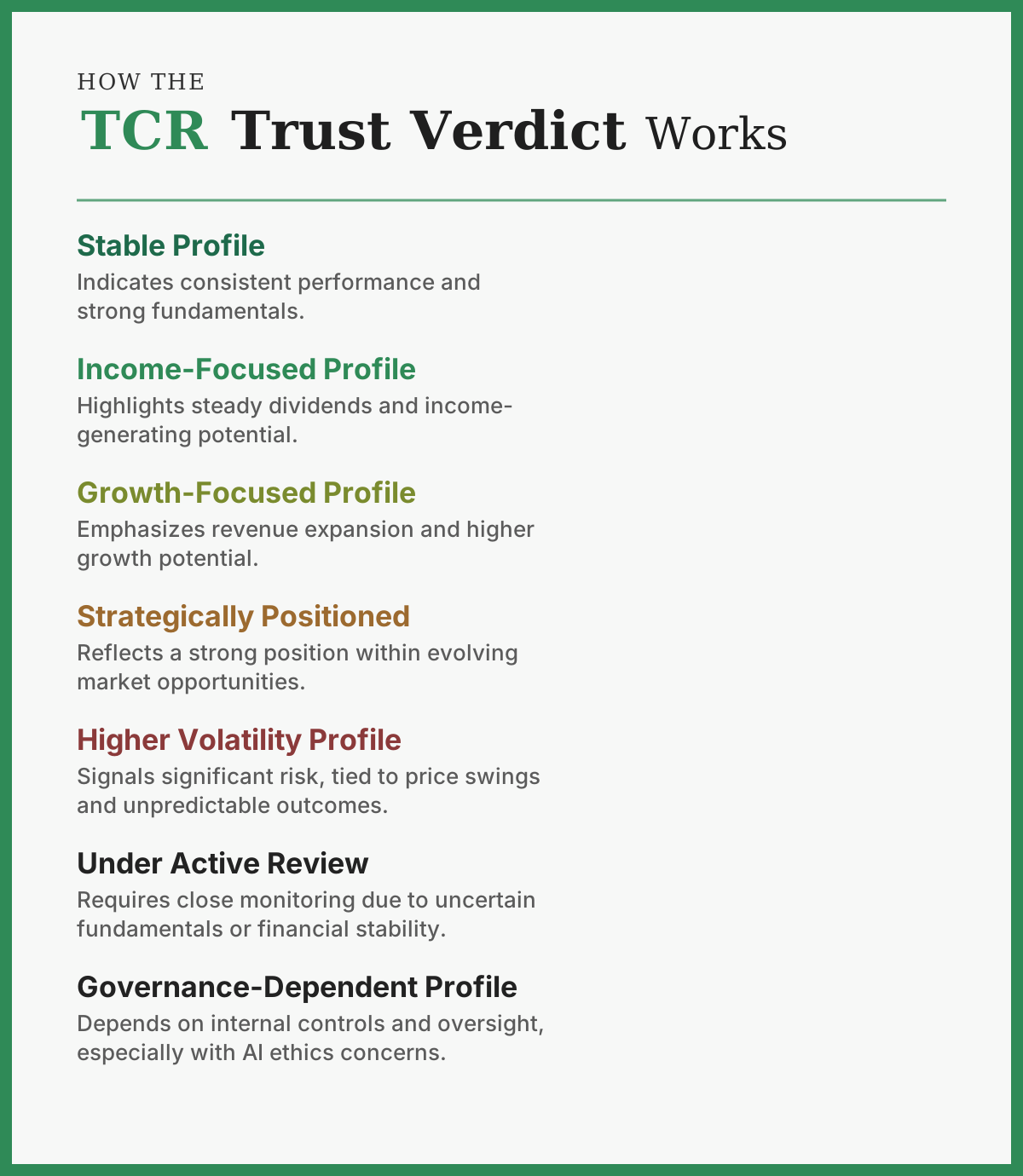
TCR’s Education Corner: “Down” Is Not the Same as “Undervalued”
A 52-week low is a price fact. It is not a valuation conclusion.
In volatile markets, prices can fall for different reasons:
- Narrative shifts (such as AI disruption fears)
- Sector-wide multiple compression
- Cyclical earnings softness
- Structural business deterioration
Distinguishing between those drivers is critical.
Analysts often compare current valuation multiples to a company’s own five- or ten-year historical range. If a stock is trading near a 52-week low but remains above its long-term average valuation band, it may still reflect elevated expectations. Conversely, when multiple compression occurs while cash generation and balance sheet metrics remain stable, market observers sometimes interpret that divergence as a research signal rather than confirmation of decline.
Also Read: April 2026 Market Analysis: Corporate Spinoffs to Research
TCR Note
If price declines occur while cash flow and balance sheet strength remain stable, market observers may interpret the move as multiple compression rather than a structural breakdown. If margins and cash conversion weaken alongside price, further caution may be warranted.
A Final Word
Volatility can amplify narrative-driven price swings. While artificial intelligence is reshaping workflows, many of the companies listed above operate as systems of record or institutional infrastructure. In such cases, technological change often alters interfaces before it replaces core platforms.
For readers evaluating broader asset allocation themes beyond individual equities, our 2026 Investing Outlook explores valuation gaps across international markets, small caps, real estate, and emerging markets in greater detail.
Market headlines describe movement. Our objective is to provide context around resilience, valuation discipline, and structural positioning.
Important Disclosures & Financial Disclaimer
Educational Purposes Only
TrustedCompanyReviews.com (TCR) is a publisher, not a registered investment advisor. This article is for informational purposes only and does not constitute personalized financial advice.
No Guarantees: Past performance is not indicative of future results. Market data is accurate as of March 2, 2026.
Conflicts of Interest
To maintain full transparency and comply with 2026 advertising standards, TCR, its owners, or its contributors may hold long or short positions in the securities mentioned in this report. These positions are held for long-term investment purposes. All commentary is produced with editorial independence to ensure objective analysis.
Also See: 5 Potentially Undervalued Index Funds for Long-Term Investors to Research in May 2026