How to Pay Off Credit Card Debt Fast: Debt Consolidation and Other Strategies by Debt Amount

TrustedCompanyReviews.com (TCR) accepts advertising compensation from affiliate partners that we review and feature on our site, which impacts the location and order in which products, services and companies are presented, and also impacts the score that is assigned to it. The reviews, rankings, and product information of affiliates constitute advertising. TCR is not paid to publish content and does not permit its affiliates, or any third party, to control or otherwise approve any of its content. Company listings on this page DO NOT imply endorsement. TCR does not feature all providers on the market. Except as expressly set forth in our Terms of Use, all representations and warranties regarding the information presented on this page are disclaimed. The information, including pricing, that appears on this site is subject to change at any time.
Key takeaways
- A debt consolidation loan is often the fastest realistic way to clear credit card debt with balances of $10,000 or more.
- Replacing 22% credit card APRs with a 12% consolidation loan can save thousands in interest while speeding up your payoff timeline.
- The avalanche and snowball methods work as standalone strategies and pair well with consolidation for maximum speed.
- For most borrowers, the fastest plan combines consolidation with aggressive monthly payments above the new loan’s minimum.
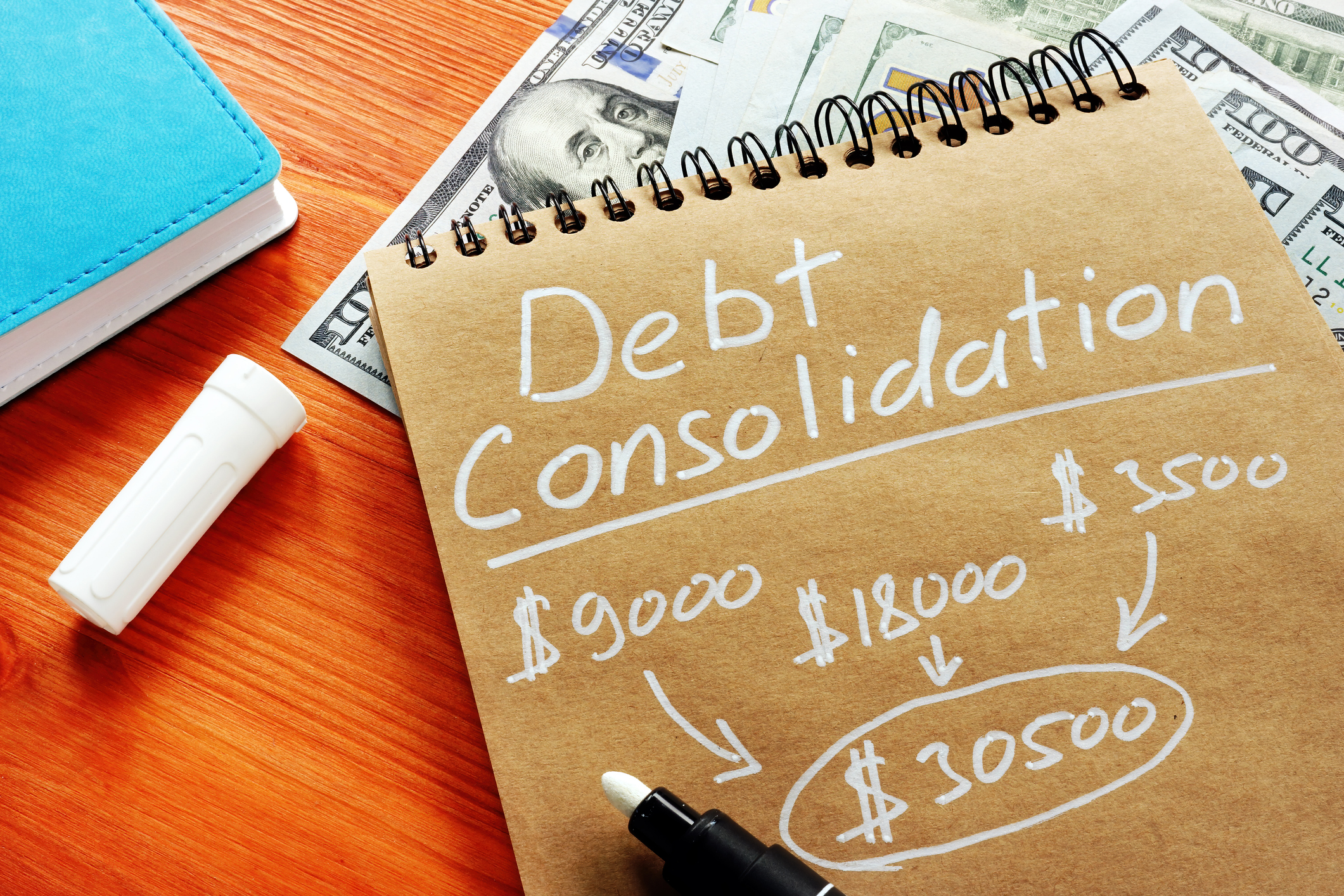
The fastest realistic path to getting debt under control for most borrowers is a debt consolidation loan. Debt consolidation replaces multiple high-interest credit card balances with a single, usually lower-rate loan and a specific payoff date, and the strategy can take years off the timeline compared to paying minimum payments alone.
Debt consolidation isn't right in every situation or for every borrower. This guide covers when consolidation can yield the fastest payoff and how it compares to the avalanche and snowball budgeting methods. We'll also look at plans for paying off $5,000, $15,000, and $30,000+ balances.
Why Minimum Payments Keep You Stuck
Most credit card lenders calculate your minimum payment at roughly 2% of your balance, which is barely enough to cover the debt's interest costs at typical rates. A $10,000 balance at 22% APR adds roughly $180 per month in interest alone. Meanwhile, the minimum payment might be $200. The scenario leaves only about $20 going toward your principal debt each month.
According to the New York Fed's Household Debt and Credit Report, household credit card balances in the U.S. recently surpassed $1.28 trillion, climbing roughly 5.5% year over year. Most of that growth happens because making minimum payments doesn't reduce balances fast enough to be practical.
For most borrowers, debt consolidation breaks that cycle more effectively than any other tool.
Why Debt Consolidation Speeds Up Payoff
If you're paying only the minimum monthly payments on credit cards with a $15,000 balance total at an average of 22% APR, you'll ultimately pay roughly $20,000 in interest over a time scale of about 25 years.
In contrast, consolidating the same balance amount into a 5-year personal loan at 12% APR can clear the debt in 60 months and cost about $5,000 in total interest.
The Three Main Fast-Payoff Strategies
There are three primary ways to quickly pay down debt, each with advantages and drawbacks.
1. Debt Consolidation Loan
A consolidation loan is a fixed-rate personal loan usable for paying off existing card balances and replacing them with a single monthly payment that generally lasts for 2 to 7 years. This method is best for balances of $10,000 or more, where the interest rate gap between the cards and the loan creates significant savings. However, borrowers must qualify for these loans, and some find that the associated fees make it not worth the trouble.
2. Avalanche Method
The avalanche budgeting method focuses on paying the debt with the highest APR off first. To use it, borrowers pay the minimum on every card, then put every extra dollar toward the highest-APR card. Once the first card is paid off, redirect those funds to the debt with the next-highest APR. This method is best for borrowers who want to minimize total interest without taking on a new loan. However, it can take a while to pay off the largest debts, so some internal motivation will be necessary.
3. Snowball Method
The snowball budgeting method involves paying off the debt with the smallest balance first. To use it, pay the minimum on every card, then put every extra dollar toward the debt with the smallest balance. Once the first card is paid off, redirect those funds to the debt with the next-lowest balance. This method is best for borrowers who need early wins for motivation. The trade-off is that you'll pay somewhat more total interest over the avalanche method.
How These Strategies Compare
| Strategy | Total Interest Cost | Motivation Factor | Best For |
| Consolidation Loan | Lowest for borrowers with solid credit | High: Defined payoff date and structured payments | $10K+ balances, steady income, fair-to-good credit |
| Avalanche Method | Lower than making minimum payments | Low: First card may take months to clear | Borrowers minimizing interest without a new loan |
| Snowball Method | Higher than avalanche | High: First card debt often clears within months | Borrowers needing motivational momentum |
Tier-Based Plans
Here are several debt payoff strategies to consider based on the amount you owe.
$5,000 in Card Debt
- Consolidation loan at 12% APR over 3 years: roughly $166 per month with about $980 in total interest.
- Balance transfer card with 0% intro APR plus $300 to $420 monthly: Interest-free if you pay off the debt within the promo period.
- Avalanche budgeting method at $300 to $400 per month: Debt is cleared in roughly 18 months.
A consolidation loan provides the most predictable payoff timeline. A balance transfer can be the cheapest option if you qualify for the card and finish paying off the debt within the promo window.
Note: Some lenders require a minimum loan amount of $10,000, which may make consolidation unavailable for smaller balances.
$15,000 in Card Debt
- Minimum payments alone: 25+ years, $20,000+ in total interest.
- Consolidation loan at 12% APR over 5 years: Payments of roughly $335 per month, and you'll pay about $5,000 in total interest.
- Consolidation loan at 12% APR over 3 years: Payments of roughly $498 per month, and you'll pay about $2,950 in total interest.
- Avalanche budgeting method at $400 per month: Will take roughly 4 years with substantially more interest cost.
Consolidation saves $15,000 or more in interest compared to making only minimum payments at this level of debt.
$30,000+ in Card Debt
- Minimum payments alone: 30+ years.
- Consolidation loan at 12% APR over 5 years: Payments of roughly $667 per month, and you'll pay about $10,000 in total interest.
- Consolidation loan at 12% APR over 7 years: Payments of roughly $530 per month, and you'll pay about $14,500 in total interest.
- HELOC for homeowners: You'll likely have lower rates, but this method secures the loan against your home, which could put it at risk if you're unable to make payments.
At this level, consolidation typically wins on both speed and total cost.
Pairing Consolidation with Accelerated Payments
The fastest realistic payoff strategy combines obtaining a consolidation loan and making extra monthly payments. Consolidate your debt at a lower rate, apply the monthly savings toward additional principal, and use the avalanche or snowball method on any remaining balances.
A $15,000 loan at 12% APR over 5 years runs about $335 per month. Adding just $100 above that can cut the payoff timeline to about 3.75 years and save another $1,500 or more in interest.
Common Mistakes to Avoid
- Paying the minimum and assuming progress is happening.
- Spreading extra payments across all cards equally instead of concentrating on a single target.
- Continuing to use cards after starting a payoff plan.
- Switching strategies repeatedly instead of committing to one.
- Skipping pre-qualification when shopping for a consolidation loan.
Conclusion
For most borrowers carrying significant credit card balances, debt consolidation offers the fastest realistic path to becoming debt-free. Replacing 22% card APRs with a 10% to 14% consolidation loan can save thousands in interest and shave years off the payoff timeline, especially when paired with extra monthly payments.
The avalanche and snowball methods work well for smaller balances or for maximizing debt-consolidation savings. The right plan is the one that fits your debt level, credit profile, and budget — and one you'll actually follow through on.
FAQs
What's the fastest way to pay off credit card debt?
A debt consolidation loan, combined with making monthly payments above the minimum, is the fastest way for most borrowers to pay down debt. For balances under $5,000, a 0% balance transfer card with aggressive payments can be similarly fast and sometimes cheaper.
How does consolidation compare to the avalanche method?
Consolidation and the avalanche budgeting method aren't mutually exclusive. Debt consolidation locks in a specific payoff date at a lower rate, while the avalanche method targets your highest-interest debt. Many borrowers combine both by consolidating main balances and applying avalanche logic to anything left over.
How much can I save by consolidating?
A $15,000 balance at 22% APR carries roughly $20,000 in total interest if you make only minimum payments until paid off. The same balance consolidated at 12% APR over 5 years carries roughly $5,000 in interest, meaning that your savings depend on the rate you qualify for, plus any origination fees.
Can I pay off credit card debt without consolidating?
For smaller balances or borrowers who can commit to making substantial extra payments, yes, you can pay off credit card debt without consolidating. For balances above $10,000, consolidation usually makes more sense by accelerating the timeline and reducing the total cost.
Conclusion
For most borrowers carrying significant credit card balances, debt consolidation offers the fastest realistic path to becoming debt-free. Replacing 22% card APRs with a 10% to 14% consolidation loan can save thousands in interest and shave years off the payoff timeline, especially when paired with extra monthly payments.
The avalanche and snowball methods work well for smaller balances or for maximizing debt-consolidation savings. The right plan is the one that fits your debt level, credit profile, and budget — and one you'll actually follow through on.