


5-Point Financial Contract Trust Checklist: How to Know If a Company Is Legit
Learn how to read a financial contract and know if a company is legitimate using this 5-point trust checklist designed to help consumers spot red flags before signing.

Written by
Deane Biermeier
Before you sign, understand what you’re agreeing to.
Image source: Gemini
How to Know If a Company Is Legit – Our 5-Point Trust Checklist
Written by Deane Biermeier, Certified Financial Educator and Senior Editor at TrustedCompanyReviews.com. Reviewed by Paul J. Paquin, Founder and Chief Investment Strategist at TrustedCompanyReviews.com.
Every financial product comes with a contract. Most consumers sign them without fully understanding what they’re agreeing to.
Before you sign any agreement, the most important question to answer is simple: Is this company legit?
Learning how to read a financial contract properly is one of the most powerful consumer protection skills you can develop. In an era where trust is fragile and fine print can feel like a battlefield, the agreement you sign should protect both parties, not trap one of them.
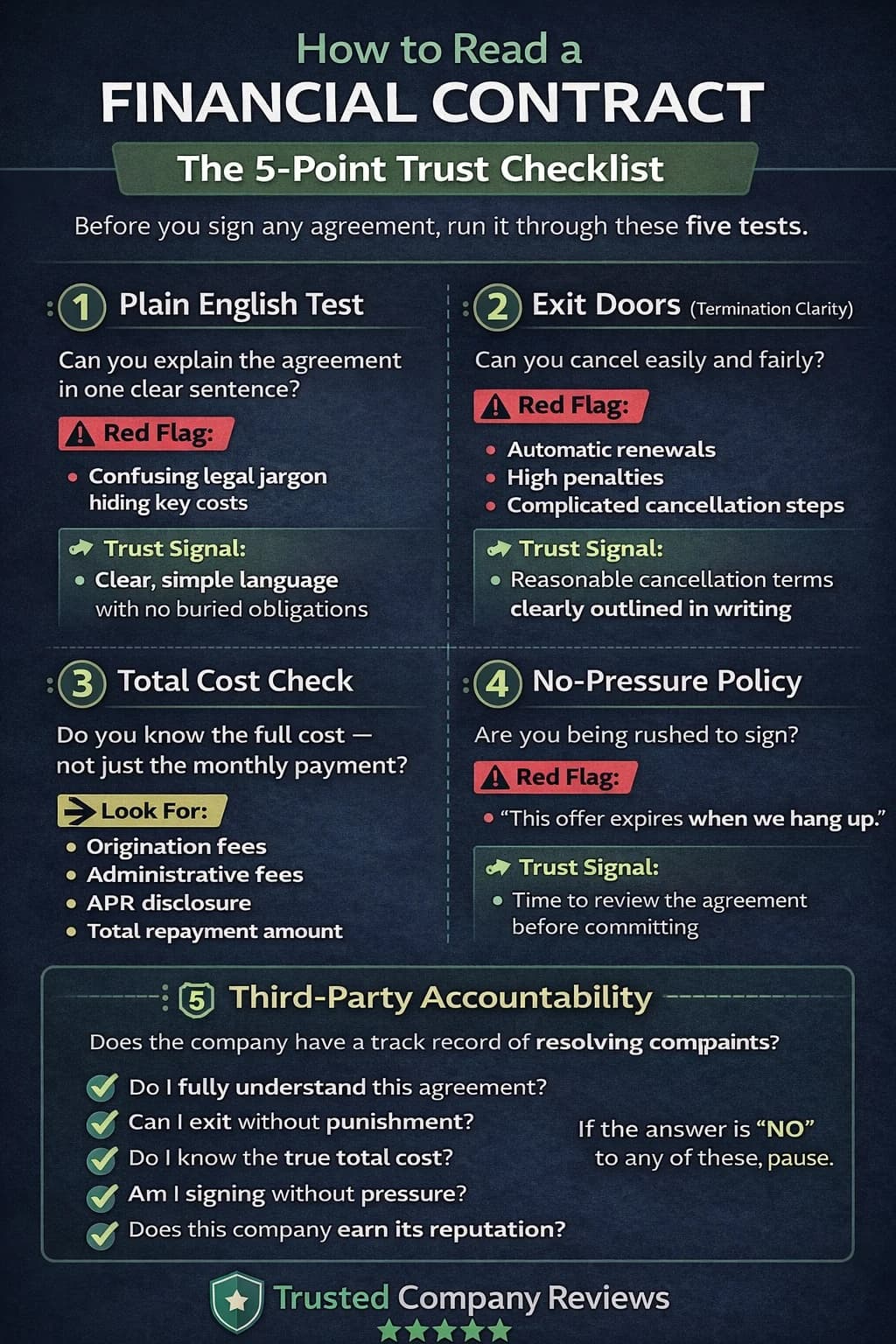
After publishing hundreds of reviews at TrustedCompanyReviews.com, we realized consumers need more than just a rating. They need a shield. That’s why we created the 5-Point Financial Contract Trust Checklist. It’s a practical framework to help you spot whether an agreement is transparent and fair or designed to confuse, pressure, or overcharge.
Before you put pen to paper, run the contract through these five standards. If a company can’t meet them, it hasn’t earned your business.
Related Article: What to Look for in the Most Trusted Review Sites
1. The Plain English Transparency Test
A trustworthy contract is written to be understood, not to hide its intent.
The Check:
Can you explain the core obligation in one clear sentence?
For example:
“I borrow $10,000 and repay it over 36 months with fixed payments.”
“I pay $29 per month and can cancel anytime.”
If you can’t summarize it clearly, that’s a problem.
Red Flags:
Excessive legal jargon hides key costs
Key numbers buried deep in fine print
Conflicting statements between marketing and contract language
Trust Marker:
Legitimate companies want you to understand what you are signing, so there are no disputes later.
2. Identifiable Exit Doors (Termination Clarity)
Trust is built on the freedom to leave. Every financial agreement should clearly outline how a consumer can cancel.
The Check:
Locate the termination clause and ask:
How do I cancel?
What type of notice and how early is it required?
Are there penalties?
Red Flags:
Automatic renewals or charges without clear notice
“Liquidation damages” language
Complex cancellation steps (certified mail, multiple forms, narrow windows)
Trust Marker:
Cancellation terms are clearly stated, understandable, and reasonable.
3. Total Cost of Certainty (Beyond the Monthly Payment)
Trust isn’t just about a low monthly payment; it’s about the total cost of the transaction.
The Check:
Look for:
Origination fees
Administrative fees
Prepayment penalties
Maintenance charges
APR disclosures
Ask yourself:
Does the math on the page match what the advertisement leads you to believe?
While origination and administrative fees are standard in many agreements, unusually high, vague, or inconsistent charges are a signal to slow down. A trustworthy company explains its pricing clearly and justifies every dollar it charges.
Red Flags:
Vague fee language
Missing total repayment amount
“Subject to change” clauses without limits
Trust Marker:
A trusted source provides a total out-the-door cost summary without you having to hunt for it with a calculator.
4. The No-Pressure Verification Period
A contract signed under duress is rarely a good one.
The Check:
Can you:
Take the contract home?
Review it for 24 hours?
Email it to a trusted advisor?
Red Flags:
“This offer expires when we hang up.”
“Sign now to lock this in.”
Refusal to provide written copies before signing
Trust Marker:
A trustworthy company respects your due diligence.
5. Third-Party Accountability (The Audit Trail)
A company’s word is only as good as its history of resolving complaints.
The Check:
Does the agreement explain:
How disputes are handled?
Is mediation or arbitration mandatory?
Where legal jurisdiction applies?
Then verify:
BBB history
Recent complaint patterns
Licensing and regulatory status
Red Flags:
No clear dispute resolution process
Heavy arbitration clauses limiting the consumer’s rights
History of unresolved complaints
Trust Marker:
At Trusted Company Reviews, we look for companies that not only have high ratings but also a documented history of resolving consumer issues fairly.
The TCR Solution: Our 1–10 Trust Rating Score
Reading contracts shouldn’t require a law degree — or blind trust.
That’s why we built the TCR Trust Rating Score — a 1-to-10 system designed to evaluate companies based on measurable trust indicators.
Our score cross-references:
Verified Costs: How pricing compares to industry standards.
Reputation Aggregation: Real-time sentiment from BBB, Trustpilot, and recent consumer feedback.
Compliance Checks: Active licensing and regulatory verification.
Dispute Patterns: How consistently companies resolve complaints.
The Result:
A single, transparent number that tells you whether a company has earned your trust.
Before signing any financial agreement, slow down. Determine the company’s legitimacy. Read carefully. Ask questions.
A trustworthy company won’t object to scrutiny — and it won’t hide from it.

Written by
Deane Biermeier