Trustedcompanyreviews.com offers free content, reviews and ratings for consumers to read, aimed at helping them compare their options. We may receive advertising compensation from companies featured on our website, influencing the positioning and sequence in which brands (and/or their products) are displayed, as well as affecting the assigned ratings. Please note that the inclusion of company listings on this page does not constitute an endorsement. We do not feature all available providers in the market. With the exception of what is explicitly outlined in our Terms of Service, we disclaim all representations and warranties regarding the information presented on this page. The details, including pricing, displayed on this site may undergo changes at any time.
Debt Consolidation Calculator
Take Control of Your Debt – Try Our Debt Consolidation Calculator
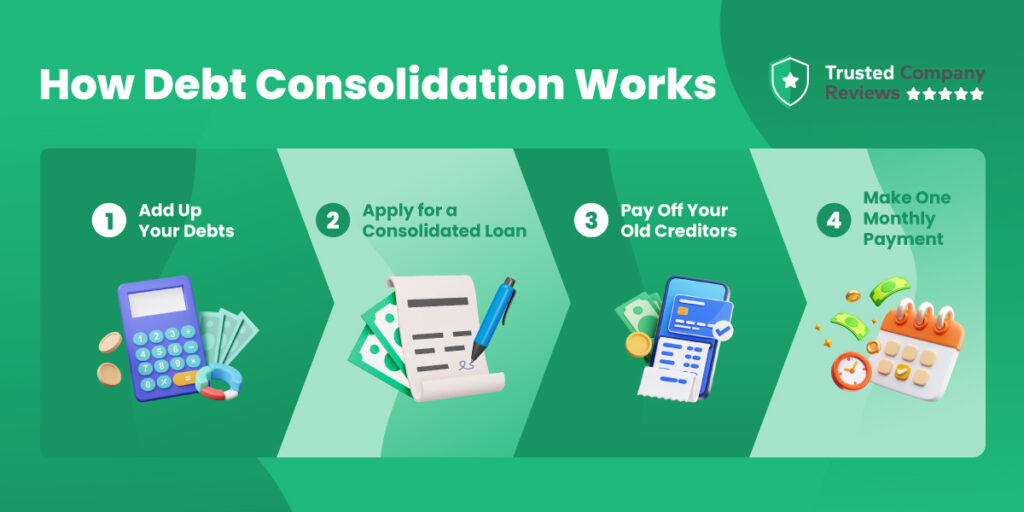
Managing multiple debts can feel overwhelming. A debt consolidation loan simplifies repayment by combining your balances into one monthly payment, often with a lower interest rate.
Your calculator results provide a useful estimate of how debt consolidation could affect your monthly payment, payoff timeline, and total interest costs. Learning more about Accredited Debt Relief can help you compare those estimates with real debt solutions and determine whether consolidating your unsecured debt is the right next step.
Use our calculator below to compare your current debts to a single consolidated loan and see how much you could save. You can also check out our overview of the best debt consolidation providers.
Use Our Debt Consolidation Calculator to Start Your Journey
Should I Consolidate My Debt?
Enter up to 10 unsecured debts. We'll estimate your payoff timeline with current payments and compare it to a single consolidation loan.
Your Debts
Consolidation Loan (What If?)
Typical APR Ranges by Credit Score (estimate only)
| Credit Score | Estimated APR Range |
|---|---|
| Very Good – Excellent (740–850) | ~ 6% – 14% |
| Fair – Good (630–739) | ~ 11% – 22% |
| Very Poor – Poor (300–629) | ~ 20% – 36% |
Results
Find the right debt consolidation loan for you
Compare prequalified offers in minutes. Checking rates won’t impact your credit score.
Your current debts
| # | Balance | APR | Monthly Payment | Months to Payoff | Total Interest | Payoff Date | Payment Adequate? |
|---|
Top-Rated Debt Consolidation Companies
Ready to take the next step? Here are some of our top-rated debt consolidation providers.
How to Use the Debt Consolidation Calculator
Follow these quick steps for the most accurate results:
- Enter your debts: Add balances, APRs, and monthly payments for each of your current unsecured debts, such as credit cards or personal loans. The current debts table will automatically update.
- Adjust the loan details: Input your estimated APR, term, and any fees for your new loan. A dropdown menu is available to help you choose an estimated rate.
- Compare the results: Review your total monthly payment, estimated interest savings, and payoff time. You can go back and adjust figures and specifics to see how changes affect your results.
- Download your summary: (Optional) Export your results to a CSV file to print or save for your records.
Ways to Consolidate Debt
1. Debt Consolidation Loan
One of the most popular ways to consolidate debt is to obtain a personal loan or a debt consolidation program specifically designed for this purpose. Online lenders provide the easiest method. However, banks and credit unions also offer these loans.
Terms and interest rates vary by lender, so shopping around is a solid plan. Online marketplaces can help simplify this process. Typical loan lengths are from one to seven years. Although some can be longer. Many providers take the extra step of paying your creditors for you, so you can skip that step.
2. Balance Transfer Credit Card
Transferring high-interest card balances to a credit card with a 0% introductory APR offer reduces your interest rate and can decrease the time it takes to pay off your debt. However, because of the shortened terms of most offers, your payments often increase, but over a shorter time period.
3. Home Equity Loan or HELOC (Home equity line of credit)
The best home equity lenders allow you to use your home’s equity to consolidate debt at a lower rate. However, there are some risks involved, including the possibility that missed payments could put your home at risk, so proceed with caution.
4. Debt Program
Working with a nonprofit credit counseling agency to combine your debts into one payment at a lower interest rate can also be a solution. Options are available through the National Foundation for Credit Counseling (NFCC) or the Financial Counseling Association of America (FCAA). Keep in mind that, while debt programs will help reduce your debt, your credit cards and unsecured loans will no longer be available for your use.
5. Savings or Retirement Account Loan
You can borrow from savings or a 401(k) to pay down your debts. It works similarly to taking a loan out from yourself. However, this approach requires careful planning, as potential tax consequences, penalty fees, and lost investment growth can affect your bottom line in the long run.
What Are the Average Debt Consolidation Loan Rates by Credit Score?
In reality, you have several credit scores. However, most only need to concern themselves with their FICO score and their VantageScore. Most lenders use your FICO score when determining your eligibility and rates for a personal, consolidation, home equity, or other loan.
While your credit score often directly relates to your interest rate or APR, many debt consolidation providers use other factors to determine your eligibility as well.
| FICO | VantageScore | Average Estimated APR Range |
| Exceptional (800-850) | Excellent (781-850) | ~7%–13% |
| Very Good (740-799) | Good (661-780) | ~10%–17% |
| Good (670-739) | Fair (601-660) | ~13%–23% |
| Fair (580-669) | Poor (500-600) | ~22%–31% |
| Very Poor (300-579) | Very Poor (300-499) | ~30%–36% |
Remember, the table above is for illustrative purposes only, and your actual rates can depend on other factors beyond your score.
What Are My Debt Consolidation Options if I Have Bad Credit?
If your credit score lands in the Fair range, debt consolidation is still possible. However, it may take a bit more planning and shopping around. You may pay higher interest rates, but it’s still one of the best ways to regain control of your finances. Check out our favorite lenders and marketplaces in our review of the best debt consolidation providers.
Be sure to always use the prequalification step, if available, to see what you qualify for before formally applying and risking an unnecessary credit score hit.
Additionally, using a secure loan, such as a HELOC, can take some of the pressure off in terms of relying solely on your credit score. However, this method does involve some risks if you’re not able to make consistent on-time payments.
Pros and Cons of Debt Consolidation
Debt consolidation can simplify your finances and potentially lower your interest rate and overall costs. However, there are some things to consider before taking the leap. Before applying for a loan or balance transfer, it’s essential to balance the potential savings against the associated costs and risks. Here’s a quick look at the primary pros and cons of debt consolidation:
Pros
- Simplified payments: Debt consolidation combines multiple debts into a single, easy-to-manage monthly payment.
- Lower interest rate potential: You may qualify for a lower APR, saving money over time.
- Predictable payoff schedule: Fixed-rate loans make it easier to plan and budget.
- Improved credit utilization: Paying off revolving balances (like credit cards) can lower your credit utilization ratio and boost your credit score over time.
- Faster payoff: Many debt consolidation borrowers find that they can pay down debt more quickly than it would take to pay off revolving credit, due to lower interest rates and fixed payments.
Cons
- Qualification depends on credit: In most cases, your credit score is the primary factor affecting your debt consolidation APR. This can mean higher rates for poor-credit holders.
- Upfront fees: Some loans include origination or transfer fees that reduce your savings.
- Temptation to overspend: Paying off credit cards can create room for new debt, so many borrowers need to change their spending habits to achieve long-term success.
- Secured loan risks: Using home equity or retirement savings puts assets at risk if you miss the monthly payments.
More Free Calculators to Help Compare Your Options
Here are additional free calculator resources designed to help you crunch the numbers. Use them to plan smarter, understand your choices, and feel confident in your financial decisions.
- Personal Loan Calculator
- Home Equity Loan Calculator
- HELOC Payment Calculator
- Debt Snowball Calculator
- Early Loan Payoff Calculator
- Monthly Budget Calculator
- Auto Loan Early Payoff Calculator
- Auto Loan Refinance Calculator
- Mortgage Payoff Calculator
- How Much Home Can I Afford Calculator
- Net Worth Calculator
- Savings Interest Rate Calculator
- Student Loan Early Payoff Calculator
FAQs
Does debt consolidation hurt your credit score?
Because most lenders perform a hard inquiry on your credit report when you apply for a debt consolidation solution, your score will see a small and temporary drop. However, making consistent, on-time payments can help rebuild your score quickly and even improve it over time.
Is debt consolidation a good idea?
Debt consolidation is possible using any one of several methods. The one that makes sense for you will depend on your financial and credit score situation. To determine if it’s a good idea for you, evaluate your current debts and rates against the potential savings offered by consolidation.
What’s the smartest way to consolidate debt?
The smartest way to consolidate debt depends on your financial and credit score situation. Borrowers with Good to Excellent credit have the most to gain from a personal loan, debt consolidation loan, or balance transfer offer, as they are more likely to receive a low interest rate. However, even borrowers with lower credit scores can often find the right lender to provide the best solution. For those with equity in their home, many find even better rates with this secured option.
Final Thoughts
There are several ways to consolidate debt. This debt consolidation calculator provides insight into how much you may be able to save. While your best options may depend on your credit score, some lenders, such as those in our overview of the best debt consolidation companies, use additional factors, including your employment status and overall history, to help determine the best rate possible.
Note
Calculator results are for educational purposes only and do not constitute financial advice or a contract. Loan terms, rates, and savings will vary by lender.