Elevated vehicle prices and financing costs are keeping average car payments high in 2026.
iStock Photo
What’s the average car payment? As of 2026, the average car payment in the U.S. is roughly $750 per month for a new car and around $530 per month for a used car. The numbers reflect elevated vehicle pricing in both categories, longer loan terms, and somewhat high interest rates, compared to pre-pandemic prices.
As of 1/13/26, according to Kelley Blue Book data, “The average new car buyer in December (2025) paid $50,326, a record high.”
That said, the “average” car payment for any particular borrower can vary widely. Your estimated monthly payment and how much car you can afford depend on a combination of factors, including loan term, annual percentage rate (APR), credit score, down payment, and the total amount you finance.
Key Takeaways
|
What Is the Average Monthly Car Payment Right Now?
The average car payment right now might be higher than you expect. The following chart numbers have their base in the most recent nationwide auto-finance data:
|
Vehicle Type |
Average Monthly Payment |
|
New Cars |
$750 |
| Used Cars |
$530 |
While these figures are a carryover from 2025, they’re the most relevant benchmark for early numbers this year.
It’s crucial to remember that averages can be misleading, and many borrowers can pay far more on a monthly basis. This is particularly true if you’re financing a larger vehicle, using longer loan terms, or borrowing at higher interest rates.
Why Are Average Car Payments Are Still High in 2026?
You’re not imagining it. There are several overlapping trends happening, which continue to push payments higher.
Vehicle Prices Remain Elevated
Supply chains, since the pandemic, have long since stabilized. However, vehicle prices are still well above pre-2020 norms. New vehicles, in particular, are more expensive due to added technology, safety features, and higher manufacturing costs.
Longer Loan Terms Are More Common
Where 60-month new car borrowing terms used to be the norm, borrowers are increasingly relying on 72- and 84-month auto loans to keep payments in check. While this lowers monthly payments, it increases total interest paid over time. Ending up “underwater” when using these longer-term loans is becoming common.
Interest Rates Are Still Restrictive
Although interest rates have dropped slightly for those with excellent credit scores, average APRs are still quite high, especially for used cars and borrowers with average or below-average credit.
How Much Car Can You Actually Afford?
Before you turn your focus on potential average car payments, it’s essential to understand how much car fits your income and overall budget. Many buyers qualify for more than they can comfortably afford, especially when lenders extend longer loan terms to entice them with low monthly payments.
A car affordability calculator works the other way by fitting your desired payment amount into the cost of the car. Instead of hoping you can once you get to the lot, you can have a good idea of your vehicle price range and avoid surprises.
Our calculator takes into account:
- Desired monthly payment
- Your down payment contribution
- How long of a loan term you desire
- Your credit rating
- Trade-in value and equity
- An estimated APR
Using an affordability tool helps prevent overextending your budget and reduces the risk of financial stress after the purchase.
What Factors Determine Your Monthly Car Payment?
By understanding how lenders calculate car payments, you can make smart car-buying decisions before you even step into a dealership.
1. Loan Amount
The amount you ultimately finance determines your monthly payment. A larger down payment, trade-in value, or choosing a less expensive vehicle directly lowers the principal and reduces your payments and the potential loan costs.
2. Interest Rate and APR
Your interest rate determines how much it will cost to borrow the money for your new vehicle. When comparing offers, always focus on the annual percentage rate (APR), which reflects interest plus lender fees and any other costs
3. Loan Term
Loan terms typically range from 36 to 72 months, with some lenders offering longer options. Eighty-four-month loans are becoming popular. While longer terms will reduce monthly payments, they invariably increase your total interest costs and carry the risk that the vehicle will depreciate faster than you can pay off the loan.
4. Credit Score
Your credit score and profile heavily influence the interest rate amount you’ll pay. Even a one- or two-point APR difference can change your payment by dozens of dollars per month.
How Credit Score Affects Monthly Car Payments
Borrowers with higher credit scores generally qualify for lower APRs and more favorable terms.
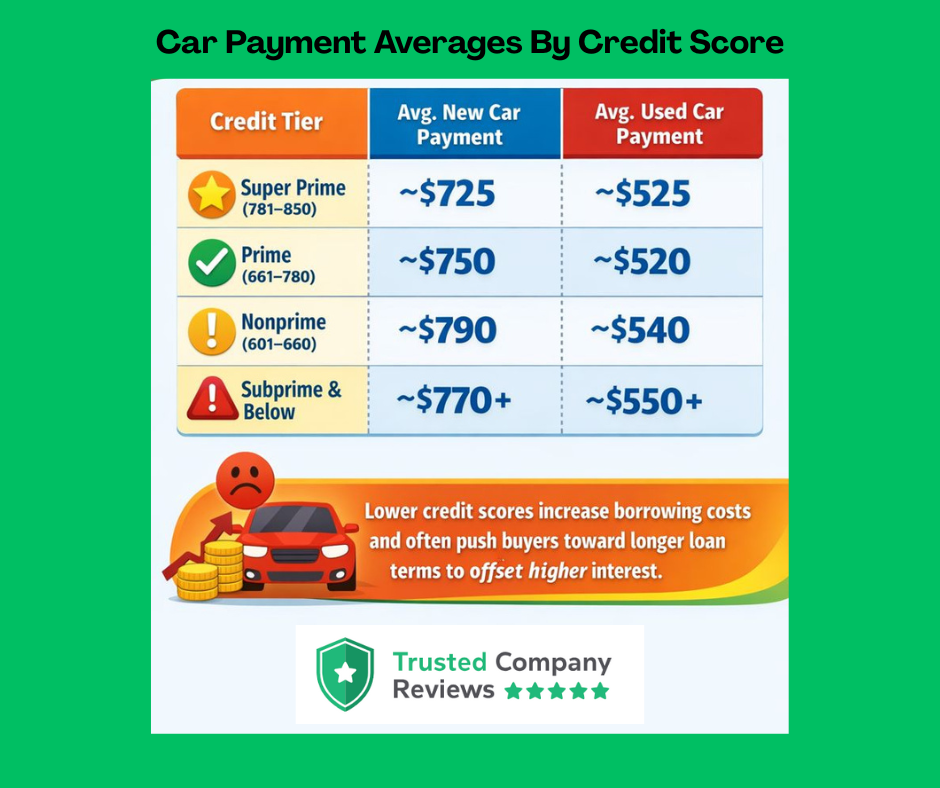
Comparing auto loan terms shows how longer loans lower monthly payments but significantly increase total interest paid over time.
How Loan Term Length Changes What You Pay
Many car shoppers focus on the monthly payment number and set aside worries about longer loan terms. However, loan length quietly drives long-term cost, and can take a toll on your budget down the road.
Example: $50,000 auto loan at 9% APR
|
Loan Term (months) |
Estimated Monthly Payment | Total Interest Paid |
|
36 |
~$1,590 |
~$7,200 |
|
48 |
~$1,245 |
~$9,800 |
|
60 |
~$1,040 |
~$12,400 |
| 72 | ~$895 |
~$14,900 |
While the 72-month option lowers the monthly payment by nearly $700 compared to a 36-month loan, it adds roughly $7,700 more in interest over the life of the loan and increases the risk of owing more than the vehicle is worth.
Pro Tip: Build the Budget First, Then ShopFrom our on-staff Certified Financial Educator Rather than letting a dealer frame the conversation around a monthly payment, start by defining what you can realistically afford both each month and in total. Keeping loan terms as short as possible can reduce interest costs over time, and comparing financing options before visiting the dealership puts you in a stronger negotiating position. It’s also important to factor in insurance, taxes, and ongoing ownership costs so the payment doesn’t stretch your budget later. If you’re unsure how a car fits into your overall finances, our Car Affordability Calculator can help you understand your limits before making a commitment. |
New vs. Used Cars: Payment Differences That Matter
While there’s some debate over whether buying a new versus used car makes more sense, it’s generally understood that buying a quality used car is the better financial deal. However, there are arguments to the contrary, and the gap between the two options is getting smaller.
| Factor |
New Car |
Used Car |
| Purchase price |
Higher |
Lower |
| Depreciation |
Steep early |
Slower |
| Interest rate |
Lower |
Higher |
| Insurance cost |
Higher |
Lower |
| Maintenance cost |
Potentially lower |
Potentially higher |
| Total ownership cost |
Higher overall |
Lower overall (usually) |
Used cars are still generally more affordable on a monthly basis than new cars. However, higher interest rates, maintenance costs, and automotive lifespan can narrow the gap.
The Hidden Costs That Don’t Show Up in Your Loan Payment
While your monthly car payment is likely the highest cost of car ownership, it’s only one part of the deal. Ignoring the rest can strain your budget. Keep these other factors in mind before committing to a car loan deal.
Insurance
As you might be painfully aware, Insurance premiums vary widely by vehicle type, location, and driving history. Newer and more expensive cars generally cost more to insure. Keep this in mind when choosing your vehicle purchase, regardless of its cost.
Taxes and Registration
Sales tax, registration fees, and local costs can add thousands of dollars upfront or increase your monthly payments if you include them in your financing. While paying them upfront increases your out-the-door cost, doing so can effectively lower your monthly car payments.
Maintenance and Repairs
Even reliable vehicles require ongoing maintenance. Some new cars come with partial maintenance plans included in the price. Beware of hidden costs if you choose to purchase an additional maintenance plan through the dealer. Budgeting for routine maintenance prevents unexpected financial stress later.
When Car Payments Crowd Out Other Financial Goals
High car payments can delay progress on savings or debt reduction. Before car shopping, it’s smart to review your entire budget to ensure it can cover any additional expenses. To help, we’ve created multiple budgeting and financial calculators for you to use.
- Car Affordability Calculator
- Home Affordability Calculator
- Debt Consolidation Calculator
- Home Equity Loan Calculator
- Monthly Budget Calculator
- Personal Loan Calculator
- Early Loan Payoff Calculator
- Auto Loan Early Payoff Calculator
- Auto Loan Refinance Calculator
- Mortgage Payoff Calculator
- Debt Snowball Calculator
FAQ
How much is a $30,000 car payment for 60 months?
A typical monthly car payment on a $30,000 car loan over 60 months is between $610 and $650. However, the precise amount will depend heavily on your interest rate and credit profile. Borrowers with higher credit scores may qualify for lower APRs, which can reduce their payments.
Is a 60- or 72-month car loan better?
A 60-month car loan generally costs less overall because you pay interest for a shorter period. A 72-month loan lowers monthly payments but increases total interest and raises the risk of owing more than the car is worth. The best option is the one that fits your overall financial profile.
What percentage of income should a car payment be?
Many financial planners recommend keeping your monthly car payment under 10% of take-home pay, when possible. How much car you can afford depends solely on your budget and financial obligations.
Bottom Line
So far, 2026 doesn’t look like it’s going to offer much relief in terms of car payments. However, making informed decisions can put you in the driver’s seat when taking on a car loan. You can help ensure that your new car fits your budget and aligns with your financial goals by understanding the effects of APR, loan terms, depreciation, and total ownership cost.