April 2026 Market Watchlist
Corporate restructurings and spinoffs create unique valuation dynamics as established companies separate out distinct business units.

Spring 2026 brings an acceleration in corporate spinoffs, highlighting the difference between mechanical selling and fundamental value.
Image enhanced by AI
This month’s report reviews publicly listed companies undergoing structural separation, including complex spin-mergers and distressed restructurings.
Written by Deane Biermeier, CFEd · Edited by Paul J. Paquin, Founder & CEO
Corporate restructurings, specifically stock spinoffs, frequently alter the traditional pricing mechanisms of the equity markets. When a parent company distributes shares of a newly independent business to its existing shareholders, it often triggers forced mechanical selling by institutional investors whose mandates do not align with the new entity’s profile.
Historically, market observers evaluate these periods of volatility to identify potential valuation gaps relative to historical trading ranges or segment-level metrics, and may provide a different risk profile depending on capital structure and asset composition.
We reviewed the companies below late on March 25th, 2026. Valuation data, including price levels, is sourced from recent market data unless otherwise noted.
This report is educational commentary, not a recommendation to buy or sell any security. Our objective is to explain why these companies are in the headlines and how they align with the TCR “Trust Test.”
April’s Top 10 Corporate Spinoffs to Research
|
Ticker |
Company Name |
Reference Price | Parent Company | Trust Verdict |
Key Research Factor |
| MSGS |
Madison Square Garden Sports |
$314.10 | MSG (Split Plan) | Under Active Review |
Asset Unbundling (Knicks/Rangers) |
|
VSNT |
Versant Media Group | $36.13 | Comcast | Strategically Positioned |
$1B Repurchase / Institutional Selling |
| MICC |
Magnum Ice Cream Co. |
$14.74 | Unilever | Under Active Review |
Pure-Play Consumer / Margin Expansion |
|
HLN |
Haleon PLC | $8.45 | GSK / Pfizer | Stable Profile |
Post-Spinoff De-leveraging / Consumer Staples |
| KDP |
Keurig Dr Pepper |
$31.03 |
JDE Peet’s (Merge/Spin) | Strategically Positioned |
Spin-Merger Complexity / Coffee Pure-Play |
|
SOLV |
Solventum | $64.03 | 3M | Stable Profile |
Insider Buying / Healthcare Demand |
|
FDXF |
FedEx Freight | Pre-Spin | FedEx Corp | Under Active Review |
LTL Pure-Play / Standalone Capital Structure |
| RNA |
Atrium Therapeutics |
$13.13 | Avidity Biosciences | Under Active Review |
Biotech Development / Cash Runway |
| SEG |
Seaport Entertainment |
$21.35 | Howard Hughes | Under Active Review |
Hard Asset / Real Estate Valuation |
| Q |
Qnity Electronics |
$118.34 | DuPont | Strategically Positioned |
Tech Infrastructure / AI Supply Chain |
1. The Asset Unbundling Test: Madison Square Garden Sports (Ticker: MSGS)
The News: MSGS traded near $314.10 (as of Mar 24, 2026). The company’s board unanimously approved a plan to explore a spinoff that would separate the New York Knicks from the New York Rangers into two distinct publicly traded companies.
Market Context: Market observers note that premium sports franchises are sometimes evaluated differently when combined under a single holding company. Separating these assets may allow the financial community to evaluate each franchise independently.
Trust Verdict: Under Active Review – The potential unbundling highlights historical valuation differences, warranting continued monitoring of the separation timeline and league approvals.
2. The Institutional Mandate Test: Versant Media Group (Ticker: VSNT)
The News: Versant Media Group traded near $36.13 (as of Mar 24, 2026), following its early January 2026 separation from Comcast in early January 2026. The company recently announced a $1 billion share repurchase authorization.
Market Context: When a mega-cap telecommunications conglomerate spins off a pure-play media entity, it can trigger mechanical selling from index funds and yield-focused institutions whose mandates may not align with the new entity’s profile. The company reported standalone adjusted EBITDA of $2.18 billion for 2025.
Trust Verdict: Strategically Positioned – Strong operational cash flow and a large repurchase program may influence capital allocation and share count over time, while broader media sector conditions remain a factor.
3. The Pure-Play Consumer Test: The Magnum Ice Cream Co. N.V. (Ticker: MICC)
The News: MICC traded near $14.74 (as of Mar 23, 2026), having spun off from Unilever in late 2025.
Market Context: Operating as an independent entity, the company is executing a €500 million productivity program designed to expand margins by 40 to 60 basis points in 2026. The business currently carries a price-to-earnings ratio of 26.4 (as of Mar 20, 2026).
Trust Verdict: Under Active Review – Brand strength provides pricing power against commodity inflation, though debt levels inherited during the separation warrant continued evaluation.
4. The Consumer Health Separation Test: Haleon PLC (Ticker: HLN)
The News: Haleon traded near $8.45 (as of Mar 24, 2026). The company, which owns brands like Sensodyne and Advil, has seen its valuation normalize following the staged exit of its former parent companies, GSK and Pfizer.
Market Context: Haleon represents a staged spinoff dynamic. Following its 2022 separation, the stock was subject to a valuation overhang as Pfizer gradually reduced its remaining 32% stake. Market observers often monitor these secondary distributions, as the completion of a major shareholder’s exit can remove temporary selling pressure.
Trust Verdict: Stable Profile – As a global consumer healthcare company with non-discretionary brand demand, the business reflects characteristics often associated with lower-volatility, defensive operating models.
5. The Spin-Merger Complexity Test: Keurig Dr. Pepper (Ticker: KDP)
The News: Keurig Dr. Pepper traded near $31.03 (as of mid-March 2026). The company expects to close its acquisition of JDE Peet’s in early April 2026, followed by a tax-free spinoff into Beverage Co. and Global Coffee Co. by year-end.
Market Context: Complex multi-step transactions can obscure the predictability of historical earnings. The company secured a $4.5 billion convertible preferred equity investment to support the capitalization of the future entities.
Trust Verdict: Strategically Positioned – The separation of business units may improve operational focus, with execution of the integration remaining a central factor to monitor.
6. The Capital Allocation Test: Solventum (Ticker: SOLV)
The News: Solventum traded near $64.03 (as of Mar 24, 2026). Following its separation from 3M in 2024, the company announced a $1 billion share repurchase program expected to begin in 2026.
Market Context: Open-market insider buying is sometimes evaluated by market observers as a signal of internal confidence in business fundamentals. Regulatory filings indicate director-level equity purchases at approximately $68.03 per share (as of Mar 10, 2026).
Trust Verdict: Stable Profile – Capital return initiatives and consistent healthcare demand support its classification as a stable operating profile during broader market fluctuations.
7. The Freight Separation Test: FedEx Freight (Ticker: FDXF)
The News: FedEx Corporation remains on track to spin off its less-than-truckload (LTL) division, FedEx Freight, with the separation scheduled for June 1, 2026.
Market Context: The parent company incurred $194 million in costs related to the separation during the third quarter of fiscal 2026. Market observers are evaluating how the independent entity may leverage its standalone capital structure to pursue potential strategic initiatives.
Trust Verdict: Under Active Review – The separation introduces distinct operational profiles for parcel and freight businesses, subject to execution and broader shipping demand conditions.
8. The Biotech Development Test: Atrium Therapeutics (Ticker: RNA)
The News: Atrium Therapeutics, previously part of Avidity Biosciences, traded near $13.13 (as of Mar 21, 2026).
Market Context: Spinoffs in the clinical-stage biotechnology sector are highly sensitive to development milestones. The company launched with approximately $270 million in capitalization to support its precision cardiology pipeline.
Trust Verdict: Under Active Review – The current cash position provides an operational runway, though the absence of commercial revenue supports continued monitoring of clinical progress.
9. The Hard Asset Test: Seaport Entertainment (Ticker: SEG)
The News: Seaport Entertainment traded near $21.35 (as of Mar 12, 2026). The company operates real estate and entertainment assets previously managed by Howard Hughes Holdings.
Market Context: Specialized real estate assets separated from broader development companies can experience valuation inefficiencies. Recent filings indicate that corporate directors continue to receive equity-based compensation aligned with long-term performance.
Trust Verdict: Under Active Review – Tangible real estate assets provide a valuation framework, though hospitality revenue remains sensitive to broader economic conditions.
10. The Tech Infrastructure Test: Qnity Electronics (Ticker: Q)
The News: Qnity Electronics traded near $118.34 (as of Mar 24, 2026), following its separation from DuPont in late 2025.
Market Context: Operating in the semiconductor and advanced packaging markets, the company currently has a price-to-earnings ratio of 32.56 (as of Mar 20, 2026). Demand tied to connectivity and artificial intelligence infrastructure remains a key driver of long-term relevance.
Trust Verdict: Strategically Positioned – Exposure to secular technology trends supports continued relevance, while elevated valuation multiples warrant disciplined analysis.
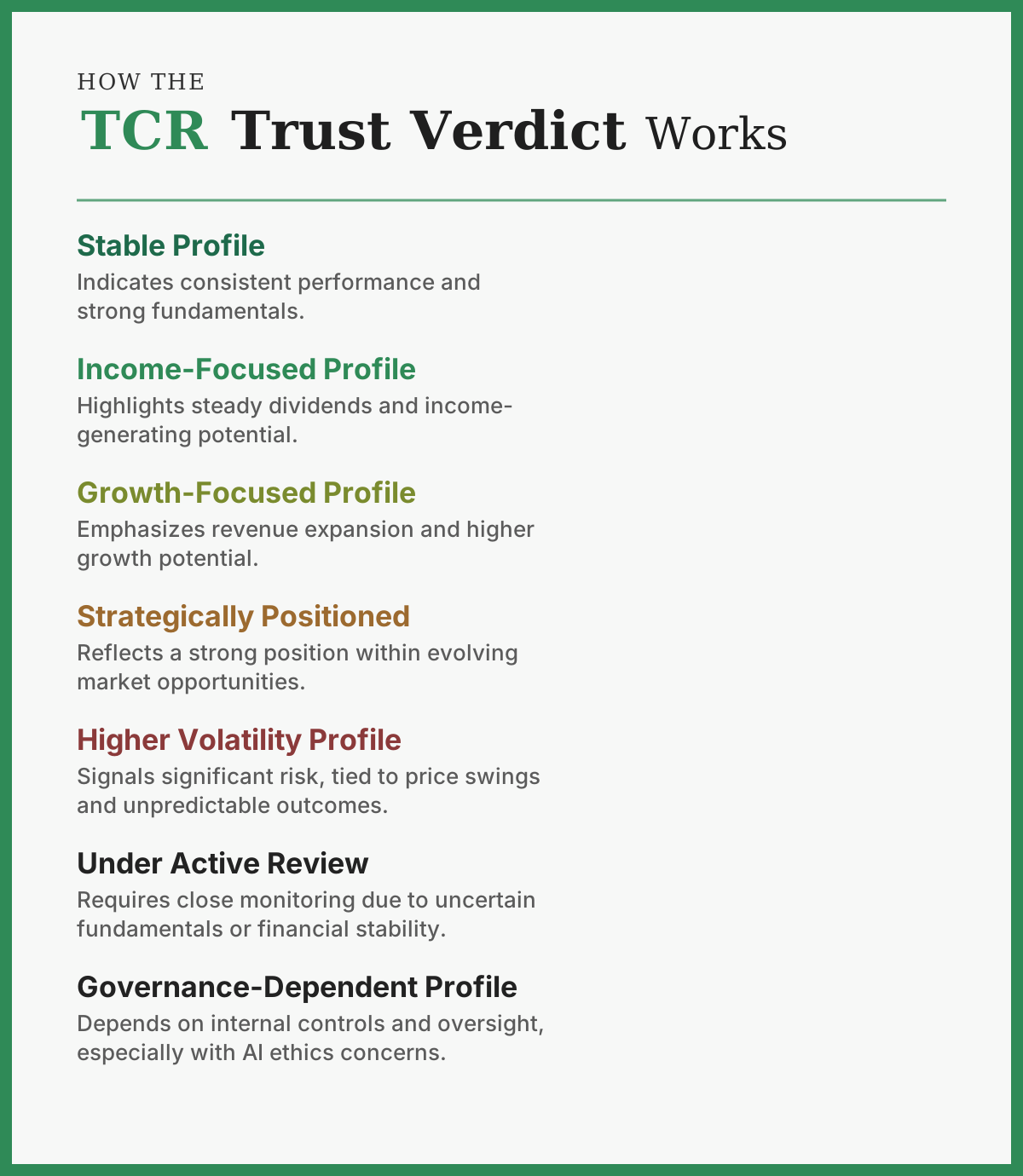
How Our Trust Verdict System Works
TCR’s Education Corner: “Mechanical Selling” vs. “Fundamental Weakness”
In the study of special situations, financial educators often look to the principles popularized by investors like Joel Greenblatt and Seth Klarman.
When a spinoff occurs, the new shares are distributed automatically to the parent company’s shareholders. Because index funds and institutional managers often operate under strict mandates (such as requiring a specific dividend yield or market capitalization), they are frequently forced to sell the new spinoff shares mechanically, regardless of the company’s actual valuation or business quality.
As a result, price declines following a spinoff do not always reflect a deterioration in business quality. Instead, they may reflect temporary supply-and-demand imbalances driven by institutional positioning.
Additionally, valuation frameworks often emphasize the concept of a “margin of safety,” which focuses on evaluating assets, cash flow durability, and balance sheet strength to account for uncertainty.
TCR Note
If price declines occur immediately following a spinoff distribution, market observers may interpret the move as mechanical selling by index funds rather than a structural breakdown of the underlying business. Historically, distinguishing between temporary institutional rotation and long-term business impairment has been a key focus in corporate restructuring analysis.
A Final Word
Volatility can amplify narrative-driven price swings. While corporate separations frequently generate complex financial engineering, many of the companies listed above operate as established systems of record, infrastructure providers, or consumer staples.
Market headlines describe movement. The objective here is to provide context around valuation, structural positioning, and business resilience.
Important Disclosures & Financial Disclaimer
- Educational Purposes Only: TrustedCompanyReviews.com (TCR) is a publisher, not a registered investment advisor. This article is for informational purposes only and does not constitute personalized financial advice.
- No Guarantees: Past performance is not indicative of future results. Market data is accurate as of late March 2026.
- Conflicts of Interest: To maintain full transparency and comply with 2026 advertising standards, TCR, its owners, or its contributors may hold long or short positions in the securities mentioned in this report. These positions are held for long-term investment purposes. All commentary is produced with editorial independence to ensure objective analysis.
Also See: 5 Potentially Undervalued Index Funds for Long-Term Investors to Research in May 2026