2026 Investing Outlook
A data-driven look at how valuation gaps and shifting rate cycles may shape markets in 2026.

Market data and valuation trends are under renewed scrutiny as investors assess the 2026 investing outlook.
Image source: chatGPT
Written by Brett Holzhauer, Senior Financial Writer and graduate of the Walter Cronkite School of Journalism, with analytical contributions from Paul J. Paquin, Founder and Chief Investment Strategist at TrustedCompanyReviews.com.
Transitioning Beyond the “Low-Rate” Era
We are entering a new economic cycle as we move into 2026. The financial environment today is markedly different from that of the pre-pandemic era.
For much of the 2010s, many investors focused on large-cap technology stocks fueled by historically low interest rates. However, since the Federal Reserve began tightening rates in 2022 to address inflation, market dynamics have shifted. The era of broad, tech-driven multiple expansion has largely normalized.
In this new cycle, the “rising tide lifts all boats” dynamic has receded. The market is currently bifurcated: while many US large-cap tech stocks trade at historically high valuations, other sectors—such as International Value, Real Estate, and Small Caps—are trading at notable discounts compared to historical averages. For those analyzing portfolio positioning in 2026, it may be prudent to evaluate overlooked areas of the market.
This report summarizes data from institutional forecasts, including Vanguard, BlackRock, and J.P. Morgan, to highlight where market fundamentals are shifting.
The Big Picture: Market Drivers for 2026
Understanding the “New Normal” of the economy is essential for evaluating 2026 opportunities.
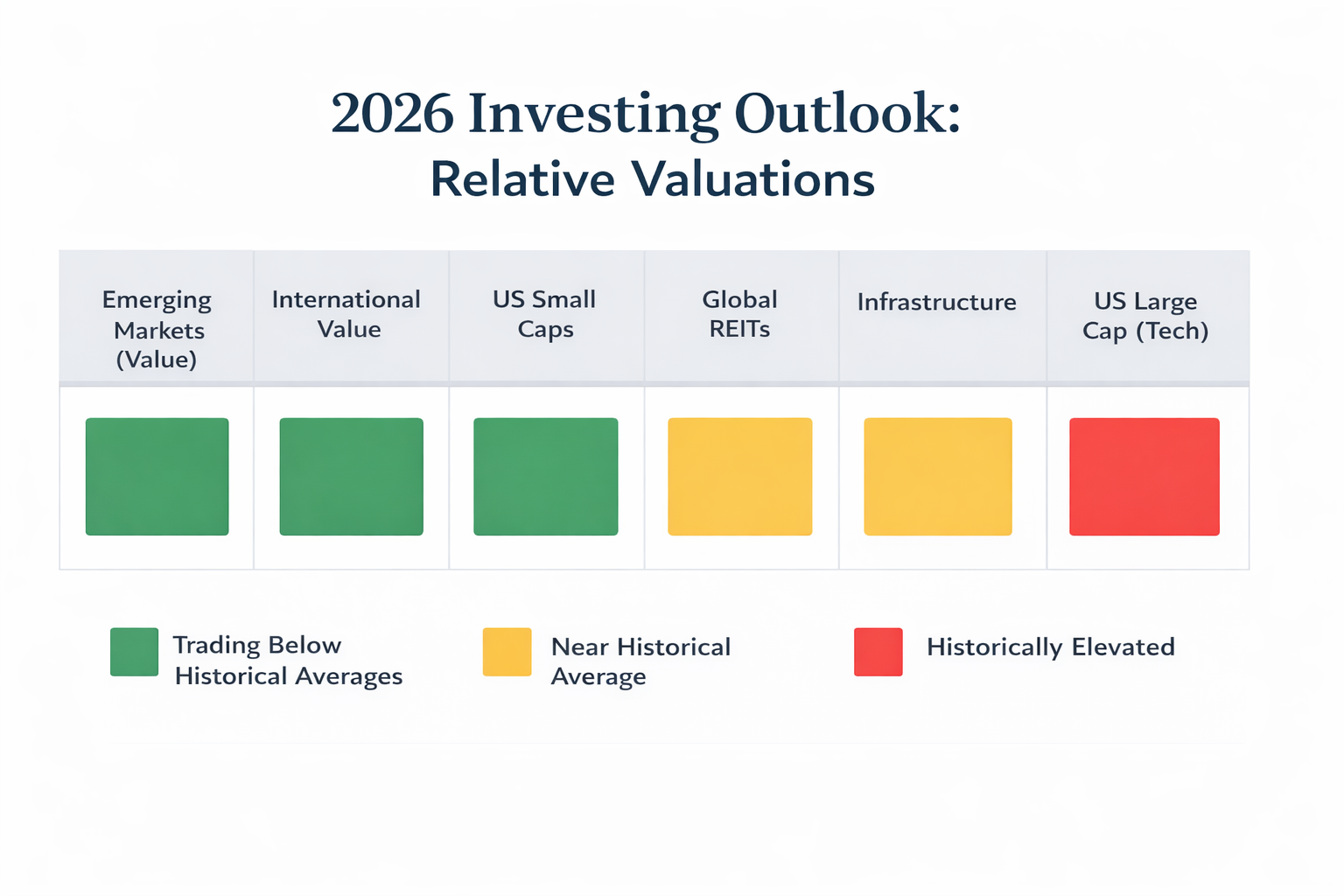
A visual summary of relative asset valuations shaping the 2026 investing outlook across global equity and real asset sectors.
- Inflation Stability: Reports suggest the U.S. may not immediately return to a 2% inflation target. Structural factors like labor shortages and supply chain shifts may keep costs slightly elevated.
- The Cost of Capital: With the “Risk-Free Rate” (cash yields) remaining above zero, companies must prioritize current profitability. This environment historically favors “Value” stocks with immediate cash flow over “Growth” stocks promising distant future earnings.
- The Growth Differential: While the US economy remains resilient, Emerging Markets in regions like Southeast Asia and India are projected to grow at nearly twice the rate of advanced economies in 2026.
Related Article: Valuation Discipline in a Volatile Stock Market
Market Commentary: Valuation Observations
Based on current data, here is a heatmap of relative valuations across asset classes:
| Asset Class |
Valuation Observation |
Market Context for 2026 |
| Emerging Markets (Value) |
Deep Historical Discount |
Trading at approx. 10.7x forward P/E (as of Jan 2026). |
| International Value |
Undervalued vs. US |
European and Japanese firms trading at significant discounts to US peers. |
| US Small Caps |
Historically Low |
Trading near recessionary valuation levels despite economic stability. |
| Global REITs |
Interest-Rate Impacted |
Historically sensitive to interest rate cycles, with potential stabilization if rates peak. |
| Infrastructure |
Defensive Growth |
Benefiting from increased power demand for data centers and AI. |
| US Large Cap (Tech) |
Historically Elevated |
Trading at elevated multiples relative to historical averages, which may impact price volatility during earnings periods. |
Also Read:
- February 2026 Market Analysis: 10 Companies in the News
- March 2026 Market Analysis: 10 Blue-Chip Companies to Research
- 5-Point Financial Contract Trust Checklist: How to Know If a Company Is Legit
- April 2026 Market Analysis: Corporate Spinoffs to Research
Deep Dive: 3 Sectors Under Observation for 2026
1. Emerging Markets (Value)
Emerging markets have faced a challenging decade, but current valuations are notable. They are trading at a significant discount—roughly 10x earnings compared to approximately 24x for the broader US market (as of Jan 2026).
- The Catalyst: As interest rates normalize, a potentially weaker US Dollar has historically served as a tailwind for Emerging Market equities.
- Market Consideration: Investors often look at Value-oriented funds that prioritize dividend yields, which in some EM sectors currently exceed 4% (as of Jan 2026).
2. International Value
While domestic tech has dominated headlines, high-quality companies in Europe and Japan have maintained strong fundamentals.
- Valuation Gap: Many pharmaceutical, energy, and financial firms in developed international markets trade at nearly half the valuation multiples of their US counterparts.
- Corporate Reform: Japan is currently undergoing a “corporate renaissance,” with new governance standards encouraging companies to increase shareholder buybacks and dividends.
3. US Small Caps
Small-cap companies have been pressured by higher borrowing costs. However, current pricing suggests the market may be overestimating the risk of a severe recession.
- The Risk: It is important to distinguish between profitable small businesses and “zombie” companies that rely on cheap debt.
- The Strategy: Market observers often focus on “Quality” Small Cap funds that screen for consistent earnings and low debt-to-equity ratios.
Implementation Considerations
Pivot strategies for 2026 do not necessarily require specialized accounts and can often be managed within standard brokerage or 401(k) structures.
1. Evaluating “Home Bias”
Many US-based portfolios hold 80% to 90% in domestic equities.
- Consideration: Market data suggests that a diversified allocation—potentially including a 20% international component—can help reduce overall portfolio volatility over long time horizons.
2. Prioritizing Cash Flow
In a higher-rate environment, “Free Cash Flow Yield” becomes a critical metric. This measures the actual cash a company generates relative to its share price.
- Expert Insight: Morningstar frequently utilizes this metric to identify companies with “Economic Moats” (sustainable competitive advantages) that may be trading below their calculated fair value.
3. The Role of Fixed Income
For the first time in over a decade, bonds are providing meaningful income. High-quality, short-term bonds were yielding between 4% and 5% as of January 2026. This can serve as a “dry powder” reserve for investors waiting for equity entry points.
Smart Money Tip: Financial Foundation
Before reallocating toward investments, financial educators recommend addressing high-interest liabilities. Paying off credit card debt (which often carries 20%+ interest) often produces a risk-adjusted outcome that historically exceeds long-term equity returns.
Disclaimer:
This guide is for educational and informational purposes only and does not constitute financial, legal, or investment advice. All investing involves risk, including the loss of principal. Please consult with a qualified financial professional before making any investment decisions.
Additional Reading: 401(k) Balances Rise, But More Workers Are Treating Them As Rainy-Day Funds
Sources:
- Global Inflation Forecast | J.P. Morgan Global Research
- Vanguard Economic and Market Outlook for 2025: Beyond the Landing
- United States Economic Forecast Q3 2025 – Deloitte
- Navigating Uncertainty in the Global Economy – Bank for International Settlements
- Weak Dollar, Strong Emerging Markets – Invesco
- Financial Channel Implications of a Weaker Dollar – BIS
- MSCI EM (Emerging Markets) Value Index Factsheet
- Why Emerging Markets Value – Lazard Asset Management
- MSCI Emerging Markets High Dividend Yield Index (USD)
- MSCI EAFE Value Index (USD)
- Global Equity Views 4Q 2025 | J.P. Morgan Asset Management
- GMO 7-Year Asset Class Forecast: 3Q 2025
- Fading Small-Cap Premium – Vanguard
- Extreme Valuations & Durable Fundamentals – Pzena Investment Management
- Equities: Addressing Big Questions About Small Caps – Lord Abbett
- Returning to REITs – Neuberger Berman
- FTSE EPRA Nareit Developed Index Factsheet
- Infrastructure 2025 Outlook – UBS Global
- Long-Term Asset Class Forecasts: Q4 2025 – State Street Global Advisors
- iShares Core U.S. Aggregate Bond ETF (AGG) Overview – BlackRock