SOTP Valuation: Is the True Value of Tech Stocks Hidden in Plain Sight?
Have you ever felt that valuing a company as massive as Microsoft or Apple is a task reserved only for Wall Street’s elite?
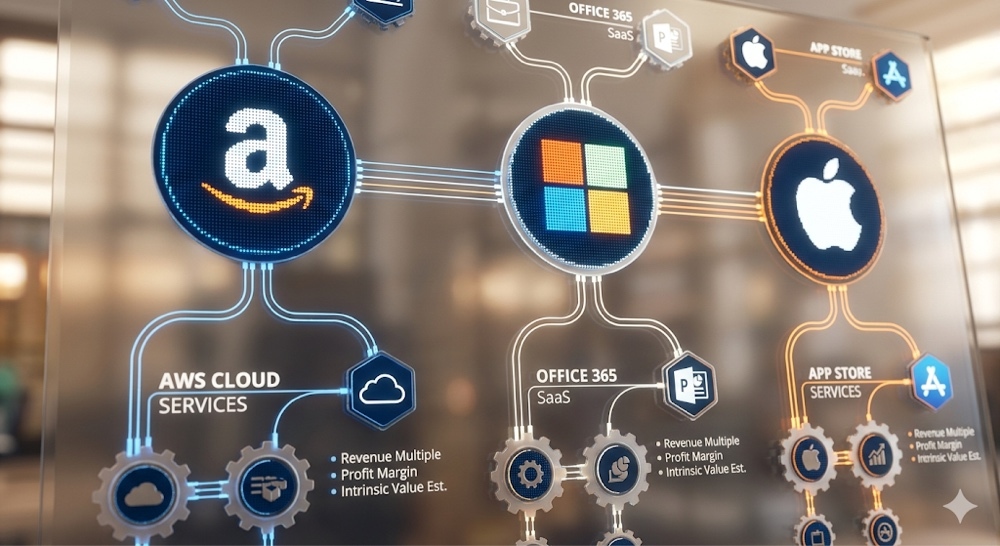
SOTP valuation reveals hidden value across major tech business segments
Image enhanced by AI
In reality, many market participants are capable of identifying true market value. The advantage doesn’t come from predicting short-term price movements, but from understanding what is actually driving the business beneath the surface. By moving beyond headlines and examining the engines that power these companies, investors can shift from reacting to price changes to analyzing underlying value.
Written by Deane Biermeier, Certified Financial Educator, with analytical contributions from, and reviewed by, Paul J. Paquin, Founder and Chief Investment Strategist at TrustedCompanyReviews.com.
As we enter the second quarter of 2026, market headlines continue to focus on the overall performance of the largest companies.
A deeper analysis suggests that the underlying value of tech giants like Amazon (AMZN), Microsoft (MSFT), and Apple (AAPL) is often obscured when viewing them as monolithic entities that fluctuate solely on consumer sentiment or regulatory headlines. Analysts often approach these companies using a Sum-of-the-Parts (SOTP) valuation.
This framework treats a company as a collection of distinct business segments. By evaluating each segment—such as cloud computing, advertising, and services—individually, the analysis can highlight differences between the company’s total market value and the implied value of its underlying businesses.
Spin-offs: The Hidden Value Mechanism
When these differences exist within large corporations, they can sometimes precede corporate spin-offs.
In these situations, shareholders of the parent company may receive shares in the newly independent entity, effectively gaining exposure to a more focused business segment.
For example, if Alphabet were to spin off YouTube, that business could be evaluated independently and potentially assigned a different valuation multiple than it currently receives within the broader company.
For long-term analysis, identifying these embedded segments is an important part of understanding how large companies generate value.
The Mechanics of SOTP Valuation Analysis and Why It Matters
SOTP valuation is particularly useful for companies operating across multiple industries with different margin profiles.
A high-growth, high-margin software segment is typically evaluated differently than a lower-margin retail or logistics operation. Applying a single multiple across the entire business can obscure these differences.
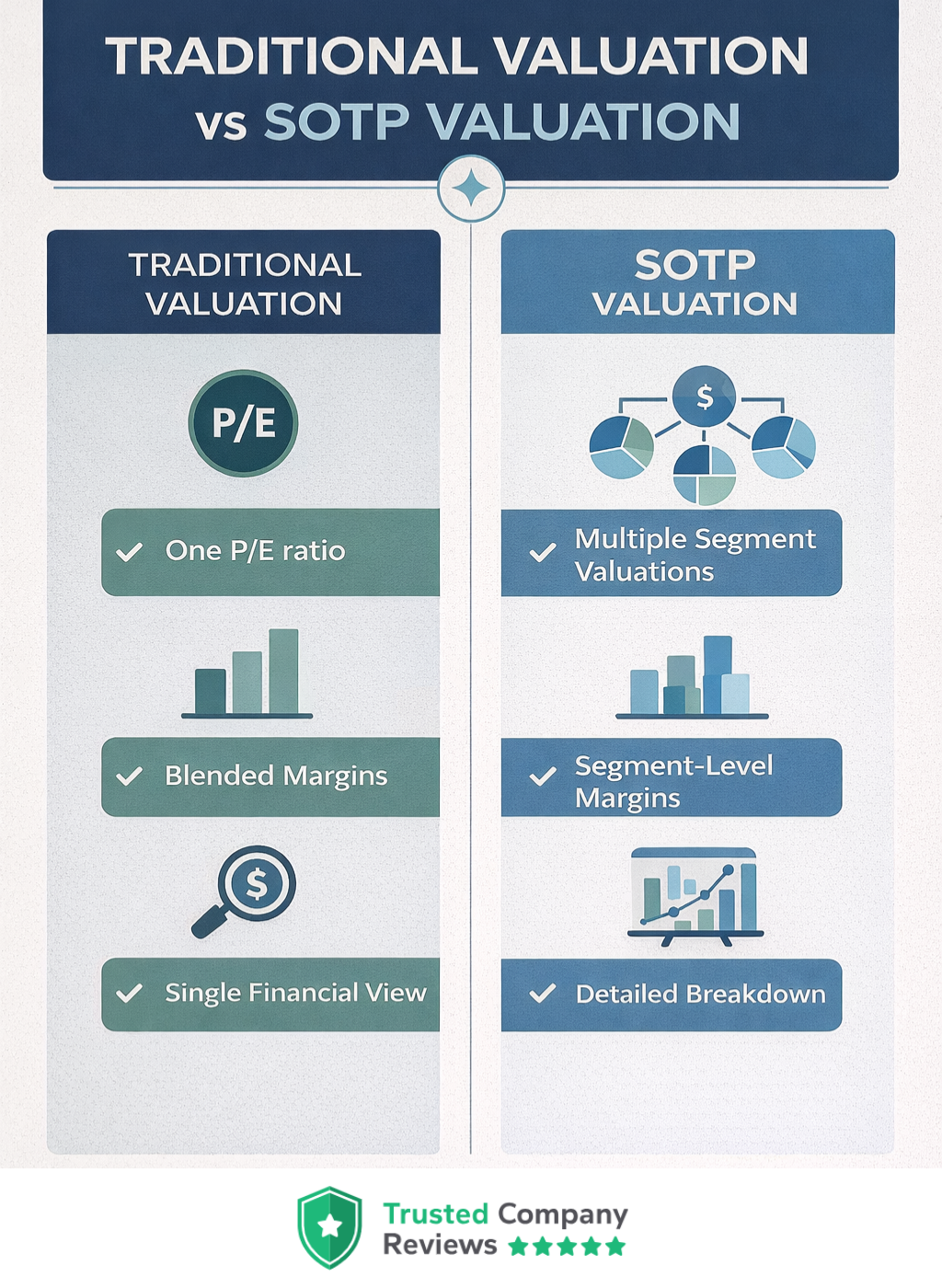
SOTP valuation compares segment-level analysis to traditional company-wide metrics
The Hidden Structure of Amazon’s Business
Amazon is often used as a case study for SOTP analysis. While commonly viewed as a retail company, its financial structure reflects several distinct businesses:
- AWS (Cloud Infrastructure): With 2025 revenue exceeding $128 billion and operating margins near 35%, AWS represents a high-margin segment that is often evaluated using technology-sector multiples. At 15x revenue, this implies a valuation near $1.9 trillion.
- Amazon Advertising: Now a $68 billion+ business, this segment carries higher margins and can be evaluated separately from retail operations.
- Retail & Logistics: Typically valued more conservatively, this segment still represents a large and complex global operation.
The Insight:
When these components are evaluated individually, the combined implied value may exceed Amazon’s total market capitalization based on the assumptions used in this SOTP framework. This type of divergence is a core concept in SOTP analysis.
As of March 20, 2026, Amazon (AMZN) closed at $205.37, down from its 52-week high of $258.60.
Amazon: The Implied Total Value
- AWS: $1.92T
- Advertising: $544B
- Retail/Logistics: ~$450B
Total Implied Value: ~$2.91T
The Interpretation:
With a market cap near $2.2T, the math suggests that a substantial portion of Amazon’s valuation is supported by AWS and Advertising alone. Within this framework, the retail and logistics business appears less fully reflected in the overall valuation, illustrating how segment-level analysis can reveal differences not visible in consolidated metrics.
Sources:
- https://finance.yahoo.com/quote/AMZN/
- https://www.sec.gov/Archives/edgar/data/1018724/000101872426000002/amzn-20251231xex991.htm
Microsoft and the AI-Driven Valuation Shift
Microsoft operates across several major segments, including Azure, Office, LinkedIn, and gaming.
As of March 20, 2026, Microsoft shares closed at $381.87, down from a high of $555 in 2025.
The company is currently trading at a P/E of 23.93 versus a 5-year average of 33.02 (Morningstar). This reflects a notable compression in valuation multiples.
Related Story: Valuation Discipline in a Volatile Stock Market
This gap could suggest that while the company’s fundamental earnings power remains robust—driven by 39% Azure growth— and that the market might be currently pricing the equity at a much more conservative multiple than we have seen in years.
While market attention has focused on AI infrastructure spending, Microsoft continues to generate significant recurring revenue from its SaaS platforms.
Segment-level analysis highlights:
- Bing/Yahoo Advertising: Has captured 27–28% of U.S. desktop search
- Azure: Growth near 39%
- Office and LinkedIn: Strong recurring revenue
- Gaming (Xbox/Activision): Expanding gaming segment
Microsoft: The Implied Total Value
- Cloud: $1.35T
- SaaS: $1.10T
- Gaming & Other: $180B
- Advertising: $117B
Total Implied Value: ~$2.75T
The Interpretation:
With the stock currently priced at $381.87, analysis suggests Microsoft is trading near its base-case valuation under these assumptions, while certain components—particularly future AI-related revenue streams—are not fully reflected in this simplified framework.
Sources:
- https://finance.yahoo.com/quote/MSFT/
- https://www.microsoft.com/en-us/investor/earnings/fy-2026-q2/press-release-webcast
Apple’s Services Transformation
Apple’s valuation increasingly reflects a combination of it being a hardware maker and a services provider.
In Q1 2026, Apple Services reported margins near 77%, significantly higher than hardware.
Apple currently trades at a P/E of 31.39 versus a 5-year average of 29.94 (Morningstar). Its share price of $247.99 remains below its 52-week high of $288.62.
Apple: The Implied Total Value
- Hardware: $2.17T
- Services: $1.20T
Total Implied Value: ~$3.37T
The Interpretation:
With a market cap near $3.8T, Apple is trading at a premium relative to this framework, reflecting market confidence in its ecosystem and recurring revenue model.
Sources:
- https://www.morningstar.com/stocks/xnas/aapl/valuation
- https://finance.yahoo.com/quote/AAPL/
- https://www.apple.com/newsroom/2026/01/apple-reports-first-quarter-results/
Analytical Perspective: Using SOTP Valuation as an Indicator
From Paul Paquin, Founder of TrustedCompanyReviews.com:
“The goal of SOTP analysis is to understand what is driving value within a business. When prices decline, the key question is whether the core, high-margin segments remain intact and continue to grow.”
Risk Management Considerations
Even when segment-level analysis suggests differences between price and implied value, market sentiment can persist for extended periods.
For this reason, capital allocation and diversification are often used to manage exposure, particularly during periods of volatility.
Conclusion
- In a market shaped by technological shifts and macro narratives, SOTP valuation analysis provides a framework for evaluating companies beyond headline figures.
- By examining individual business segments, it becomes possible to assess whether price changes reflect structural shifts or changes in expectations.
- This approach does not eliminate risk, but it can provide additional context when analyzing large, diversified companies.
Important Disclosures & Financial Disclaimer
Educational Purposes Only
TrustedCompanyReviews.com (TCR) is a publisher, not a registered investment advisor. This article is for informational purposes only and does not constitute personalized financial advice.
No Guarantees
Past performance is not indicative of future results. Market data referenced is current as of March 20, 2026.
Conflicts of Interest
TCR, its owners, or its contributors may hold positions in the securities mentioned. All analysis is conducted independently for educational purposes.
Primary Source Links
- Amazon (AWS & Advertising): Amazon.com Announces Fourth Quarter 2025 Results (SEC.gov)
- Microsoft (Azure & Cloud): Microsoft FY26 Q2 Earnings Release
- Apple (Services & iPhone): Apple Reports First Quarter 2026 Results (Apple Newsroom)