Life is expensive, and for many, borrowing for essential purchases is an absolute necessity. Furthermore, according to the United States Census Bureau statistics, debt is inversely related to age, with younger borrowers carrying higher balances overall, many with more than $100,000 in debt.
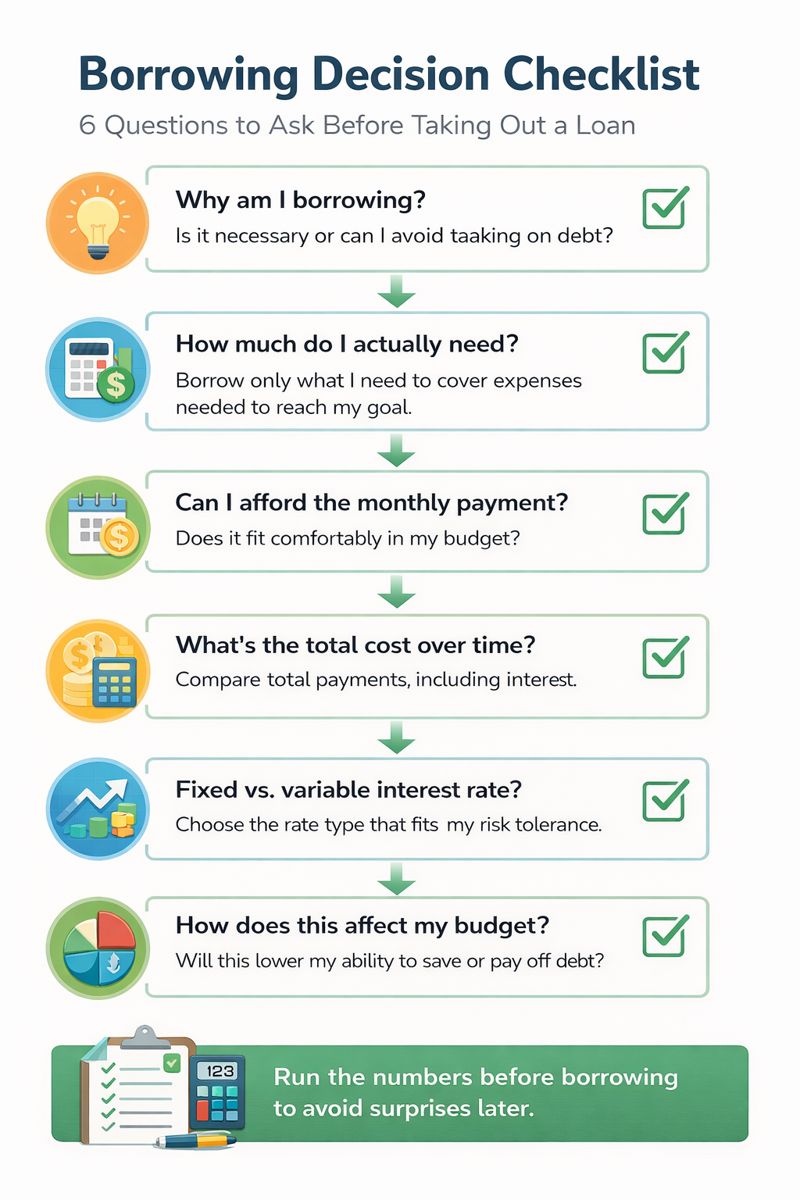
Unfortunately, heavy debt often leaves borrowers struggling financially. That’s why we’ve created this guide to walk you through the factors to consider when borrowing money.
Key Takeaways
|
1. Why Are You Borrowing the Money?
Before you borrow any money, consider the reasons why you’re borrowing. While the answer may seem obvious, thoughtful reflection will help you determine what terms you’re willing to accept to secure funds, or if you need to borrow the money at all.
Borrowing hastily and without a clear goal often leads to regret later on. Start with these critical questions:
What problem are you trying to solve?
Do you have a significant challenge in front of you that money can resolve? Setting your sights on the problem you aim to solve will help you determine the parameters you accept to solve it.
For instance, if you’re borrowing money for a new car, you may be trying to solve the problem of securing transportation to work. However, before you borrow the cash, consider alternative options such as ride share or public transportation. Will one of these other options solve your problem, even temporarily? Be sure to consider and eliminate alternative options before moving forward.
Are you borrowing the money for a want or a need?
In our current world, where brands use powerful marketing tactics to convince consumers that wants are actually needs, this is a significant question. Do you actually NEED to secure funds to solve your problem?
Using the above example of borrowing to purchase a new car, the purchase could qualify as either a want or a need. Do you still have a car that works, but it isn’t quite the vibe you’re going for? That makes your purchase a WANT. Do you live within walking distance of public transportation that could easily take you to work and wherever else you want to go?
Again, if so, the purchase is likely a WANT. Is your car completely unusable, and you have no alternative means of getting to work or other necessary places? If so, purchasing the vehicle is likely a NEED. Being honest with yourself about want vs need and being willing to delay the gratification of purchasing new items will save you thousands in the long run.
Related Article: What to Look for in the Most Trusted Review Sites
Are you borrowing to move forward or just to get by?
There’s a big difference in borrowing money to move forward vs borrowing money just to get by. Borrowing to move forward means that your loan will allow you to improve your life in such a way that you will become more financially stable in the long run. On the other hand, borrowing just to get by will leave you in a cycle of debt that gets you nowhere.
Let’s consider buying a new car. If you’ve determined that purchasing a new car is necessary, you can now apply this question to your problem. Examples of borrowing to move forward with a car loan include purchasing a work vehicle to start or continue a business, or purchasing a used vehicle that fits your family and is reliable long-term to get you around.
Just getting by would be borrowing money for a junker car that will last just long enough for you to save up enough money to buy what you actually need. Which is a better option for your financial situation?
Related Article: How Much Should I Be Saving Each Month?
2. How Much Money Do You Really Need to Borrow?
When taking out a loan, lenders will sometimes offer more money than you actually need. Depending on your credit history, credit score, and financial outlook, they may extend a line of credit that far exceeds your original plan. Or, you may find yourself struggling to secure funds for a lofty purchase. Before you decide on the amount to borrow, ask yourself these questions:
How much do you need to borrow to cover your expenses?
This is an important question to consider before you sign on the line. How much do you really need? Even if the lender approves you for more, can you borrow less by opting for a lower-cost purchase or using some of your savings?
If you’re unsure, use our loan calculator to determine how much your payments will be and how much interest you’ll pay over the life of the loan. This may help you decide if a higher principal is worth the cost.
Related Article: When Should I Refinance – Anything?
How much interest will you pay overall?
Interest! While a 6% rate might seem low, it can add up exponentially over the life of a loan. Mortgages often charge more in interest than the home’s cost over 30 years. That means you’re paying double for your home! Before you take out a loan of any type, ask about the total interest to be paid over the loan’s life and consider if the item you’re purchasing is worth that cost.
Curious about your mortgage and how to pay less in interest? Check out our mortgage payoff calculator.
Can you get by with a smaller loan?
Once you’ve determined how much money you’ll need to secure the item you’re purchasing and how much interest you’re willing to pay, consider if you can get by with a smaller loan. Can you use personal savings or choose a less expensive option? Doing so can save you money on your monthly payments and over the life of the loan. Keep in mind:
- Borrow only what you need
- Interest will accrue on all the money you borrow
- Smaller loans are easier to manage and repay
Related Article: How Much Car Can I Afford?
3. Can You Afford the Monthly Payment?
Sometimes, when shopping for a loan, it’s easy to get caught up in the excitement of approvals and problem-solving. Even if you choose a personal loan from one of the top loan providers, you must pay close attention to the repayment schedule, payment, and fees.
Can you comfortably handle the monthly payment over the life of the loan? What if your income changed, you needed to switch jobs, or an emergency arose? Would the payment leave you unable to save or barely able to pay?
Before you decide, work out your personal and household budgets. Using our handy budget calculator, you can customize your needs, wants, savings + debt percentages and easily determine how much you can comfortably afford. If the payment doesn’t fit within your budget or allow room for you to save money for emergencies, you should consider an alternative way to secure funds.
Related Article: How Does a HELOC Work?
4. Monthly Payment vs. Total Cost: What’s More Important?
When you receive a loan approval from a lender, you will see a breakdown of your monthly payment. In many cases, if you express concern about the payment amount, they will offer to lower your monthly payment by adjusting the loan terms and spreading it over a longer period. While this is a solid way to lower your monthly cost, it means you’ll pay more interest over the life of the loan.
Let’s consider an example using our free personal loan calculator. Let’s assume you’re considering this personal loan as a supplement to your student loan. While the student loan covered your tuition, you still need money for books, a meal plan, and personal expenses. In our example:
- You are approved for a $12,000 loan at 9.99% for 36 months.
- You’ll pay $387.15 per month and $13,937.40 over the life of the loan
- You decide to spread the payment over 60 months to lower your monthly payment.
- You’ll now pay $254.91 per month, saving $132.24 monthly.
- Your total repayment amount jumps to $15,294.33, an increase of $1,356.93.
Once you have the facts, you must decide which is more important to you: saving now or saving over the life of the loan.
Related Article: How to Find Extra Money in Your Budget
5. Fixed vs. Variable Interest Rates
While most credit cards and personal loans use fixed interest rates, many mortgages, home equity lines of credit (HELOCs), some student loans, and business loans offer variable interest rates.
What is a variable interest rate?
A variable interest rate is one that changes with market conditions. For instance, if you purchase a home with a variable-rate mortgage and start with a 7% rate, your monthly payment will drop if the Federal Reserve cuts rates to 6%. However, you will experience an unexpected rise in your mortgage payment if they raise rates.
Which is better: variable or fixed interest rates?
Accepting a loan with a variable interest rate is a gamble. However, if you’re starting off at the predicted rate height, it could work in your favor. Unfortunately, there is no guarantee that your rate will ever drop or that it won’t rise significantly.
If you’re on a budget and want to ensure that your loan payment always remains the same, choose a fixed interest rate that locks in the initial rate for the life of the loan. While you won’t see any benefits if rates drop, you also won’t have any surprise spikes in your loan payment.
Alternatively, if rates drop significantly while you’re still paying on your loan, you may qualify to refinance your loan at the lower rate. Use this free Auto Loan Refinance Calculator to determine how much you can save on your loan by refinancing.
Related Article: Compound Interest Vs. Simple Interest: What You Need to Know
6. How Will Borrowing Affect Your Overall Budget?
Before you borrow, take a close look at your budget to determine how the new loan will affect your overall financial outlook. Do you need to tighten the budget for entertainment, lower the amount you save each month, or slow down your debt snowball? Using a budget calculator provides a clear picture of how to apply your resources to cover all your expenses. Keep in mind:
- Less flexibility can lead to more financial stress
- New debt can limit your ability to save for emergencies
- Before taking on new debt, it’s important to understand how it fits in your budget
Top-Rated Debt Consolidation Companies
If multiple loans or credit cards are straining your budget, debt consolidation may help simplify payments and lower monthly costs. Below are some of our top-rated debt consolidation providers to explore.
Related Article: What Happens if I Don’t Pay a Collections Agency?
7. Is This a “Good” Debt or a “Bad” Debt?
Not all debt has the same impact on your life. Before you borrow money, consider whether this new debt is “good” or “bad.”
Good Debt
- Solves a major problem
- Tied to a NEED
- Assists you in achieving your goals
- Fits comfortably in your current budget
- Relieves financial stress
Examples of good debt include student loans for a degree that will allow you to earn beyond the payment terms, an affordable mortgage for a home purchase, a business loan to expand or generate future income, and low-interest car loans for needed transportation to work.
Bad Debt
- May solve a problem
- Tied to a WANT
- Does not fit comfortably into your current budget
- Leads to financial stress
Examples of bad debt include high-interest loans for shopping or vacations, and payday loans, which charge high interest for short-term debt.
Related Article: Credit Card Debt Is Soaring. Here’s How You Can Escape It
8. What Happens If You Miss a Payment?
Before you take on a loan payment that stretches your budget, consider the repercussions of falling behind on your payments. While you intend to make your payments on time, financial emergencies may strain your budget and leave you unable to pay. Study your loan’s terms to determine what the impact is if you’re late on or miss a payment. You may see costly:
- Late fees and penalties
- Credit report hits
- Increased collection efforts
- Repossession of belongings or your home
- Legal action
Pro TipFrom our on-staff Certified Financial Educator: Before you borrow, review the lender’s grace period, late fee policy, and hardship options. Some lenders offer short-term payment deferrals, temporary forbearance, or modified payment plans if you experience a financial setback. Keep in mind that you may still experience negative marks on your credit report. However, knowing these details in advance can help you respond quickly if you ever fall behind and reduce the long-term impact on your credit report and overall financial situation. |
9. Have You Taken Time to Run the Numbers?
Before you sign on the dotted line, take time to run the numbers on your loan. Doing this ahead of time ensures you won’t overpay or receive a surprise bill filled with hidden costs. Look for:
- Total loan amount
- Closing fees (paid upfront for the loan)
- APR (Annual Percentage Rates)
- Variable or fixed interest?
- Term (length of the loan in months)
- Monthly payment
- Amount of monthly payment applied to interest and principal
- Total amount to be repaid (interest + principal)
- Late fees and penalties
- Early payoff penalties
As you’re considering these factors, stop and use our Loan Calculator to determine how much money you can save by shortening your loan’s term, or by paying extra towards your principal each month.
Using calculators to estimate payments, interest, and the total cost of borrowing can help you explore your options before committing.