

Mortgage Help Searches Surge to Record High as Homeowner Stress Grows
More homeowners are searching for mortgage help than ever before as rising costs make it harder to stay current on payments.

Rising housing costs are leading more homeowners to seek mortgage help and explore their options.
AI-enhanced
Distressed homeowners are running to their trusty sidekick, Google, to find a lifeline, and the data is concerning. Help with mortgage as a search term just reached an all-time high search volume, signaling that homeowners are reaching desperation to meet their monthly obligations.
A simple Google search shouldn’t be interpreted as a signal of an imminent financial crisis. However, it underscores that there are economic cracks forming. Here’s what you need to know about the financial predicament homeowners face, and what resources are available for those who need them.
More Homeowners Are Falling Behind—But Not All at Once
Since the pandemic, the cost of buying and owning a home has only gone up. Home prices have swelled, interest rates remain elevated, and property taxes are up 27% since 2019, as reported by National Mortgage Professional. Additionally, insurance is up over 40%, according to LendingTree, and Forbes reports that home maintenance costs have all risen, putting pressure on homeowners.
This confluence of factors has led to rising unaffordability: the annual income required to afford the U.S. median-priced home has gone from $68,000 in 2020 to $130,000 in 2025.
These factors are manifesting not just in Google search trends, but in tangible data. Mortgage delinquencies have slightly ticked up. The delinquency rate for mortgage loans reached 4.26% at the end of Q4 in 2025, according to the Mortgage Bankers Association’s (MBA) National Delinquency Survey. This isn’t shocking, as roughly half of Americans are struggling to meet their monthly housing costs, according to a Redfin survey.
What Happens When You Start Missing Payments
Falling behind on your mortgage doesn’t happen all at once; it unfolds in stages. The earlier you act on the timeline, the more options you have to stop things from spiraling.
The timeline of falling behind
30 days late → credit hit
Once you miss a payment by 30 days, your lender can report it to the credit bureaus. This is where the damage starts. A single late payment can knock significant points off your credit score. One study suggests that one missed payment results in a 52-point loss. You may also get hit with a late fee, but you can still recover at this point.
60 days → compounding penalties
At 60 days past due, things escalate. You’ve now missed two payments, late fees are stacking, and your lender is likely increasing outreach. Your credit score takes another hit, and catching up becomes harder because you now owe multiple payments at once, plus penalties.
90+ days → serious delinquency/foreclosure risk
Once you pass 90 days, your loan is considered seriously delinquent. At this point, lenders may begin the foreclosure process, depending on your state and loan type. You’ll likely receive formal notices. This is a critical window where taking action can still prevent losing the home.
120+ days → foreclosure will likely begin
Once you reach 120 days delinquent, lenders are generally allowed to formally start the foreclosure process under federal servicing rules. This is when things move from warnings to legal action, depending on your state. While this doesn’t mean you’ll lose your home immediately, the process is now underway, and timelines can accelerate. At this stage, options like loan modification or repayment plans may still be available, but they become more time-sensitive and harder to secure the longer you wait.
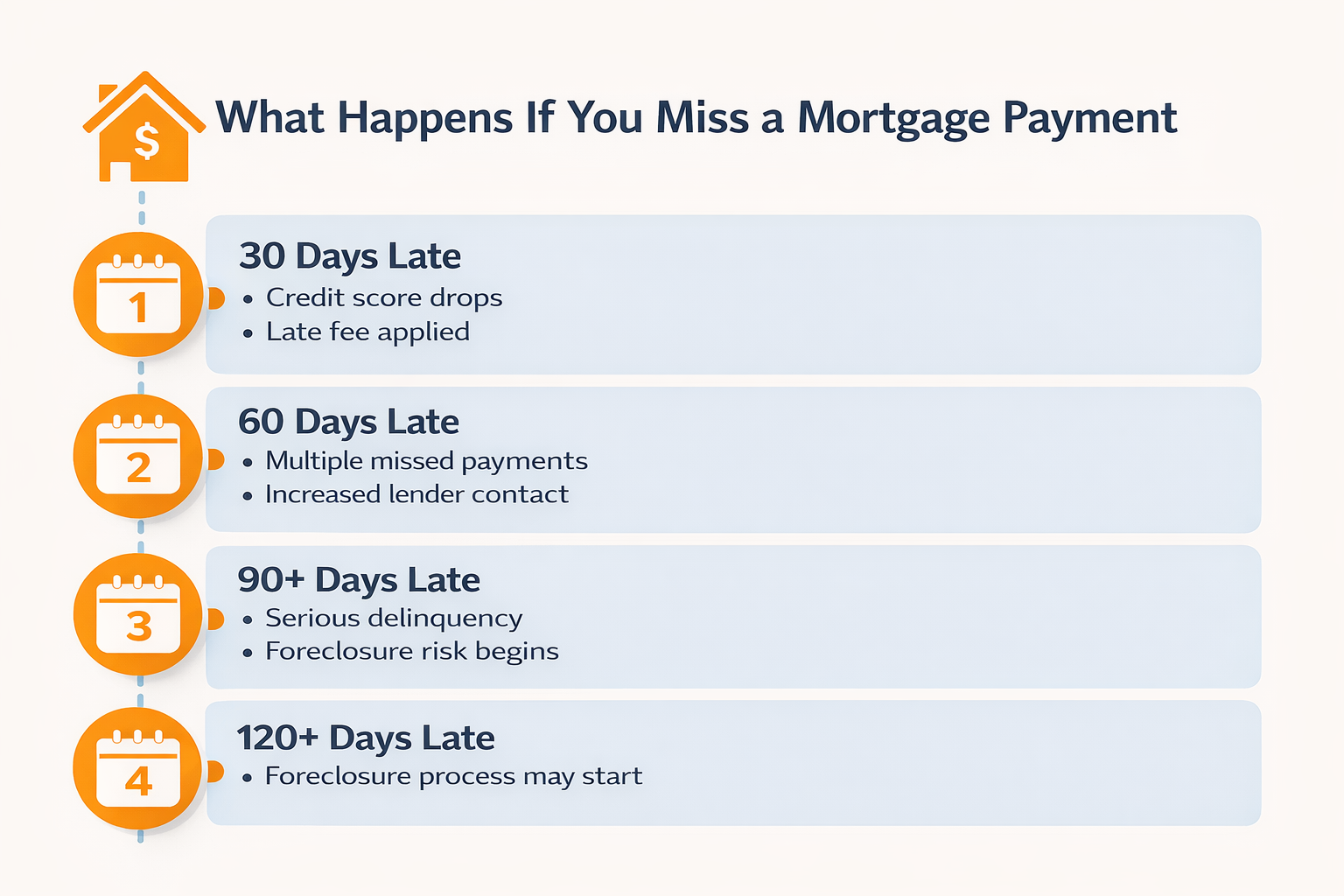
Falling behind on your mortgage happens in stages—understanding the timeline can help you take action before foreclosure risk increases.
Related Article: How Late Can You Be on a Car Payment Before You Lose Your Car?
What Help Actually Exists for Homeowners
If you’re falling behind on your mortgage, it can feel like you’re out of options. You’re not. There are multiple ways to get back on track.
Here are the steps to take today:
The first call you should make
Your loan servicer (not optional)
This is the company you send your mortgage payment to. This should be your first call, not your last resort.
Servicers are required to work with borrowers who are struggling, and in many cases, they actually prefer to help you avoid foreclosure. Banks would rather you stay in your home than force you out. Foreclosures are expensive and time-consuming. Because of this, servicers want to work with borrowers, and they will likely recommend one of several options:
- Forbearance: Temporary pause or reduction in payments to give you breathing room during short-term hardship.
- Loan modification: Permanent change to your loan (lower rate, longer term, or added balance) to reduce your monthly payment.
- Repayment plans: Spread missed payments over time instead of paying everything back at once.
HUD housing counselors
There’s an entire network of free, government-approved housing counselors whose job is to help homeowners navigate situations exactly like this—and most people never use them.
These counselors are trained, unbiased, and focused on helping you avoid foreclosure. They can review your finances, explain your options, and walk you through programs like forbearance or loan modification. They’ll also help you prepare the paperwork your servicer requires, which is often where people get stuck.
In many cases, they can even communicate directly with your loan servicer on your behalf, helping you stay organized and avoid costly mistakes or delays.
Just as important, they can help you spot scams. When you’re behind on payments, it’s common to get targeted by companies promising “guaranteed” foreclosure relief—for a fee. HUD counselors are free and vetted, which makes them one of the safest places to start.
What Distressed Homeowners Should Do Right Now
If you live in one of the roughly 87 million homes that are owner-occupied, and you’re facing financial challenges, there are several things you can do today to improve your financial situation.
Prioritize paying down (or consolidating) high-interest debt
Credit card debt can severely impact your monthly budget and put even more pressure on making your monthly mortgage payment.
If you’re struggling with high-interest debt, consider these options:
- Institute a strict budget: Your home is one of the most important assets on your balance sheet. If you’re struggling month to month, take the time to do an audit of where you can possibly cut back. A budgeting app can help you do this.
- Debt consolidation: This can help you bring higher-interest debts into a more manageable monthly payment.
- Balance transfer credit card: If you have credit card debt, you’re likely paying significant amounts of interest each month. With a balance transfer credit card, you can move your balance from a high-interest card to one that may have a lower introductory rate.
Consider selling your home
If you’re really up against financial pressure, you may consider selling your home. However, be sure to run the numbers on what your financial situation would look like if you sold your home and opted to rent.
It’s better to consider this earlier on than force yourself into a financial pickle, where you could potentially lose your home.
Related Article: Saver’s Credit Explained: How It Works and What’s Changing
Tools to Help You Take the First Step
If you’re feeling overwhelmed, you’re not alone—and having the right tools can make a big difference. Trusted Company Reviews has created these financial calculators to help you organize your debt, explore your options, and start building a plan with confidence.