Savers Credit Is Changing: How to Get the New $1,000 Retirement Match
The new Saver's Match replaces the existing tax credit, giving eligible Americans a new way to build their retirement savings.

Written by
Brett Holzhauer
The new Saver's Match will help eligible Americans grow their retirement savings through government contributions beginning in 2027.
The IRS has started sending letters out to qualifying taxpayers who may be eligible for free money towards their retirement. If you recently received a CP321J notice, you may be eligible for this valuable retirement match.
Key Takeaways
- The Saver's Match replaces the Saver's Credit beginning in 2027.
- Eligible taxpayers can receive up to $1,000 annually, or $2,000 for married couples filing jointly.
- Eligibility depends on income, filing status, and other requirements.
- Claim your match on your tax return and receive a deposit in an eligible retirement account.
Here’s what you need to know about the Saver’s Match, how to claim your funds, and how this can positively impact your retirement journey.
Brett Holzhauer is a senior financial writer and editor with over a decade of experience covering personal finance, investing, and the U.S. economy. His work has been featured in Forbes and CNBC, where he focuses on helping readers make sense of real-world financial challenges. |
What the Saver's Match is
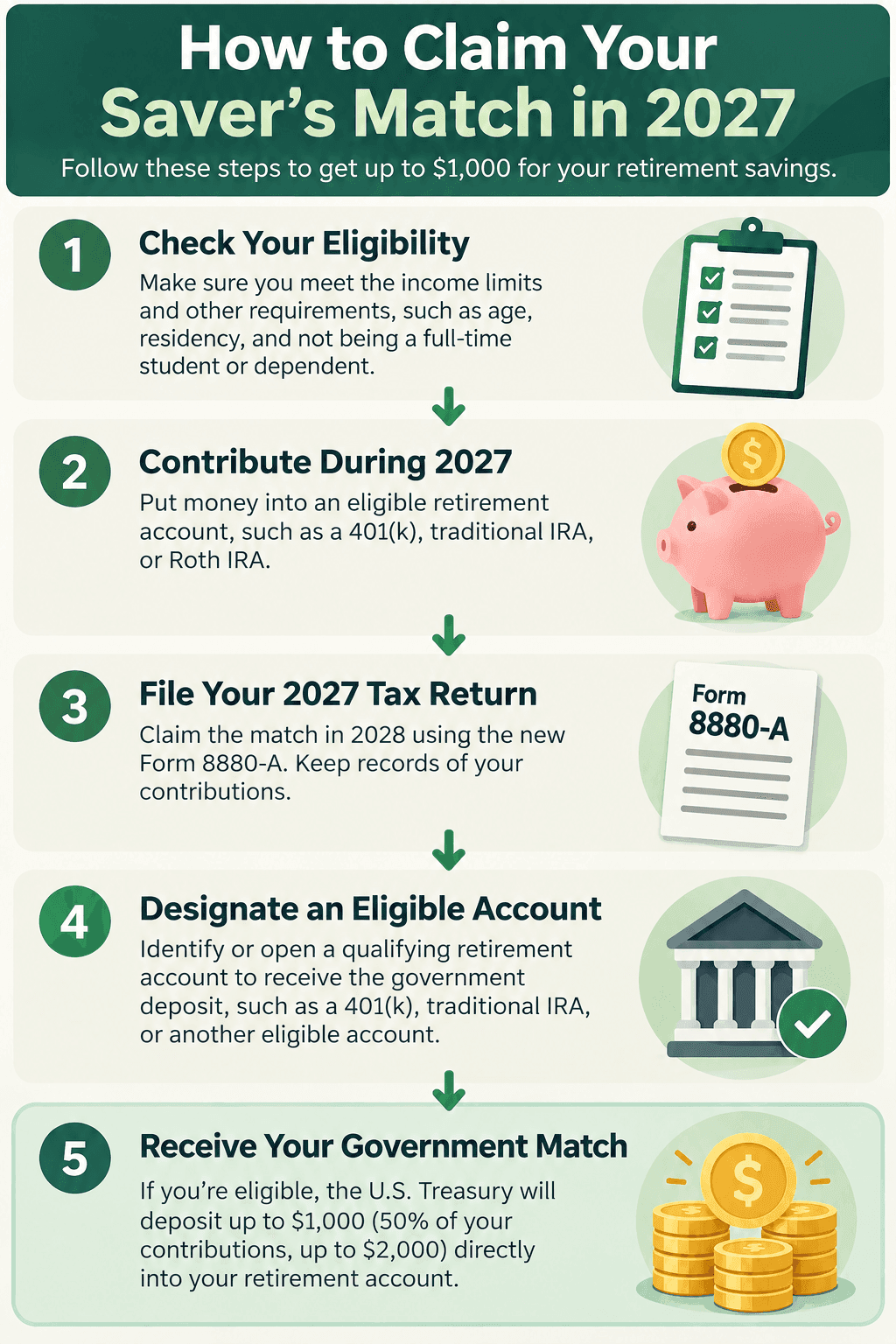
Starting in 2027, the federal government will add 50 cents for every dollar you contribute to a retirement account, up to $2,000 in your own contributions. That works out to up to $1,000 a year, deposited straight into your 401(k) or IRA by the U.S. Treasury.
Congress created the program in the SECURE 2.0 Act of 2022 to replace the underused Saver’s Credit. This new incentive applies to contributions you make towards your retirement accounts in 2027, and you claim it when you file your 2027 tax return in 2028 using a new form, Form 8880-A.
Here’s what you can get:
If you’re single, you can get up to $1,000 when you deposit $2,000 – a 50% return on your investment.
If you're married filing jointly, each spouse can earn a separate match — so a couple could get up to $2,000 combined.
There's no minimum contribution to qualify. Even $20 a month ($240 over the year) would earn a $120 match.
Why this replaces the old Saver's Credit — and why that matters
The Saver’s Credit has a core design flaw: it was nonrefundable.
Take Maria. She stocks shelves at a warehouse, earns $26,000 a year, and puts $1,000 into her 401(k). Under the old Saver's Credit, her income qualified her for the top rate — a 50% credit, or $500. But the credit could only shrink taxes she owed, and after the standard deduction she owed almost nothing in federal income tax. So her $500 credit was worth close to $0.
The new Saver’s Match awards actual money in your account, rather than a tax deduction.
Under the new Saver's Match, her tax bill doesn't matter. She gets the same 50% rate, and the Treasury deposits $500 straight into her 401(k).
Do you qualify for the Saver’s Match?
An estimate from Pew suggests nearly 22 million Americans could benefit. However, qualifying for this largely comes down to your income. The IRS sets the limits using your modified adjusted gross income (MAGI) — basically your total income with a few adjustments.
Here are the 2027 numbers as reported by the IRS:
Filing status | Full 50% match up to | Match phases out completely at |
Single | $20,500 | $35,500 |
Head of household | $30,750 | $53,250 |
Married, filing jointly | $41,000 | $71,000 |
If your income falls between the two numbers in your row, you still get a match — just a smaller percentage.
Additionally, there are a few more basic rules for you to qualify for the match:
You must be 18 or older by the end of the year, and a U.S. tax resident
Not a full-time student
Not claimed as someone else's dependent
What you should do now
In 2027, keep doing what you're doing. Contribute to your workplace retirement plan, such as your 401(k), as usual.
If you don't have one through work, open an individual retirement account (IRA). Roth contributions can qualify you for the match, but the government deposit itself generally can't go directly into a Roth IRA — so if Roth is all you have, you may need a traditional or other non-Roth account to actually receive the money.
Remember: a Roth IRA uses post-tax funds, while a Traditional IRA uses pre-tax funds.
Also, keep your contribution records; you'll need them when you claim the match on your 2027 tax return in 2028 using the new Form 8880-A.
One thing to watch: the federal government plans to launch a website, TrumpIRA.gov, before 2027 starts. It's supposed to list IRA providers that meet federal standards and will accept the match deposits. Be sure to sign up on the website for updates.
Free Financial Calculators to Help You Plan Ahead
Retirement planning is just one part of managing your finances. Whether you're working on reducing debt, building savings, or making the most of your monthly budget, use our free calculators can help you explore your options and plan your next steps.
Budget Calculator: See where your money goes each month and identify opportunities to save more.
Savings Interest Rate Calculator: Estimate how your savings can grow over time with interest.
Coast FIRE Calculator: Explore how much you need invested today to potentially reach your retirement goals without making additional contributions.
Debt Snowball Calculator: Create a debt repayment plan that can eventually free up more money for savings.
Debt Consolidation Calculator: Estimate whether consolidating existing debt could lower your monthly payments or interest costs.
Even small adjustments to your budget can make a difference. Finding an additional $20 or $50 per month to contribute to retirement could help you qualify for a government match beginning in 2027.
Bottom line
The Saver’s Match is a great way for low- and middle-income Americans to start or boost their retirement account.
If you haven’t started your investing journey, it’s never too late to get started. You still have time to fill your Roth IRA before the end of the year to put post-tax funds away for your post-working years. Start budgeting money today, and when the calendar turns to 2027, you may be able to grab some extra funds from Uncle Sam.

Written by
Brett Holzhauer