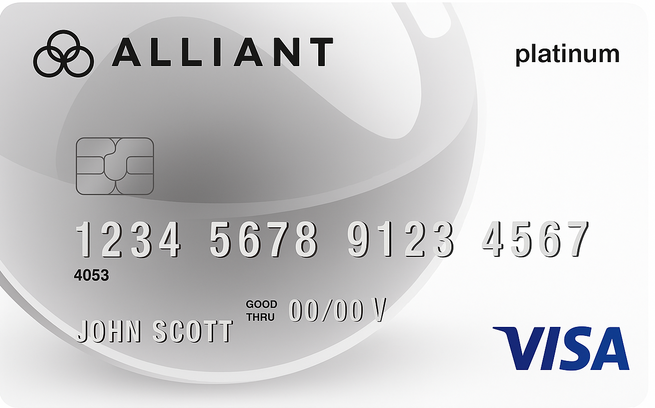
If you’re looking for a simple, low-cost credit card option that balances debt consolidation with reliable benefits, our Alliant Visa Platinum card review explains why it’s a solid choice. Its introductory 2% balance transfer fee, affordable long-term APR offer, and lack of an annual fee qualify this card for inclusion in our overview of the best balance transfer cards for average credit scores.
Pros
0% intro APR for 12 months on purchases and balance transfers
Low 2% balance transfer fee
No annual fee
Lower-than-average variable APR after the intro period
Prequalification is available, which won’t impact your credit score
Cons
No significant rewards program
Shorter intro APR period compared to competitors
Alliant Credit Union membership required
About Alliant Visa Platinum
The Alliant Visa Platinum card stands out from competitors because of its focus on keeping borrowing costs low. While it doesn’t try to compete with flashy cash-back bonuses or high-reward rotating categories, it does provide cardholders with a decent intro APR period with the lowest transfer fee rate our research could find in this tier. The card also features a comparatively low standard APR after the promo period ends.
For borrowers already connected to Alliant Credit Union, this Visa Platinum card can be a seamless addition to their existing products and services. It’s particularly helpful for members who want a card that works well for short-term debt reduction without carrying extra costs like an annual fee.
Product InsightsA disclosure form at the Consumer Financial Protection Bureau summarizes the Alliant Visa Platinum details as follows: In summary: The Alliant Visa Platinum card offers an introductory APR of 0% to 5.99% for the first 12 months on purchases and balance transfers, depending on creditworthiness. After that, the APR ranges from 14.49% to 26.49% for the Platinum card and 17.99% to 27.99% for the Platinum Rewards version. Cash advances carry APRs between 22.49% and 28.49%, while a penalty APR of 29.49% may apply if payments are missed or returned. The card has no annual fee, with transaction fees of 2% for foreign purchases, 2% (minimum $5) for balance transfers, and 3% (minimum $10) for cash advances. |
Features and Benefits
While it may not be packed with rewards, the Alliant Visa Platinum still includes practical features and protections that appeal to budget-conscious borrowers.
- 0% intro APR for 12 months on both purchases and balance transfers
- Low 2% balance transfer fee (minimum $5)
- No annual fee
- Competitive variable APR after the intro period
- Auto rental collision damage waiver coverage
- Online account management
- Fraud liability protection
Alliant Visa Platinum Reviews: Editorial Rating
Trusted Company Reviews Rating Score for Alliant Visa Platinum: 8.7
This card earned a strong score because of its affordability, simplicity, and credit union affiliation. While its APR period of 12 months is shorter than some competitors, the low 2% transfer fee and absence of an annual fee make it a solid balance transfer tool. However, its lack of rewards and membership requirements keeps it from ranking higher.
| Intro Offer | Credit Score Needed | Intro Balance Transfer Fee | Annual Fee |
| 0% intro APR for 12 months on purchases and balance transfers | Good (670+) | 2% | $0 |
Why We Like It
We like the Alliant Visa Platinum as a contender for borrowers with average credit primarily because of its low 2% transfer fee intro offer. It’s one of the very few cards available that combines a 0% intro APR with a transfer fee below 3%, which is particularly rare in the average credit score tier category.
What We Don’t Like
Despite the fact that this card ranks well in this tier, it has a few limitations to consider. Once the 12-month intro offer expires, the card offers few perks besides its low average APR and association with a well-liked credit union.
Alliant Visa Platinum Rates, Fees, and Information
As a contender in the balance transfer category, this card’s strongest feature is its cost-efficiency related to its sub-3% transfer fee. However, the card also features a lack of an annual fee, decent approval odds for average-credit consumers, and a relatively low variable APR after the intro period.
The typical APR range for the Alliant Visa Platinum is subject to change, but currently stands at between 14.49% to 26.49%. A rewards version of the card is also available, which carries slightly higher average rates.
Alliant Visa Platinum Card Customer Reviews
Cardholding Alliant Credit Union members cite the card’s low-fees and interest rates as the reason they give for the mostly positive company reviews. The auto rental collision damage waiver, which adds peace of mind, also appears as a positive in many reviews. Negative feedback mostly revolves around the lack of rewards, with some users wishing for more long-term benefits.
Alliant Visa Platinum Vs Citi Double Cash
The Alliant Visa Platinum card and the Citi Double Cash card serve different types of credit card users. In a balance transfer situation, Alliant is better if you’re looking to minimize upfront fees and don’t require an extensive intro APR period.
On the other hand, while the Citi Double Cash card’s transfer fee is higher, it provides a longer 0% intro period for transfers and rewards ongoing spending with a respectable 2% cash back rewards plan. Both appear in our overview of the best balance transfer cards for average credit.
| Alliant Visa Platinum | Citi Double Cash | |
| Intro Offer | 0% intro APR for 12 months on purchases and balance transfers | 0% intro APR for 18 months on balance transfers |
| Ongoing Rewards | No rewards program | Unlimited 2% cash back on all purchases |
| Approval Odds for Average Credit | Good | Good |
| Prequalification Available? | Yes | Yes |
Who Is Alliant Visa Platinum Best For?
This card is best suited for individuals who prioritize simplicity and low future costs over pursuing categorical rewards. If you’re already an Alliant Credit Union member, it’s an easy choice. It works particularly well for people who only need a short, year-long window to pay down balances or enjoy interest-free purchases, followed by long-term value.
How to Get the Most From Using Alliant Visa Platinum
To maximize the benefits this card offers, take advantage of the low 2% balance transfer fee by consolidating balances early in your membership. Or, use the 0% intro APR period for 12 months on purchases to finance necessary expenses, and plan repayment before the promo expires.
Alliant Visa Platinum Alternatives
Alliant Visa Platinum is designed to provide low cost and practical protections, but if you’re searching for cards with more robust rewards or longer intro periods, these alternatives, found in our overview of the best balance transfer cards for average credit, are worth a look.
- Discover it Cash Back: Competitive 15-month, 0% intro APR plus rotating 5% categories and a Cashback Match.
- BankAmericard: 18-month, 0% APR timeframe for both transfers and purchases.
- Citi Double Cash: Long intro period plus a flat 2% return on purchases
- Citi Simplicity: 21-month, 0% APR balance transfer offer plus 12-month, 0% APR on purchases
Frequently Asked Questions
Does the Alliant Visa Platinum card have rewards?
How long is the Alliant Visa Platinum’s intro APR offer?
Do I need to be a member of Alliant Credit Union to apply?
Conclusion
The Alliant Visa Platinum won’t appeal to everyone, but its value lies in simplicity and overall affordability. With a short but useful 0% intro APR period, a low balance transfer fee, and no annual fee, it’s an excellent fit for those who want a straightforward balance transfer solution without extra costs.
Its lack of rewards means that most of its long-term value relies on the likelihood that you’ll qualify for its lower-than-average APR. However, it still has potential as a short-term financial tool to help reduce debt.

Deane Biermeier is a certified financial educator through the University of Minnesota and a respected authority in financial research, writing, and editing, renowned for his in-depth analyses and expert advice. With a distinguished career that previously spanned home improvement, real estate, and finance topics, Deane's role at Trusted Company Reviews focuses exclusively on finance.
Deane has contributed to leading publications such as Forbes Home, US News and World Report, Newsweek Vault, and others.
Since joining TrustedCompanyReviews.com in 2023, he has solidified his reputation as a crucial resource for clear, factual financial guidance.
Deane Biermeier
Last Updated: October 15, 2025
Editorial Reviews
Must Reads
What Happens If I Can’t Pay a Judgment?
If you can't pay a judgment, the creditor can take additional steps to collect the debt. Creditors may use enforcement tools such as wage garnishment, bank account levies, or property liens, depending on your state's laws. However, a judgment against you does not mean...
What Happens If I Can’t Pay My Mortgage? Your Options and Next Steps
If you can't pay your mortgage, the most important thing you can do is contact your mortgage servicer immediately, before you miss a payment, if possible, and as early as possible after if not. The foreclosure process doesn't happen overnight, and most lenders have...
What Happens If I Can’t Pay My Credit Card?
Falling behind on a credit card payment is stressful, but panicking won’t help. On the other hand, understanding the consequences will. Whether you’re short on cash this month or dealing with a longer stretch of financial hardship, knowing exactly what happens, and...
What Happens If You Can’t Pay Your Student Loans
Missing a student loan payment can lead to late fees, credit reporting, and other consequences if the debt remains unpaid. Federal student loans typically enter default after 270 days of missed payments, which may result in wage garnishment or tax refund offsets....
What Is a Home Equity Investment
A home equity investment (HEI) is a way to access the cash value of your home's equity without adding monthly payments to your budget. Instead of borrowing against your equity, you sell a share of your home's future value to an investment company in exchange for a...
Are Data Removal Services Worth It?
If you search your name online, the results can be unsettling. Home addresses, phone numbers, past residences, and even relatives can show up on data broker sites you’ve never heard of. That visibility isn’t random. Data brokers collect information from public...
What Happens If I Don’t Pay A Collections Agency?
Ignoring a debt collector can lead to collection calls and letters, damage your credit score, and, in some cases, result in a lawsuit. If a creditor or collector wins a court judgment, wage garnishment or bank account levies may also be possible. However, the...
Farmers Insurance vs State Farm
Farmers and State Farm are two of the most recognizable insurance companies in the country, and both offer competitive home and auto bundles, but compared side-by-side, they win on different fronts. This comparison breaks down where each carrier leads, where it falls...
Benefits of Bundling Home and Auto Insurance
Key Takeaways Bundling home and auto insurance typically saves policyholders between 10% and 25% on combined premiums. Having a single insurer simplifies billing, policy management, and claims for both home and auto. Some insurance providers offer a single combined...
Late Car Insurance Payment? What Happens and How to Avoid Cancellation
Key Takeaways Most auto insurers offer a grace period of 7 to 30 days for a late car insurance payment before canceling the policy. A canceled policy creates a coverage lapse, which often leads to higher rates when you reinstate or shop for new coverage. Driving...
Social Links