
Debt consolidation loans for bad credit can help you roll high-interest credit card debt and other balances into one single monthly payment. The key to success is to understand the process, the expected outcome, and your follow-up actions. Here's what you need to know.
Key Takeaways
- Debt consolidation loans for bad credit work like other consolidation strategies. However, you'll want to be extra careful to make sure you're working with a trusted provider.
- Prequalifying with one of the best debt consolidation companies lets you see your options first, using a soft inquiry that doesn't affect your credit score until you formally apply.
- Consolidating debt with poor credit can be a good idea if it lowers your total interest costs, simplifies payments, and you avoid running balances back up.
- Debt consolidation will affect your credit score, often causing a small short-term change. Long-term positive results will depend on your ability to make on-time, consistent payments and avoid taking on additional debt.
- There is more than one way to consolidate your debt, including personal loans, accessing home equity, and potential balance transfer offers on existing cards
What Are Debt Consolidation Loans for Bad Credit?
A debt consolidation loan is, in most cases, an unsecured personal loan you use to pay off multiple debt accounts, such as credit card debt and other unsecured loans.
Instead of juggling several due dates and amounts, you move everything into one new loan with a fixed interest rate and set loan terms.
Debt consolidation loans for bad credit work the same as any other consolidation loan strategy, but they're designed for borrowers whose credit score and credit history are not perfect.
That means you'll likely pay a higher rate than someone with excellent credit, but you can still take advantage of similar benefits, including having a single monthly payment, a clear payoff strategy, and the chance to save money on interest if you are consolidating high-interest debts, such as credit cards.
Related Article: Late Car Insurance Payment? What Happens and How to Avoid Cancellation
How Debt Consolidation Loans Work When You Have Bad Credit
The process is similar for most lenders, but there are some details to consider when you are working with a lower credit score. While many lenders are willing to work with borrowers with poor credit, tightening up your strategy before you apply can improve your chances of approval and secure more favorable terms.
Step 1: Review Your Credit Score and Amount of Debt
Start by checking your credit score and reviewing your credit history. Then, determine the amount of debt you'd like to consolidate. Include your credit card debt and other unsecured balances. Knowing where you stand at the outset helps you be realistically prepared.
Step 2: Prequalify Without Affecting Your Credit Score
The best debt consolidation providers offer prequalification steps for borrowers. These lenders offer online prequalification using a soft inquiry, which does not affect your credit score until you choose a consolidation product and formally submit an application.
Prequalification lets you:
See your estimated fixed interest rate
Review possible loan amounts and terms
Get a good idea of your monthly payments
Step 3: Compare Rates, Fees, and Loan Terms
Online loan marketplaces and other platforms will provide you with one or more borrowing options.
Use these to compare:
The fixed interest rate versus your current high-interest cards and loans
Loan amounts versus the amount of debt you want to consolidate
Loan terms and your projected monthly payments
Any origination fee or other charges that may apply
Use the Trusted Company Reviews debt consolidation calculator to plug in different interest rates, loan terms, and loan amounts. That makes it easier to see whether consolidating debt with a specific offer is likely to save money now or in the future.
Related Article: How Long After Debt Consolidation Can I Buy a House?
Pro TipFrom our on-staff Certified Financial Educator: It can be tempting to turn to payday lenders or “fast cash” offers when you’re stressed about bills. However, the super short payback terms and steep costs can make things harder, not easier. Look for lenders that clearly spell out their rates, fees, and terms so you know exactly what you’re getting into. |
Step 4: Apply for the Loan and Receive Funding
When you move from prequalification to a formal application, the lender will perform a hard inquiry on your credit report. A hard inquiry can lower your credit score by a few points in the short term.
If you're approved, the lender will either deposit the loan amount into your bank account or pay your creditor directly on your behalf. In either case, the process generally takes a few business days. Although timing varies between lenders.
As soon as your loan is funded, pay off the accounts you're consolidating if the lender didn't already do it for you.
Step 5: Start Making a Single Monthly Payment
After your consolidated debt lenders are paid, begin making one single monthly payment to your new lender instead of several payments to different creditors.
You now have:
A single due date each month
One fixed interest rate
A predictable payment schedule
Making each payment on time and in full is crucial for protecting your credit score and realizing the full benefit of the consolidation.
Top-Rated Debt Consolidation Companies
Ready to take the next step? Here are some of our top-rated debt consolidation providers.


- TCR Editor's #1 Pick
- Lower Monthly Payment
- No Credit Score Required
- Loan Options Available
- A+ Rating with BBB

- Compare Rates for Free
- Loans up to $250,000
- Receive funds as soon as tomorrow*

- Minimum Credit Score: 600
- Soft Credit Check To Pre-Qualify
- Home Equity Credit Options Available
Is a Debt Consolidation Loan a Good Idea With Bad Credit?
A debt consolidation loan can be a good idea with bad credit, but only if the numbers and your payment habits support the change. It also helps to take a thorough and honest look at what led to your current credit situation. Determine whether it was a tight season for your budget, an unexpected emergency, or habits you want to adjust, and make a simple plan to avoid the same issues where you can.
Debt consolidation can be a good idea if:
Your new fixed interest rate is lower than your current average high interest rates
The loan term keeps monthly payments affordable without stressing the rest of your budget
You can commit to not running your old credit cards back up
It may not be a good idea if:
The rate you qualify for is higher than what you pay now
Fees or other costs wipe out potential savings
You intend to keep using your cards for new purchases without paying the balance in full each month
Related Article: Does Debt Consolidation Ruin Your Credit? 11 Common Myths Explained
How Debt Consolidation Loans Can Affect Your Credit Score
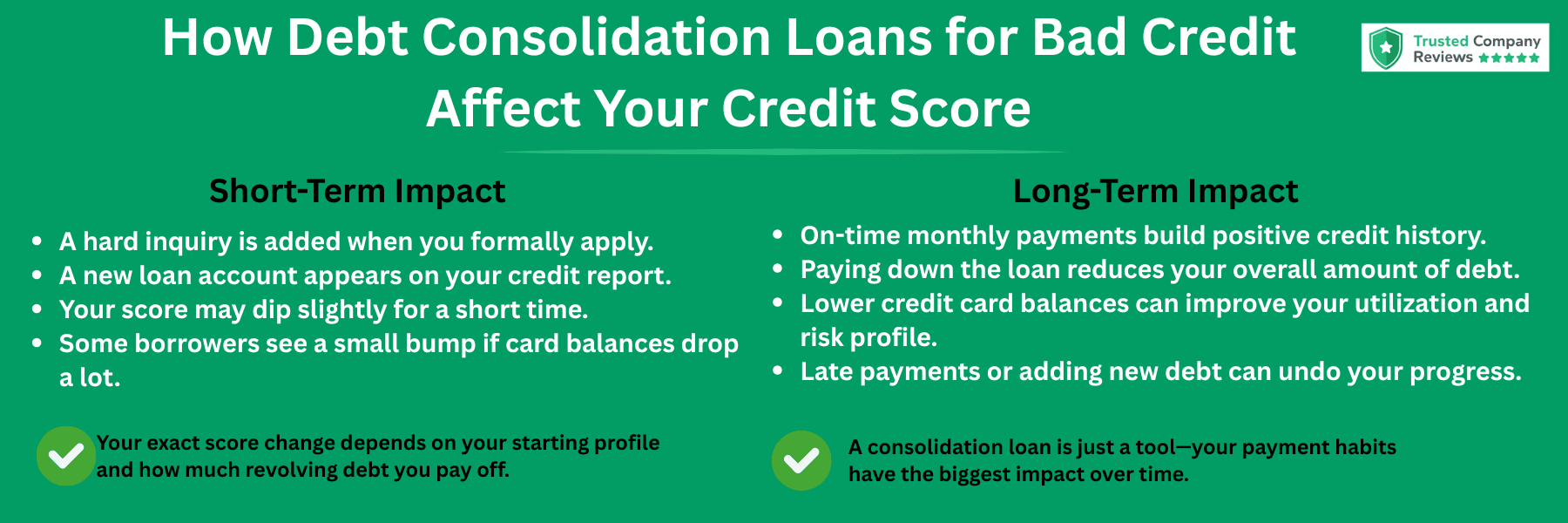
A debt consolidation loan may cause your credit score to dip at first, but it can also help you build it back up over time. The infographic below shows the typical short-term and long-term effects.
How To Improve Your Credit Score Before Applying for a Debt Consolidation Loan
Improving your credit score before you apply can help you qualify for better loan terms and save money on interest, although it is not always necessary or realistic to wait. If you have a little time, there are some steps you can take.
Lower your revolving balances. Extra payments toward high-interest credit card debt can improve your credit utilization ratio and help you qualify for a better fixed interest rate.
Bring past-due accounts current. Recent on-time payments can strengthen your application, especially if you have a lower credit score.
Avoid taking on new credit. Try not to open a new credit card, personal loan, or line of credit right before you apply, since multiple hard inquiries can make you look riskier.
Financial Tools to Check Out Before You Consolidate
If you have other debts, including secured loans, you may also find that making small changes to how you approach the debts can make a significant difference. Check out our calculator pages to see alternative options for paying down these debts.
Here are a few calculators you'll find there:
Other Ways To Consolidate Debt With Bad Credit
Debt consolidation loans for bad credit are one approach to help you manage your finances, but they're not the only way to combine multiple debt accounts into more manageable payments.
Here are a few alternatives:
1. Home Equity Loan or Home Equity Line of Credit
If you own a home and have available equity, you may be able to access funds using a home equity loan or home equity line of credit, which you can sometimes use to pay off high-interest debt at a lower rate.
Lenders may be willing to work with you if you have:
A strong mortgage payment history
Enough equity to cover the amount of debt you want to consolidate
A home equity loan usually includes a fixed interest rate and predictable monthly payments. A home equity line of credit works more like a revolving account.
Both typically offer lower rates than many unsecured loans, but it's important to understand that they use your home as collateral, which can put it at risk of foreclosure if you can't make consistent on-time payments.
2. Using a General Personal Loan To Consolidate Debt
While most people consider personal loans a way to make a large purchase or cover unexpected expenses, they can also be a solid way to consolidate high-interest debt.
The key is to choose a fixed interest rate, borrow only what you need, and pay the targeted balances in full as soon as the loan funds arrive. Then simply treat the loan as your debt consolidation solution.
3. Balance Transfer Credit Cards
A balance transfer can also help consolidate several credit card balances into one account, but qualifying for a brand-new balance transfer card can be difficult with bad credit. Instead, it may be worth checking the cards you already have to see if any are offering a limited-time balance transfer promotion for current cardholders.
These offers appear from time to time and typically include a low, temporary interest rate. If you choose this route, pay close attention to any transfer fees, how long the promotional rate lasts, and your payoff plan.
Related Article: How Late Can You Be on a Car Payment Before You Lose Your Car?
Frequently Asked Questions
Conclusion
Debt consolidation loans for bad credit can be a helpful way to simplify your payments, lower your overall interest costs, and potentially rebuild your credit. However, there are factors to consider and understand before committing.
Take a moment to review your budget, check your credit score, and choose a lender, such as one of those in our overview of the best debt consolidation providers, carefully, that can work with you and meet your needs.
About Author

Deane Biermeier
Deane Biermeier is a certified financial educator through the University of Minnesota and a respected authority in financial research, writing, and editing, renowned for his in-depth analyses and expert advice. With a distinguished career that previously spanned home improvement, real estate, and finance topics, Deane's role at Trusted Company Reviews focuses exclusively on finance. Deane has contributed to leading publications such as Forbes Home, US News and World Report, Newsweek Vault, and others. Since joining TrustedCompanyReviews.com in 2023, he has solidified his reputation as a crucial resource for clear, factual financial guidance.