
Written by Deane Biermeier, a Certified Financial Educator who has studied and now helps people apply real-world strategies for budgeting, debt management, and personal finance.
Every once in a while, a little extra money shows up.
Sometimes it’s $50 left over at the end of the month. Other times it’s a tax refund, bonus, or unexpected check.
And when it does show up, there’s usually a quick reaction:
“Wow… this is great. Now what?”
Or, it arrives with a mix of excitement and uncertainty, as in "This is awesome… I didn’t expect this. So what’s the smartest thing to do with it?"
That moment can matter more than it seems. Because what you do next can either have a meaningful impact on your financial situation or make almost no difference at all.
So, what should you actually do with that extra money?
Using it well can be more than just a one-time shot. In many cases, it can actually change your financial situation, almost regardless of the dollar amount. In this guide, we’ll walk through some of the smartest, most practical ways to put that money to work so it makes a real difference.
If part of your plan for using extra money includes reducing high-interest debt, it can be worthwhile to explore all of your available options before deciding where to put those dollars. Learning more about Accredited Debt Relief can help you determine whether a debt solution could help you eliminate unsecured debt faster and free up more money for future financial goals.
Related Article: How Long After Debt Consolidation Can I Buy a House?
Key Takeaways
- Extra money can come from monthly savings or one-time events
- Stability comes before growth
- Small amounts build momentum, larger amounts create leverage
- The “right” decision depends on your situation
- Consistency matters more than perfection
What to Do With One-Time Extra Money (Tax Refunds, Bonuses, Inheritance)
Knowing what to do with a sudden chunk of money is where a lot of people get stuck. Not necessarily because they don’t know their options, and not even because they haven't been thinking about it, but because suddenly having money feels… unfamiliar.
You might be used to stretching every dollar. Then a $2,000 tax refund hits, and the question becomes:
“Do I spend this, save it, or fix something with it?”
The good news is you don’t need a perfect answer. You just need a smart starting point. Here’s how to think about it.
A Real-Life Way to Think About It
Let’s say you get a $2,000 refund.
One version of the story:
It disappears over a few weekends
You buy yourself something nice
Maybe make a purchase here or pay a bill there
And a month later, nothing really changed
Another version:
You put some or all of it into an emergency fund, and you finally have a cushion that can help reduce financial stress.
You pay some or all of it toward a credit card balance and reduce your overall debt and, at least slightly, lower your overall interest cost over time.
You save some or all of it for a future goal or savings.
Same money. Completely different result.
What This Looks Like at Different Levels
Let's say it's not $2,000, but a different one-time amount.
$500 or less: This is your chance to stop being one unexpected bill away from a problem
$1,000–$5,000: Enough to stabilize your finances and begin to make real progress
$5,000+: This is where real change can happen. You may be able to take a significant chunk out of your debt, perhaps reduce your financial stress level, and start to increase your money options.
While a one-time windfall, by definition, may not happen often, that doesn't mean its effect has to be temporary.
The goal isn’t to “optimize perfectly.” It’s to make sure the money actually makes a difference in your overall financial picture.
What Should You Do With Extra Money First?
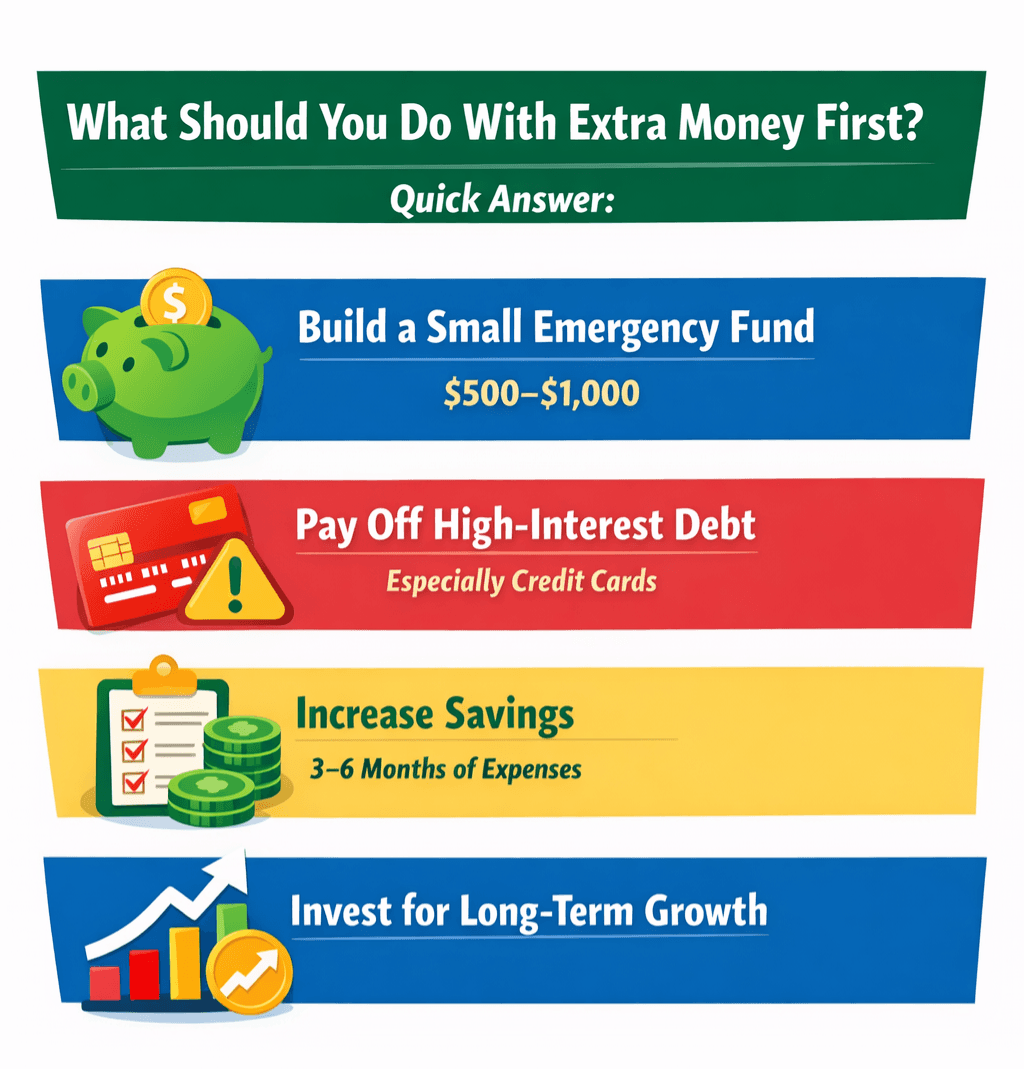
Straight up: Start by building a small emergency fund, then focus on high-interest debt, savings, and long-term investing, in that order.
That’s the simplest way to think about using extra money so it actually improves your financial situation.
With that mindset, here's how to break it down into a practical order you can follow, along with how that approach shifts depending on how much money you’re working with.
If you find extra money (whether monthly or one-time), follow this general order:
Build a small emergency fund ($500–$1,000, and more if possible or it makes sense)
Pay off high-interest debt (especially credit cards)
Increase your savings (aim for 3 to 6 months of expenses set aside for long-term stability)
Invest for long-term growth
This order helps protect your finances before trying to grow them.
However, we're aware that life doesn't always follow a clean checklist.
If you’ve got $75 extra this month, you’re not “starting a full strategy." However, you can make a smart move toward one of the goals listed above.
If you’ve got $300, now you’re making decisions, like, do I split this? Do I knock out a bill? Or do I finally start saving?
And if you’ve got real money, say $2,000, $5,000, or more, things can start to feel different. You’re no longer just managing a little cash. Instead, you're looking at a situation where you can reshape your financial situation.
What to Do With Extra Money
Step 1: Build a Financial Safety Net
This is the least exciting step, but for many, it's most important.
Because life doesn’t wait until you’re ready.
Your car breaks down. A bill shows up. Something unexpected happens.
Without savings, those moments can easily become something like, "Put it on the card and deal with it later.”
However…
What This Looks Like in Real Life
You can look at that scenario in two ways:
Person A
No savings
Puts a $600 repair on a credit card
Is now paying interest for months
Limits near-term future savings for the next emergency, potentially creating a downward spiral.
Person B
Has a $1,000 emergency fund
Encounters the same repair bill, but can handle it immediately with cash
No long-term impact
Creates an opportunity (by avoiding a credit card bill) to rebuild the emergency savings
That’s the simplest example of how having a few dollars in savings can make a big difference.
So, how much should you have in savings? There’s no perfect amount, which is why it helps to ground your expectations in reality. Think of the age and state of repair of your vehicle and home systems, health cost expectations, and any upcoming maintenance, education, or moving costs.
How It Usually Plays Out
In reality, especially if you're dealing with a small extra amount in your budget each month, this can feel a bit slow. However, it can still be worthwhile.
$25/month: This can feel slow, but remember that you're not only building savings but also building discipline.
$100/month: Can feel and act like noticeable progress
One-time $1,000: While it can provide some instant relief, it's important to remember solid budgeting calculations.
While you may not be building wealth just yet, you can create some breathing room.
Step 2: Pay Off High-Interest Debt
Once you have some savings in the bank, things can start to feel a bit different… In a good way. Because now, your money isn’t just sitting there. Now, it’s working toward getting rid of something that can hold you back.
What This Feels Like
You’ve got a $4,000 credit card balance.
Every month:
You make the payment
The balance barely moves
Interest quietly eats your progress
Then you start adding $100 extra.
This can sometimes feel like too little, too late.
But after a few months:
The balance drops faster as the interest portion of the payment drops.
Your principal balance decreases substantially with each payment.
Momentum begins to build.
You can actually see and calculate these patterns by using an early loan payoff calculator, which just so happens to work with credit card debt as well.
If you’ve got multiple debts, it gets even more powerful when you create structure with a debt snowball calculator.
Pro Tip:From our on-staff Certified Financial Educator Make the decision while it still feels like “extra” money: In my experience, once an extra injection of money blends into your checking account, it’s gone. Do something with it right away, even if it’s small, so it actually has a chance to work for you instead of disappearing. |
Step 3: Strengthen Your Cash Position
After the first two steps, many people begin to feel like they are finally controlling their money, instead of the other way around.
At some point, something shifts.
You’re no longer just reacting, but preparing for real life and stability.
What This Feels Like
Instead of:
“I hope nothing goes wrong.”
You start thinking:
“I can handle it if it does.”
At this point, you can worry less about unexpected expenses and start making intentional decisions about your finances. This is where, as they say, it can get fun.
You’re no longer just trying to keep a $500 balance for emergencies; you’re now aimed at creating financial stability. In this scenario, where you put your money can matter. Putting it into a high-yield savings account makes sense for many people at this stage, which allows them to earn interest on money they set aside. Use a savings interest calculator to see how this could work for you.
Step 4: Start Building Long-Term Wealth
This is the part everyone wants to jump to. However, the best results happen when the first three steps are in place and functioning correctly.
What This Feels Like
Investing can feel slow at first. Building wealth takes time. However, compounding interest coming in, rather than going out, can make significant changes to how you perceive money as a whole.
You put in money… and nothing really seems to happen.
Then, over time:
The balance grows
The interest gains grow
And suddenly, it starts compounding
How Compound Interest Builds Over Time
Now, you've got your budget under control and can invest in long-term, high-yield savings. Here's how that could look. Even modest interest rates can lead to meaningful growth when combined with time and consistency.
This infographic shows how compound interest can grow your money over time when you consistently invest extra money.
Decide What Makes Sense for Your Situation
While this guide is a good framework for what to do with extra money when you find it, it's not the perfect solution for everyone. The earlier steps give you a strong foundation, but how you use extra money from here depends on your goals, your timeline, and what’s going to make your life easier.
For some people, that might mean continuing to focus on paying down debt. For others, it could be building savings or starting to invest more consistently.
If you’re thinking about a major step, like buying a home, saving for a mortgage down payment, or purchasing an automobile, this whole framework may not apply to your situation very well right now. Now it’s less about general progress and more about preparing for something specific, and making sure your monthly budget can handle what’s coming.
The key here isn’t to follow a perfect plan, but to make intentional decisions when extra money comes your way to leave yourself in a better financial situation than before.
Common Mistakes to Avoid
Old habits are hard to break. While this may all sound lovely, but overwhelming at the same time, you're not alone. Most people don’t run into trouble because they don’t care about their finances. More often, it comes down to small habits that don’t feel like a big deal in the moment but slowly derail the plan over time.
Most often, falling into the habit trap is a result of not taking the steps in order. As I said earlier, this isn't a perfect plan for everyone. However, protecting yourself from incurring higher costs is crucial before taking the next steps.
That can look like putting too much money into savings while carrying a high-interest credit card balance, starting to invest before building any kind of emergency cushion, or having extra money show up each month only to watch it disappear without a clear purpose.
None of these common budgeting mistakes feels wrong on its own. However, under some circumstances, they can cancel out the progress you’re trying to make.
The good news is that, in most cases, the fix doesn't mean making a major financial overhaul. Simply starting small and making new habits, like redirecting $50 toward a balance, making one extra payment when you can, or setting up a simple automatic transfer into savings, can have huge and positive impacts over time.
Related Article: How to Get Out of Debt: How I Paid Off $44,000
Frequently Asked Questions
Conclusion
Extra money, whether it shows up a little at a time or all at once, can be an excellent opportunity to make a positive difference in your financial situation. You don’t need a perfect plan or a large amount to make progress. What matters most is using that money with the intention to build stability first, reduce costly debt, and then focus on long-term growth.
Over time, those small, consistent decisions can add up to something much bigger, eventually leading to less stress, more flexibility, and a financial situation that actually feels manageable.
About Author

Deane Biermeier
Deane Biermeier is a certified financial educator through the University of Minnesota and a respected authority in financial research, writing, and editing, renowned for his in-depth analyses and expert advice. With a distinguished career that previously spanned home improvement, real estate, and finance topics, Deane's role at Trusted Company Reviews focuses exclusively on finance. Deane has contributed to leading publications such as Forbes Home, US News and World Report, Newsweek Vault, and others. Since joining TrustedCompanyReviews.com in 2023, he has solidified his reputation as a crucial resource for clear, factual financial guidance.