The Holiday Season Arrives as Credit Card Debt Hits a New High
Rising credit card balances and high interest rates are putting added pressure on household budgets as Americans prepare for holiday shopping.

Written by
Brett Holzhauer
Holiday shopping can add to existing credit card debt as consumers face rising balances and high interest rates.
The latest Survey of Consumer Finance released in October shows that credit card debt balances continue to climb.
Key Takeaways
- Credit card debt is rising, with average household balances and interest rates increasing significantly since 2022.
- Holiday shopping could worsen debt, as nearly half of shoppers expect to borrow money for holiday purchases.
- Managing debt starts with a plan, including budgeting, prioritizing high-interest balances, and considering debt consolidation.
Household credit card balances rose 5% compared to the last survey completed in 2022 to an average of $3,100. At the same time, average interest rates rose from 14.6% to 21.4%, mirroring the Federal Reserve’s interest rate policy to fight inflation. The rise in unsecured debt is unsurprising as costs continue to rise for families.
This data comes as holiday shopping is about to go into full swing, and many are planning to take on debt for it. Nearly half of shoppers expect to borrow money to pay for holiday purchases they can’t pay for in full, according to ICSC’s 2026 Holiday Intentions Survey.
Here’s what you need to know about the current state of credit card debt and options to mitigate existing or future potential debt.
Brett Holzhauer is a senior financial writer and editor with over a decade of experience covering personal finance, investing, and the U.S. economy. His work has been featured in Forbes and CNBC, where he focuses on helping readers make sense of real-world financial challenges. |
Why the same balance hurts more now
The average household balance jumping 5% in three years isn’t a significant jump. However, that rising balance is now even more punishing for everyday families. Here’s what those numbers look like:
In 2022, the average household had $2,950 in credit card debt at 14.6%. The annual interest is $430.
In 2025, the average household held $3,100 in credit card debt at 21.4%. The annual interest is $663.
What’s more, survey data suggests more households rely on these high-interest credit cards for everyday expenses. In a Debt.com survey, 55% say they use credit cards to make ends meet, and 46% say they’ve maxed out a credit card at some point in the past year.
Shopping joy turns into financial woes
Holiday shopping can feel like death by a thousand cuts. It’s one purchase here, one Amazon order there, and it can quickly grow into a financial burden once the holiday festivities end.
In LendingTree’s December 2025 survey, 37% of Americans took on holiday debt, averaging $1,223 per person. Among those borrowers, 63% expected it to take three months or longer to pay it off. And with the average person unable to afford a $1,000 emergency, this can become a significant financial issue months after the new year.
What’s more, retailers have designed systems that make spending feel like a slippery slope. From buy now, pay later products to enticing store credit cards with spending offers, it’s easy to overspend beyond your budget.
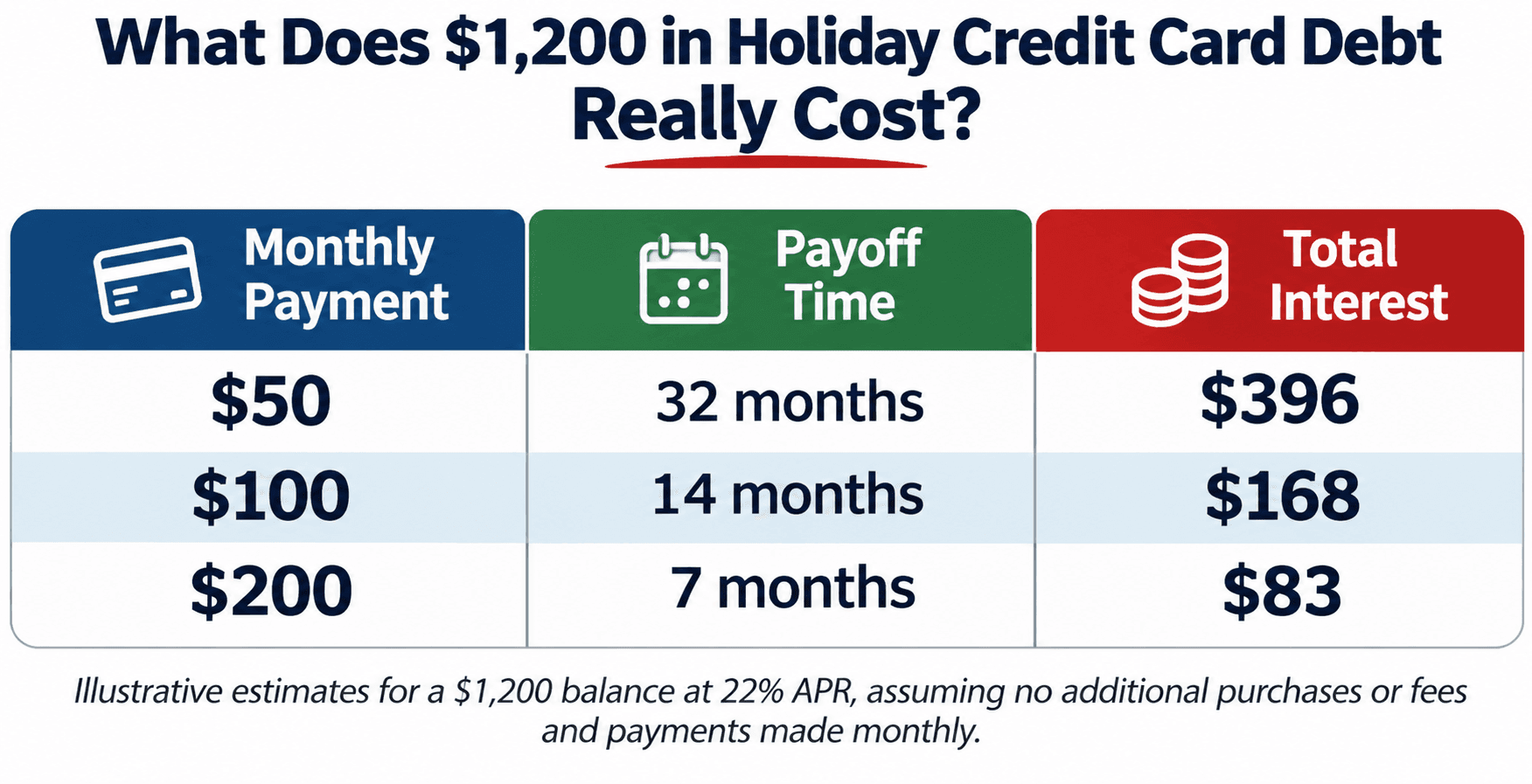
How to crush credit card debt, effectively
If you have credit card debt, or may need to lean into your credit card during financially difficult times, you aren’t alone. U.S. consumers currently hold nearly $1.3 trillion in credit card debt. Over 110 million Americans can’t afford their monthly credit card bills.
If you’re struggling with credit card debt, there are several ways to tackle it, and none of them start with shame or a perfect budget. They start with clarity. Knowing what you owe, what rate you are paying on each balance, and what your minimum payments add up to each month gives you something solid to work with, instead of a vague feeling of being behind.
First, list every card, balance, APR, and minimum payment, starting with the highest APR.
Card | Balance | APR | Minimum payment |
Card 1 | $ | % | $ |
Card 2 | $ | % | $ |
Card 3 | $ | % | $ |
Total | $ | $ |
From there, choose between the avalanche or snowball method. Avalanche targets the highest APR first and saves the most interest. Snowball budgeting targets the smallest balance first and gives faster wins.
Next, call your issuer and ask for a lower APR. One study shows more than 80% of people who asked for a lower rate were given one. This can help slow down interest accumulating on your balance and ensure more of your monthly payment is going to the principal.
Additionally, consider debt consolidation if you have multiple debts. It can help organize your debts into one place, so you can focus your efforts on one amount to pay down.
How to shop this season without adding to it
The simplest way to avoid new holiday debt is to start with one number and stay underneath it.
Before you buy anything, figure out what you can actually spend this season without borrowing. That leftover amount is your real holiday budget, not what you wish you could spend, and not what a credit limit says you can spend.
Keep the number visible while you shop. Use one payment method for gifts, so the total stays in one place, and you can check it after every purchase. If you’re shopping in person, cash can also help you stick to your budget. When the total spending gets close to your number, it’s time to stop, swap, or scale back, not switch to another card or BNPL plan.
Staying under the number also means leaving a little room. Prices go up, shipping adds up, and last-minute gifts happen. If your number is $600, aim to finish around $550. That buffer keeps a small surprise from turning into new debt.
Find the number you can spend, write it down, and let it decide for you before the checkout page does.

Written by
Brett Holzhauer