Dollar-Cost Averaging: Why Waiting for a Stock Market Dip May Backfire
Learn how dollar-cost averaging helps investors navigate market volatility and build wealth without trying to time the stock market.

Written by
Brett Holzhauer
Dollar-cost averaging helps investors build consistent investing habits through market highs and lows without trying to time the market.
The bull market keeps ripping higher in 2026, hitting record highs in recent days despite economic headwinds, including rising energy prices, the Fed hiking interest rates, and stubborn inflation.
Key Takeaways
- Dollar-cost averaging means investing a fixed amount regularly, regardless of market conditions.
- Waiting for a market dip can backfire because predicting stock market movements is difficult.
- Consistent investing builds long-term habits and reduces emotional decision-making, although returns aren't guaranteed.
Brett Holzhauer is a senior financial writer and editor with over a decade of experience covering personal finance, investing, and the U.S. economy. His work has been featured in Forbes and CNBC, where he focuses on helping readers make sense of real-world financial challenges.
The S&P 500 hit its 28th record close of the year on October 6, and remains up roughly 14% this year. This continues the bull run that started in 2022; the index has rocketed about 120% on the back of the AI boom.
This run-up has left some wondering whether we’re in a bubble, when the good times will end, and whether waiting for the market to drop is a better time to begin investing. This is where everyday investors can lean into the meaning of dollar-cost averaging–buying consistently regardless of price.
Here’s what you need to know.
What's actually going on in the market
The S&P 500 is a popular stock market index many investors use to take the market's pulse. At a glance, things look fantastic, as the index is up double digits for the year.
However, investors are growing concerned about the lack of breadth, or evenly spread performance, across the index's 500 companies.
First, the 10 largest stocks in the index make up 37%. This includes companies like Nvidia, Apple, Amazon, and Meta. That means the other 490 make up 63%. This means if the tech stocks with a large weight in the index perform poorly, they could drag down the entire index.
What’s more: there are worries that the popular index is being propped up by AI and tech stocks. Roughly 40% of the 500 stocks within the index are down this year.
Seeing this alongside record highs can discourage investors trying to time their next stock investment. But as history suggests, dollar-cost averaging can be a practical way to invest consistently without trying to time the market.
What Is dollar-cost averaging?
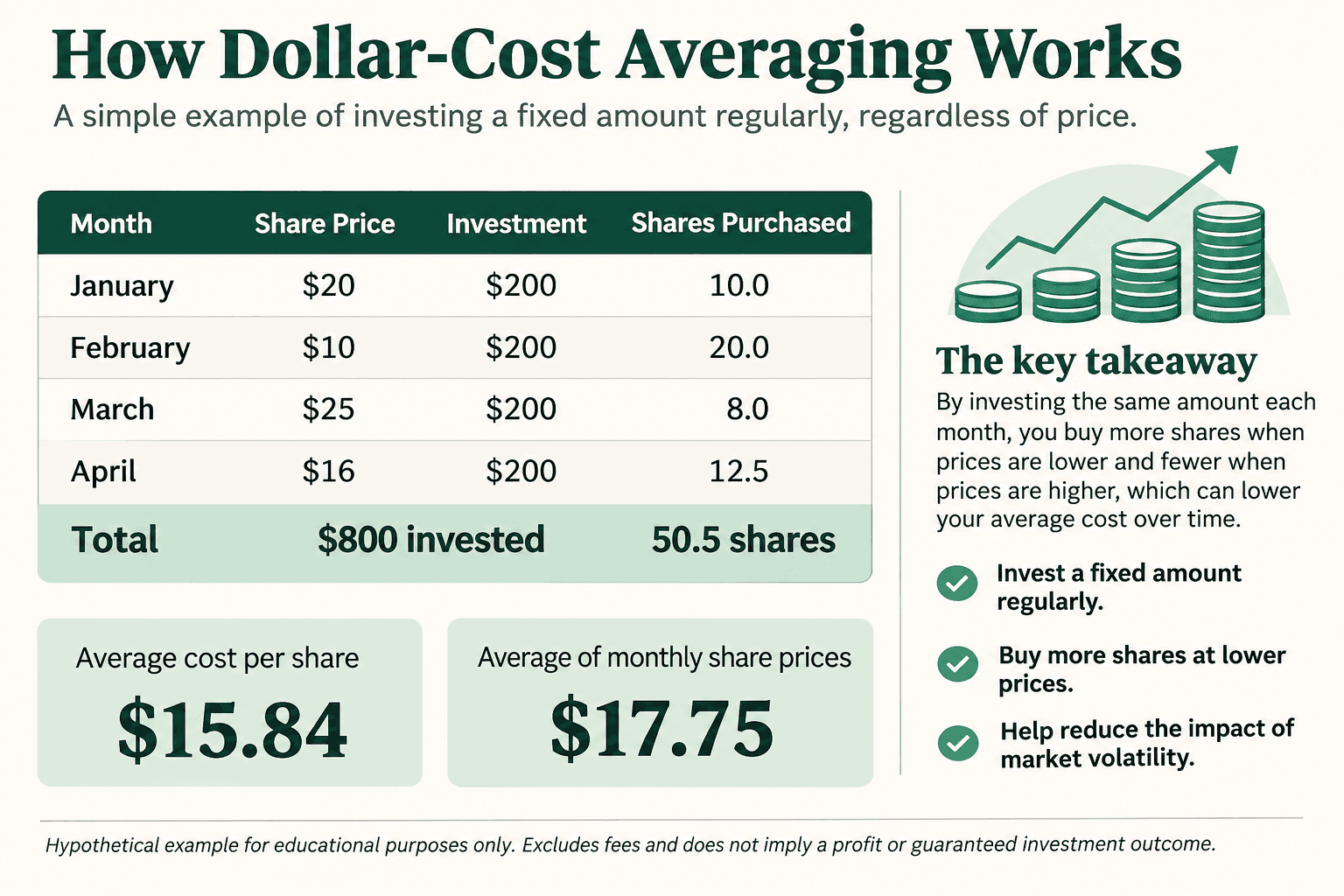
Dollar-cost averaging is an investment strategy that involves investing a fixed amount of money at regular intervals, regardless of whether stock prices are rising or falling.
For example, investing $200 into an index fund every month means buying more shares when prices are low and fewer shares when prices are high. Over time, this approach can help reduce the emotional pressure of deciding when to invest.
Many people already use dollar-cost averaging through automatic contributions to workplace retirement accounts, such as 401(k) plans.
Dollar-cost averaging doesn't guarantee profits or protect against market losses. It also doesn't always outperform investing a lump sum immediately. However, it can help investors develop consistent investing habits without trying to predict short-term market movements.
Why a record high doesn't mean "too late"
Seeing “all-time high” in a headline can make you want to wait. If stocks have never cost more, buying now feels like buying at the top. The record books say otherwise. Record highs are routine, not rare.
Since 1950, roughly 7% of all trading days have been new all-time highs. That's one in every 15 trading days. In this decade, it's been 13% of trading days.
That's one reason dollar-cost averaging can be useful when markets reach record highs. Rather than waiting for a decline that may never arrive, investors can continue making regular contributions through changing market conditions.
So if you’re putting money away in a 401(k) from every paycheck, you’re already dollar-cost averaging.
Why waiting for a dip usually backfires
Waiting for a dip sounds careful. However, it requires predicting when prices will fall and deciding when to invest. That's difficult because some of the market's strongest days occur during periods of uncertainty.
J.P. Morgan’s version tells the same story over 20 years. From January 2005 through December 2024, $10,000 in the S&P 500 grew to about $71,750. Miss the 10 best days, and it fell to about $32,871, less than half. Seven of those 10 best days came within two weeks of the 10 worst days.
Rather than trying to outperform the market through short-term timing decisions, dollar-cost averaging provides a consistent approach.
You invest the same amount on a schedule, no matter what the market did that week. It does not maximize returns. It maximizes follow-through by taking the decision out of your hands on the days when fear is loudest.
Your running start: end of 2026 into early 2027
If you’re catching this before the turn to 2027, you still have time to sneak in tax-advantaged dollars into your investment accounts.
Check your 401(k) first
For 2026, the 401(k) employee limit is $24,500, or $32,500 if you’re 50 or older. Those contributions come through payroll, so they generally have to land by December 31. A bump now still counts, but check how many paychecks you have left and whether your plan lets you change your rate that fast.
Open and fund an IRA
For 2026, the limit is $7,500 across traditional and Roth IRAs combined, or $8,600 if you are 50 or older. IRA contributions for 2026 stay open until the tax filing deadline in April 2027, so this is a second window if cash is tight now.
Don’t forget about an HSA
If you’re on a qualifying high-deductible health plan, check your HSA too. For 2026, the limits are $4,400 for self-only coverage and $8,750 for family coverage, plus a $1,000 catch-up at 55 or older. You can generally also make HSA contributions for 2026 until the tax filing deadline.
Then set one automatic transfer and forget it. Automation beats willpower, because it removes the monthly decision to invest.
More Market News and Investing Insights
Explore more TCR market insights to better understand stock market trends, investment opportunities, and long-term investing strategies.
Oil Stocks in 2026: How Energy Companies Build Competitive Advantages
Is the Stock Market in a Bubble in 2026? What 2006 and 2017 Can Teach Investors
5 Potentially Undervalued Index Funds for Long-Term Investors
SOTP Valuation: Is the True Value of Tech Stocks Hidden in Plain Sight?
Bottom line
Dollar-cost averaging offers investors a practical way to build wealth without trying to predict the stock market's next move. By investing consistently through market highs and lows, investors can focus on their long-term financial goals instead of short-term price changes.
While the strategy doesn't eliminate investment risk or guarantee better returns, it can make staying invested easier, especially when market uncertainty makes waiting seem like the safer choice.

Written by
Brett Holzhauer