
If you can't pay your mortgage, the most important thing you can do is contact your mortgage servicer immediately, before you miss a payment, if possible, and as early as possible after if not.
The foreclosure process doesn't happen overnight, and most lenders have programs designed to help borrowers avoid it. What those options look like depends on whether your hardship is short-term or long-term, how far behind you are, and how quickly you act.
If other debts, such as credit cards or personal loans, are making it harder to keep up with your mortgage payments, exploring professional debt solutions may help improve your overall financial situation. Learning more about Accredited Debt Relief can help you determine whether a debt solution could reduce financial pressure while you work to protect your home.
Related Article: What Happens If I Can’t Pay a Judgment?
Key Takeaways
- Contact your mortgage servicer immediately if you expect to miss a payment.
- Mortgage lenders generally can't begin foreclosure until you're at least 120 days past due.
- Options such as forbearance, repayment plans, and loan modification may help you stay in your home.
- Options if you can't stay include selling your home, a short sale, and a deed in lieu of foreclosure.
- Free foreclosure assistance is available through HUD-approved housing counselors.
What Happens When You Miss a Mortgage Payment?
Missing a mortgage payment follows a predictable timeline. However, exact procedures vary by lender and state, the sequence below is typical.
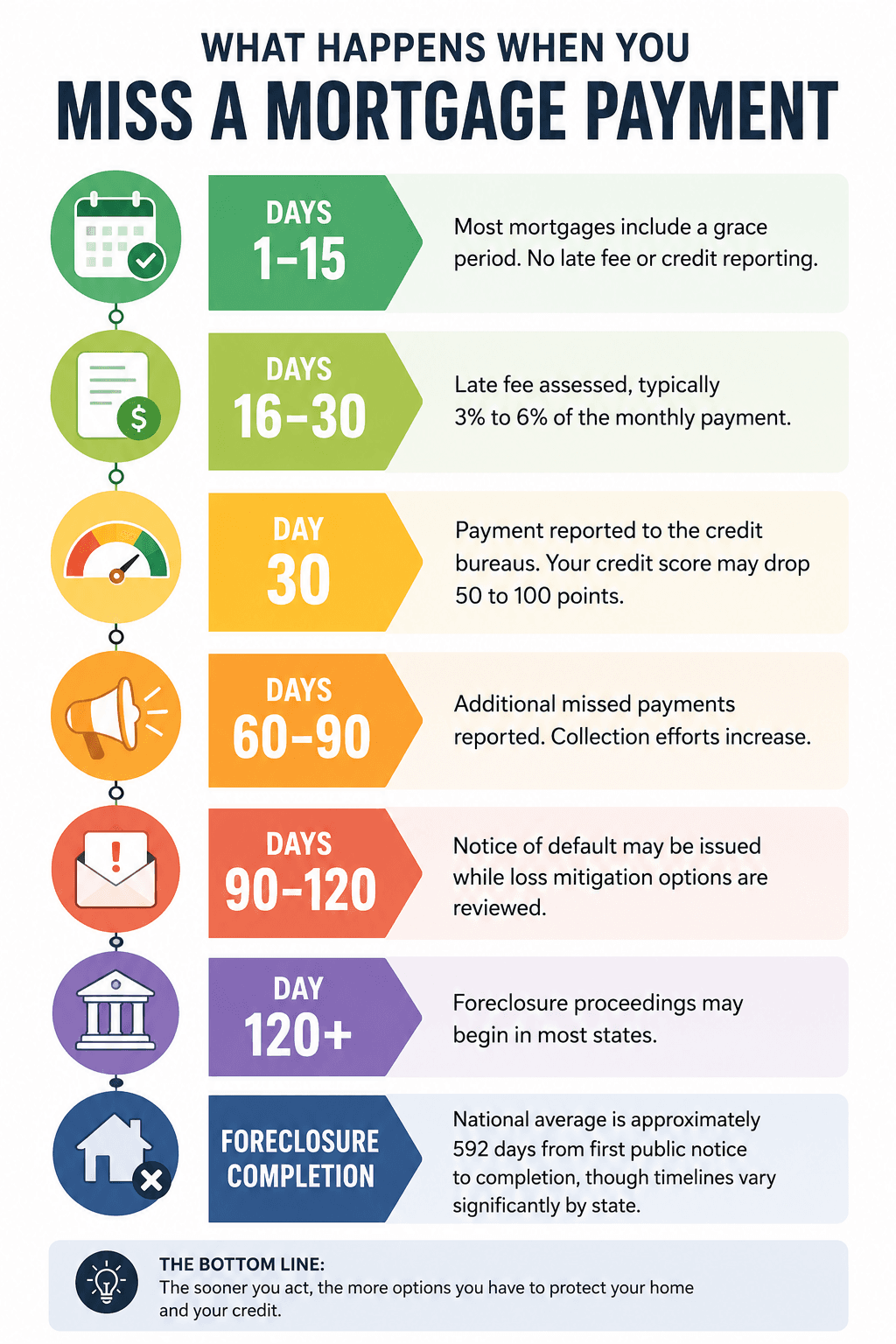
The biggest mistake homeowners make is waiting. The earlier you contact your servicer, the more likely you'll qualify for programs that help you avoid foreclosure.
Assess Your Financial Situation First
Before contacting your lender, determine whether your financial hardship is temporary or long term.
Temporary setbacks, such as job loss, illness, or a short-term reduction in income, often qualify for forbearance or a repayment plan. Long-term income reductions may require a loan modification, selling your home, or other permanent solutions.
Our free budget calculator can help you compare your monthly income and expenses to better understand which options are realistic.
Pro TipFrom our on-staff Certified Financial Educator Call your mortgage servicer before you miss a payment whenever possible. Have documentation showing your income, expenses, and hardship ready. Applying early generally provides access to more assistance programs. |
Related Article: Does Debt Consolidation Ruin Your Credit? 11 Common Myths Explained
Options If You Want to Stay in Your Home
There are several programs designed to help homeowners recover from financial hardship while keeping their homes.
Forbearance
Forbearance temporarily reduces or pauses your mortgage payment during a financial hardship. The missed payments aren't forgiven but allow you to repay them later through a repayment plan, added to the end of the loan, or handled through another agreement with your servicer.
Best for: Temporary financial hardship.
Repayment Plan
A repayment plan spreads missed payments over several months while you continue making your regular mortgage payment. This option works best once your income has recovered.
Best for: Borrowers who have overcome a temporary setback.
Loan Modification
A loan modification permanently changes your mortgage terms to lower your monthly payment. Your lender may reduce your interest rate, extend your repayment period, or move part of the balance to the end of the loan.
You'll be required to provide proof of hardship and evidence that you can afford the modified payment.
Best for: Long-term income reduction.
Refinancing
If you haven't missed payments and your credit remains strong, refinancing may lower your monthly payment by reducing your interest rate or extending your loan term. Once your mortgage becomes delinquent, qualifying becomes much more difficult.
Best for: Homeowners who anticipate payment problems before falling behind.
If credit cards or other debts are also straining your budget, our free debt snowball calculator can help you prioritize repayment and potentially free up cash for your mortgage.
Options If You Can't Stay in Your Home
If keeping your home isn't financially realistic, acting early can significantly reduce the long-term damage compared with foreclosure.
Sell Your Home
Selling is usually the best option if you have equity. Paying off the mortgage through a traditional sale avoids foreclosure and typically results in less credit damage.
Best for: Homeowners with equity.
Short Sale
A short sale allows your lender to accept less than the remaining mortgage balance. While it still affects your credit, it's generally less damaging than foreclosure. Depending on state law, negotiate whether the lender will forgive any remaining balance.
Best for: Homeowners who owe more than their home is worth.
Deed in Lieu of Foreclosure
A deed in lieu transfers ownership directly to the lender instead of going through foreclosure. Lenders usually require proof that selling the home wasn't a viable option first.
Best for: Homeowners who cannot sell and want to avoid foreclosure.
If high-interest credit card debt or personal loan payments are contributing to your inability to keep up with your mortgage, consolidating those debts into a single lower-rate payment may help free up monthly cash flow.
Our review of the best debt consolidation companies covers what to look for and which lenders fit different credit profiles.
What Is the Foreclosure Process, and How Long Does It Take?
Foreclosure is the legal process by which a lender takes possession of a home when the borrower has defaulted on the mortgage. Most lenders cannot begin formal foreclosure proceedings until a borrower is at least 120 days past due under federal mortgage servicing rules.
There are two types of foreclosure:
Judicial foreclosure
Judicial foreclosure requires the lender to file a lawsuit and obtain a court order before selling the property. This process is slower, typically lasting 12 months to several years, and is used in states including New York, New Jersey, and Florida.
Nonjudicial foreclosure
Nonjudicial foreclosure allows the lender to proceed without court involvement under a power-of-sale clause in the mortgage. This process moves much faster and can happen in as few as 60 to 90 days in states like Texas and Georgia.
According to ATTOM Data Solutions, the national average foreclosure timeline is approximately 592 days from the first public notice to completion, though the timeline varies significantly by state.
What Is a Deficiency Judgment?
If your home sells for less than the remaining mortgage balance, your lender may attempt to collect the difference through a deficiency judgment.
Whether this is allowed depends on state law. Some states provide anti-deficiency protections for certain residential mortgages, while others allow lenders to pursue the remaining balance after foreclosure.
If you're considering a short sale or deed in lieu of foreclosure, ask whether the lender will waive any deficiency balance as part of the agreement.
How Missing Mortgage Payments Affects Your Credit Score
Mortgage payments have a significant impact on your credit because payment history accounts for the largest portion of your credit score.
Here's what typically happens:
A payment becomes reportable once it's 30 days past due, potentially lowering your credit score by 50 to 100 points.
Multiple missed payments can result in much larger score declines.
A completed foreclosure remains on your credit report for seven years, making it more difficult to qualify for future mortgages, auto loans, or favorable interest rates.
Taking action before your account reaches 30 days delinquent can help limit long-term credit damage.
Options Comparison Table
Option | Stay in Home? | Credit Impact | Timeline | Best For |
Forbearance | Yes | Mild to moderate | 3 to 18 months | Short-term hardship |
Repayment plan | Yes | Mild (if payments made) | 3 to 12 months | Recovered from hardship, need to catch up |
Loan modification | Yes | Moderate | Ongoing (permanent) | Long-term income reduction |
Refinancing | Yes | Minimal | Weeks to months | Before default, credit still intact |
Sell your home | No | Moderate (late payments) | Weeks to months | Have equity, can sell before foreclosure |
Short sale | No | Moderate to severe | Months | Owe more than home is worth |
Deed in lieu | No | Severe (less than foreclosure) | Weeks to months | Can't sell, want to avoid public foreclosure |
Foreclosure | No | Severe (7 years on report) | 592 days average | Last resort — all other options exhausted |
Free Help Is Available
You should never pay a company that promises to stop foreclosure. A housing counselor can review your finances, explain your options, and help you complete loss mitigation paperwork.
Legitimate assistance is available at no cost through:
The Consumer Financial Protection Bureau's mortgage assistance resources
The HOPE Hotline (888-995-HOPE)
Warning: Be cautious of anyone who charges upfront fees, guarantees they can stop foreclosure, or asks you to sign documents transferring ownership of your home. These are common foreclosure scam tactics. Legitimate foreclosure prevention is always free.
Further Reading
Frequently Asked Questions
Conclusion
Missing a mortgage payment doesn't automatically mean you'll lose your home. Most lenders would rather help borrowers find a solution than complete a foreclosure. Contact your mortgage servicer as soon as you know you're facing financial difficulty, determine whether your hardship is temporary or long-term, and explore every available option before your account becomes seriously delinquent. Acting early gives you the best chance of protecting both your home and your credit.
About Author

Deane Biermeier
Deane Biermeier is a certified financial educator through the University of Minnesota and a respected authority in financial research, writing, and editing, renowned for his in-depth analyses and expert advice. With a distinguished career that previously spanned home improvement, real estate, and finance topics, Deane's role at Trusted Company Reviews focuses exclusively on finance. Deane has contributed to leading publications such as Forbes Home, US News and World Report, Newsweek Vault, and others. Since joining TrustedCompanyReviews.com in 2023, he has solidified his reputation as a crucial resource for clear, factual financial guidance.