
Falling behind on a credit card payment is stressful, but panicking won’t help. On the other hand, understanding the consequences will. Whether you’re short on cash this month or dealing with a longer stretch of financial hardship, knowing exactly what happens, and when, gives you the power to act before the situation gets worse.
If you're finding it difficult to keep up with your credit card payments, exploring professional debt solutions early may help you avoid more serious financial consequences. Learning more about Accredited Debt Relief can help you understand whether a debt solution or other approach makes sense for your financial situation.
Here’s a clear breakdown of what happens when you can’t pay your credit card bill and, more importantly, what your real options are.
Related Article: How to Get Out of Debt: How I Paid Off $44,000
Key Takeaways
- A missed payment triggers a late fee and potentially a penalty APR right away.
- Your credit score takes its first hit once a payment reaches 30 days past due.
- Credit card debt doesn’t disappear, and it compounds the longer you wait.
- Paying the minimum payment keeps your account current and protects your credit score in the short term.
- Hardship programs, balance transfers, and debt consolidation are all viable options.
How Credit Cards Work
Your card runs on a monthly billing cycle. At the end of each cycle, your credit card company sends a statement with your balance and a minimum payment due. You have a grace period (usually 21 to 25 days) before interest kicks in.
Carrying a balance means interest accrues daily based on your APR. The minimum payment keeps you current, but paying only that is the slowest and most expensive way to reduce credit card debt.
What Happens When You Stop Paying
Days 1–29
When you miss a payment, your provider will immediately charge a late fee, which is usually between $25 and $40. A penalty APR may also kick in. However, your credit score won't be affected yet, as credit bureaus don’t receive a delinquency report until your account is 30 days past due. There’s still time to act.
30 Days Past Due
Your credit card company reports the missed payment to the credit bureaus. Since payment history makes up 35% of your FICO score, the impact on your score can be significant. Many in this situation see quick drops of between 50 and 100 points.
60–90+ Days Past Due
At this stage, your account may be charged off and the credit card debt sold to a collections agency. Legal action and wage garnishment become real possibilities. The credit damage is severe and can follow you for up to seven years.
Related Article: Which Credit Card Companies Sue the Most Over Unpaid Debt?
Your Options When You Can’t Afford to Pay
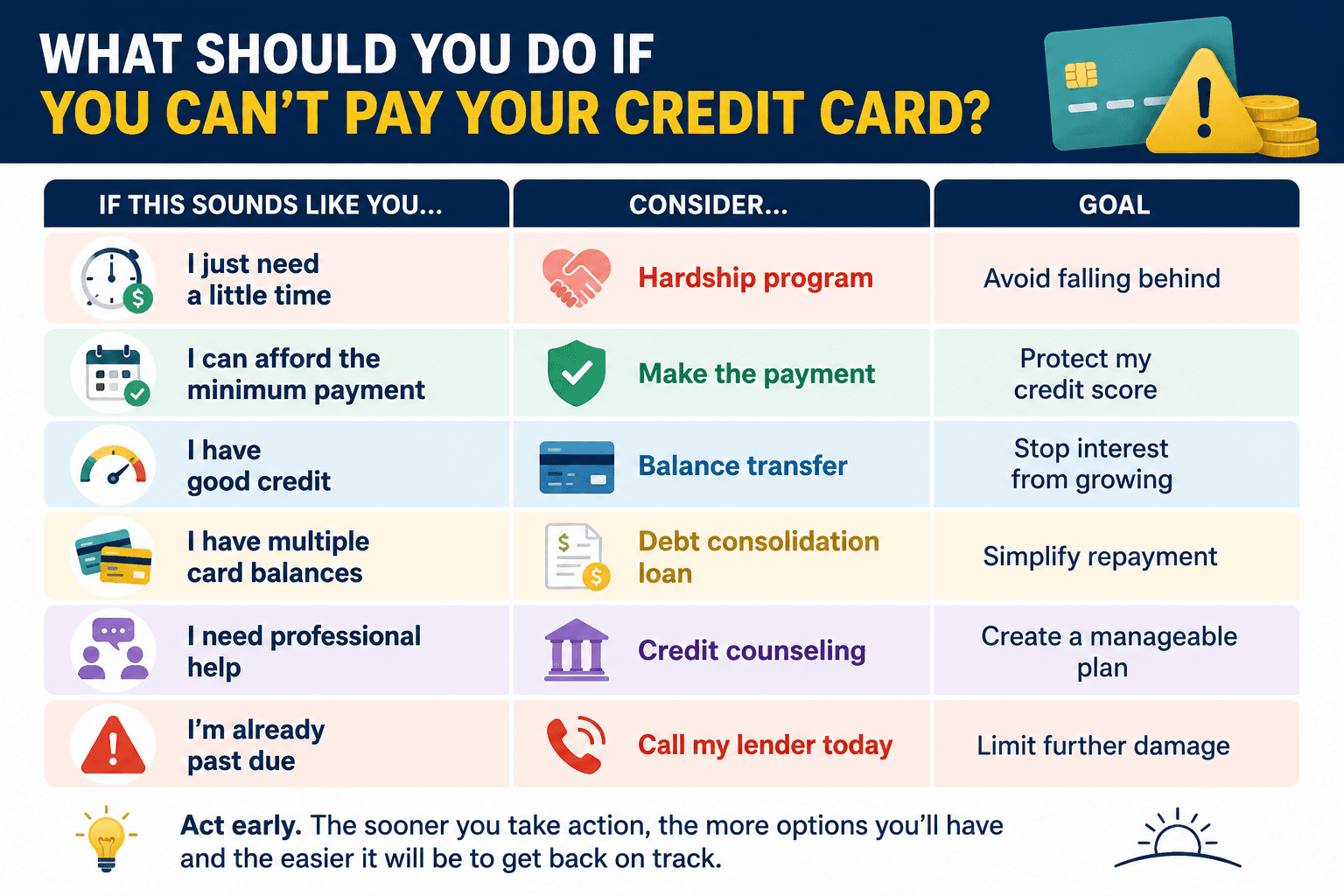
Call Your Credit Card Company First
This is the most important step. The CFPB recommends contacting your issuer as soon as you think you might miss a payment. Many credit card companies offer hardship programs, temporary rate reductions, or payment deferrals, but each lender is different, and you'll have to ask.
Pay at Least the Minimum
If you can manage it, making the minimum payment stops the 30-day clock and keeps your account in good standing. It won’t reduce your credit card debt much, but it protects your credit score while you work through the situation.
Consider a Balance Transfer
If you can transfer your balance to a 0% intro APR card, it pauses interest and gives you breathing room to pay down credit card debt without it growing. This works best if your credit score is still intact.
Transferring your balance to a 0% intro APR card pauses interest and gives you breathing room to pay down credit card debt without it growing. This works best if your credit score is still intact.
Look Into Debt Consolidation
If you’re juggling multiple credit card bills, you may be able to use debt consolidation to roll them into one loan, often at a lower rate.
Related: What is Debt Consolidation?
Try Nonprofit Credit Counseling
Agencies affiliated with the National Foundation for Credit Counseling (NFCC) can negotiate reduced rates with your creditors and set up a debt management plan for your credit card bills.
How to Recover After Missing Payments
Getting back on track takes time, but it’s doable. Start by catching up on past-due credit card bills as quickly as possible. The damage to your credit score will stop getting worse once you can make your account current again.
Pro TipWe asked Professor Mary Sasmaz, Assistant Professor in the Department of Accountancy at Case Western Reserve University, for her thoughts on catching up after missing payments… If you are only able to make the prior-statement payment, then you should expect interest charges on the next month's bill and should be able to restore the no-interest grace period within a couple of months, as long as you are making full payments. If there is a good reason for the late payment (hospitalization, banking issue, something else), some credit card companies are willing to waive a late payment fee. Sometimes they are even willing to waive the fee as a courtesy for long-term loyalty, but they don't have to and won't do it regularly. It's worth a call to ask. After getting current, it's worth a thought about whether setting up credit card payments for autopay makes sense for you. Just be sure to review your statement every month, even if it's autopaid, to monitor for any fraudulent activity. |
Going forward, keeping a closer eye on your monthly cash flow with a budgeting app can help you catch a shortfall before it becomes a missed payment. Simple, basic, and free versions are available through several providers.
Related: What Happens If I Can't Pay My Mortgage?
Further Reading
Frequently Asked Questions
Conclusion
If you can’t pay your credit card bill, doing nothing is your worst option. Instead, call your credit card company as soon as you know you'll miss the payment, and, if possible, make the minimum payment just to protect the account.
If your balance is unmanageable, consider credit counseling to help regain control. For longer-term solutions, some find that debt consolidation can help, too.
Your credit score is recoverable over time, but only if you act.
About Author

Deane Biermeier
Deane Biermeier is a certified financial educator through the University of Minnesota and a respected authority in financial research, writing, and editing, renowned for his in-depth analyses and expert advice. With a distinguished career that previously spanned home improvement, real estate, and finance topics, Deane's role at Trusted Company Reviews focuses exclusively on finance. Deane has contributed to leading publications such as Forbes Home, US News and World Report, Newsweek Vault, and others. Since joining TrustedCompanyReviews.com in 2023, he has solidified his reputation as a crucial resource for clear, factual financial guidance.