
Saving for retirement is, for many, a long journey over the course of your entire working career. This means consistently setting aside money from your paycheck from the day you start working until you clock out on your final day.
The FIRE movement uses a different methodology: you save aggressively so that your retirement is set well before your last working day. Coast FIRE is a version within the FIRE movement, and I recently reached that feat at the ripe age of 32.
Now, hitting Coast FIRE doesn’t mean retiring on the beach with a cold beverage and never working again. It means I’m now at a point where my current retirement nest egg will grow enough to sustain me in my post-working years.
In this article, you’ll learn what Coast FIRE is, how it works, how I reached this mark, and how you can strive for this mark as well.
Key Takeaways
- Coast FIRE means your retirement savings can grow without additional contributions.
- Starting early gives compound growth more time to work.
- Your Coast FIRE number depends on your age, spending goals, and expected returns.
- Reaching Coast FIRE can provide more flexibility in your career and lifestyle.
What Is FIRE?
FIRE is the acronym for financially independent, retire early. This is a movement that has emerged in the last decade, founded on aggressively saving to give yourself more options financially, in your career, and in your lifestyle.
There are several different versions of FIRE that are commonly referred to.
Traditional FIRE: Save enough to retire decades before the traditional retirement age and live off your investments.
Lean FIRE: Retire early by living on a smaller, minimalist budget with lower annual expenses.
Fat FIRE: Retire early while maintaining a more comfortable or luxurious lifestyle, requiring a larger investment portfolio.
Barista FIRE: Save enough to cover most living expenses, then work a part-time or lower-stress job to supplement your income and, in some cases, receive benefits like health insurance.
Coast FIRE: Save enough early in life that your investments can grow to fund retirement on their own, allowing you to stop—or significantly reduce—retirement contributions if you choose.
This isn’t a niche trend either. Hundreds of thousands participate in FIRE-related subreddit discussion boards, with major outlets covering them and personal finance pundits weighing in.
How Does Coast FIRE Work?
Coast FIRE is built around one simple idea: bury enough money in your retirement accounts to give compound interest time to do the heavy lifting. Once you reach your desired number, you can officially “coast” your way to retirement, without contributing another dime.
If you want to skip the math, our Coast FIRE Calculator can estimate how much you need invested today based on your age, retirement timeline, expected spending, and investment assumptions.
Here’s what the basic formula looks like, and how it works:
Current Investments × Compound Growth = Future Retirement Portfolio
Suppose you're 35 years old with $300,000 invested for retirement. If that money earns an average annual return of 7%, and you don't contribute another dollar, here's what it could grow to by age 65:
Starting Balance | Years to Grow | Average Annual Return | Retirement Value |
$300,000 | 30 | 7% | About $2.3 million |
Next, use the Rule of 25 to see whether this number is sufficient. Take your monthly living expenses, and multiply them by 25.
For example, if you expect to spend $80,000 per year in retirement:
Annual retirement spending: $80,000
$80,000 × 25 = $2 million target portfolio
In this example, the projected $2.3 million portfolio would exceed the $2 million goal, meaning you may have already reached Coast FIRE.
Keep in mind that this is only a starting point. Your retirement expenses may look very different from your current spending. You might have paid off your mortgage, relocated to a lower-cost area, or face higher healthcare expenses. Additionally, you have to account for market fluctuations. Your portfolio will fluctuate, and you will need to account for that when projecting for budgeting.
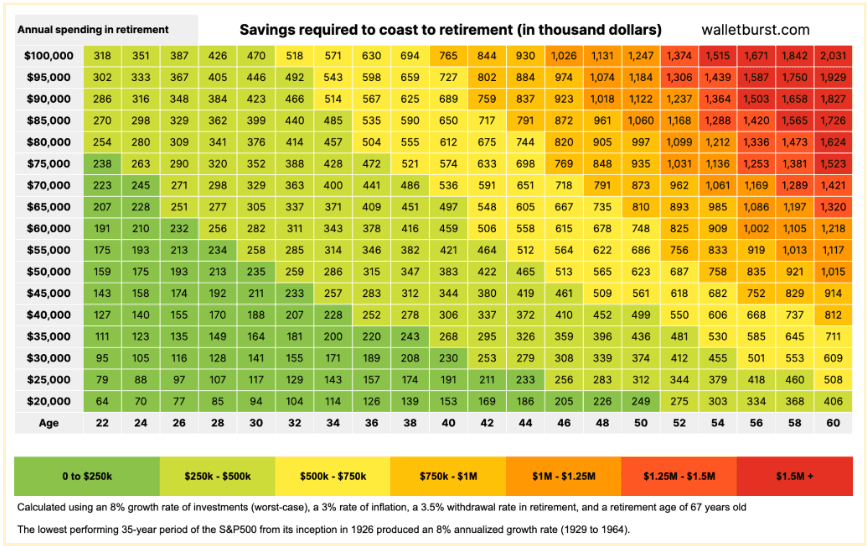
You can get an idea of how much you need in your retirement portfolio with this chart from WalletBurst:
Reaching Coast FIRE at 32
Reaching Coast FIRE didn’t happen overnight. I started investing for the future in 2018. It started slow, and there were plenty of setbacks along the way, including a divorce and multiple layoffs. From 2018, it took me 5 years to reach $100,000 in investments. From there, it took me a little over two years to hit $200,000. Now, just over a year later, I’ve reached over $325,000 saved for retirement.
That balance is spread across several accounts, each serving a different purpose:
Solo 401(k): I’m self-employed, and I make contributions on my own behalf as both the employee and the employer.
Traditional IRA: This is where I have rolled funds over from previous full-time jobs. It’s an easy way to avoid losing track of retirement funds. In fact, there are trillions of dollars in assets in “lost 401(k) accounts.”
Roth IRA: Tax-free growth and withdrawals in retirement.
Health Savings Account (HSA): Invested for the long term as an additional retirement asset.
Taxable brokerage account: Supplemental investments after contributing to tax-advantaged accounts.
I also own two rental properties, which aren't included in that $325,000 figure. While I don't consider it part of my retirement portfolio, it provides rental income and growing equity that strengthen my overall financial picture.
Here’s how the math works if I choose to retire at 62 years old:
Assuming I never contribute another dollar to retirement and earn an average 7% annual return, that $325,000 could grow to roughly $2.5 million by age 62 through compound growth alone.
At a 4% withdrawal rate, a $2.5 million portfolio could generate about $100,000 per year (roughly $8,300 per month) before taxes. Add an estimated $3,000 per month in Social Security, and I'd have approximately $11,300 per month in retirement income before considering rental income or any future investments. Considering that, according to Investopedia, the average annual retirement budget is $61,000 today, adjusting for inflation, I’m likely to have a comfortable post-working life
This is my current reality without investing another penny. Of course, I don't plan to stop investing today. I'll continue contributing to my retirement accounts for years to come, which should make my eventual retirement portfolio substantially larger. But knowing that I've already crossed the point where time alone can fund a comfortable retirement has completely changed how I think about my career and finances.
Getting to Coast FIRE Starts With Creating Room to Invest
Reaching Coast FIRE requires more than choosing investments and waiting for compound growth. First, you need enough room in your budget to consistently put money toward long-term goals. For someone carrying high-interest debt, reducing that burden may be an important step before aggressively pursuing Coast FIRE. That could mean paying balances down directly or, in some situations, using debt consolidation to combine multiple debts and potentially reduce monthly payments or interest costs. The goal isn't to consolidate debt simply because you want to pursue Coast FIRE. It's to improve your overall financial position so more of your future income can eventually go toward savings and investments rather than high-interest debt. You can also use our financial calculators to model different debt, savings, and retirement scenarios as you build a longer-term financial plan. |
Is Coast FIRE Right for You?
Coast FIRE isn't just a financial strategy; it's a different way of thinking about work and money. The goal is to reach a point where your future retirement is largely funded, giving you more choices today.
Whether that goal is realistic depends heavily on your current savings and how much time your investments have to grow. You can use our Coast FIRE Calculator to test different retirement ages, spending goals, contribution amounts, and investment assumptions.
For many people, that freedom might mean taking a more enjoyable lower-paying job, starting a business, shifting to part-time work, spending more time with family, or taking a sabbatical. That said, Coast FIRE isn't for everyone. Some people love their careers and have no desire to slow down. Others would rather maximize their wealth or retire as early as possible (Lean FIRE).
Coast FIRE is less about escaping work and more about creating options. For me, Coast FIRE gives me peace of mind that comes from knowing I can choose work based on purpose, fulfillment, and curiosity—not just because I need to work to meet my needs after I’m done working.
Frequently Asked Questions
Conclusion
Coast FIRE is a major milestone toward creating the financial flexibility to live life on your own terms. By investing early and allowing compound growth to work over decades, you may eventually reach a point where your retirement is largely on autopilot.
For me, reaching Coast FIRE means I now have the freedom to make career decisions based on purpose and opportunity instead of financial necessity. Whether you're just starting your investing journey or already well on your way, every dollar you invest today gives your future self more options to live your version of a rich life.
About Author

Brett Holzhauer
Brett’s perspective is shaped by the realities facing millennials and younger professionals: rising housing costs, student debt, shifting labor markets, and the growing gap between traditional financial advice and modern economic life.
He is particularly interested in opportunity cost, behavioral finance, and how technology is reshaping the way people save, spend, and invest.
A graduate of the Walter Cronkite School of Journalism and Mass Communications at Arizona State University, Brett brings editorial rigor, data fluency, and a strong consumer lens to every piece he publishes. In his off time, he is either traveling or watching college football.