
Debt consolidation will affect your credit score. However, whether that impact is negative or positive, and to what extent, is less black and white. In fact, much of what happens to your credit is within your control and depends on several factors.
As far as debt consolidation automatically ruining your credit goes, that's a myth, and it's just one of several misconceptions we'll cover here. What actually happens depends largely on how you consolidate your debt and what you do afterward.
Understanding what consolidation is and does, what it costs, and what happens during and after the process can help you determine whether it's a useful financial tool for your situation.
Key Takeaways
- Many debt consolidation myths come from misunderstanding what consolidation actually does. It restructures debt, but doesn't erase it or guarantee you'll save money.
- Debt consolidation can temporarily affect your credit, but it doesn't automatically ruin it.
- Debt consolidation doesn't eliminate debt, and you don't necessarily need a new loan to consolidate what you owe.
- Consolidation works best when the new terms improve your situation, and you avoid accumulating new debt.
Myth 1: Debt Consolidation Ruins Your Credit
Debt consolidation doesn't automatically ruin your credit.
Several things happen when you consolidate debt with a personal or debt consolidation loan, and each can affect your credit differently.
First, applying for a new loan typically creates a hard inquiry.
The Consumer Financial Protection Bureau defines an inquiry as “a request to look at your credit report” to determine eligibility for credit or other purposes. Credit inquiries fall into two categories: hard and soft.
A soft inquiry is what many lenders, including those listed in our overviews of the best debt consolidation companies and personal loan providers, often use to prequalify you and determine your initial eligibility for a loan. Soft inquiries don't affect your credit score and aren't visible to lenders when they view your credit report.
A hard inquiry generally occurs when you formally apply for new credit, and the lender reviews your credit report. Hard inquiries can temporarily lower your credit score and generally remain on your credit report for up to two years.
Opening the new loan can also change factors used to calculate your credit score. However, using a consolidation loan to pay down revolving credit card balances can reduce your credit utilization. Making the new loan payments on time can also help you build a positive payment history over time.
The key is what happens after you consolidate. While you may see an initial score drop, lower credit utilization and consistent, on-time payments can work in your favor over the long run. Missing payments or running your credit card balances back up can work against you.
Myth 2: Debt Consolidation Is Only for People in Serious Financial Trouble
You don't have to be falling behind on your bills to consider consolidation.
In fact, many people consolidate their debt as a method of smartly managing money. Someone successfully making every payment might consolidate debts to:
Reduce interest costs
Replace several payments with one
Simplify budgeting by eliminating multiple due dates
Create a defined repayment schedule
Having good credit can actually work in your favor, potentially helping you qualify for lower rates and better consolidation terms.
The important question isn't whether you're "in enough trouble" to consolidate. It's whether consolidation improves your financial situation in a smart way.
Myth 3: Debt Consolidation Gets Rid of Your Debt
Consolidating debt generally moves or restructures what you owe rather than eliminate it.
For example, using a $20,000 personal loan to pay off $20,000 in credit card balances doesn't eliminate $20,000 of debt. You now owe the new lender instead of the credit card companies.
The potential advantage is getting a lower interest rate, predictable payment, fixed repayment period, or simply fewer bills to manage.
To dig deeper into what debt consolidation actually does, I spoke with Michael Rodriguez, a CERTIFIED FINANCIAL PLANNER™ and founder of Equanimity Wealth, an advice-only, fee-only financial planning firm. In our conversation, Rodriguez explains some of the most common misconceptions about debt consolidation, including what it can and can't accomplish, how it can affect your credit and overall finances, and what to consider before deciding whether consolidation makes sense for you.
Myth 4: I Need to Get a Loan to Consolidate My Debt
A debt consolidation loan is only one way to consolidate debt.
In fact, several ways to consolidate your debt exist, and the one you choose depends on your unique situation. They include:
Personal consolidation loan: Combines multiple debts into a fixed-rate loan with a predictable monthly payment and repayment term. It can be a good fit for larger balances when you qualify for a rate that improves on your existing debt.
Balance transfer card: Moves credit card balances to a card offering a low or 0% introductory APR. It generally works best for smaller balances you can repay before the promotional period ends.
Debt management plan, relief, or counseling: Financial counseling and debt management services can provide alternatives to taking out a new loan, including structured repayment plans and assistance working with creditors. Nonprofit credit counseling may be especially useful when qualifying for an affordable consolidation loan is difficult.
Home equity loan or HELOC: Homeowners with sufficient equity sometimes use a home equity loan to consolidate other debts, often at a lower rate. However, your home becomes collateral, creating foreclosure risk if you can't make the payments.
Each of the options above has different eligibility requirements, costs, benefits, and potential risks. The goal isn't just to get another loan, but to find the consolidation method that fits your budget, circumstances, and needs.
Myth 5: A Lower Monthly Payment Means You're Saving Money
In some cases, having a smaller payment can actually cost more in the long run.
In fact, extending repayment over a longer period can reduce your monthly payment while increasing the amount of interest you pay.
Before accepting a consolidation offer, compare:
Interest rate
Monthly payment
Loan term
Origination and other fees
Total repayment amount
Don't judge a consolidation offer by the monthly payment alone.
Myth 6: Debt Consolidation and Debt Settlement Are the Same Thing
Debt consolidation and debt settlement are very different strategies.
Debt settlement has different considerations than debt consolidation and may be appropriate for people experiencing significant financial hardship. Depending on the program, the process may involve pausing payments while funds accumulate for settlement offers. This can affect your credit and may result in additional interest, fees, or collection activity. Before enrolling, understand the process, costs, potential credit impact, and how completed settlements could affect the amount you ultimately repay.
Debt Consolidation | Debt Settlement |
Combines or restructures debts | Attempts to settle debts for less than owed |
You generally repay the principal | Some principal may be forgiven |
May involve a new loan, balance transfer, or other repayment strategy | Typically involves negotiating with creditors |
Usually intended to make repayment easier or less expensive | Generally used when borrowers are struggling to repay their debts |
Myth 7: Once You Consolidate, Your Debt Problem Is Solved
Consolidation is a financial tool, not a cure for overspending.
In fact, one of the biggest risks comes after paying off your credit cards with a consolidation loan. Suddenly, those cards have available credit again.
If you begin using them and carrying balances, you could end up owing the consolidation loan and another round of credit card debt.
Consider putting the cards away, locking them through the issuer's app, removing them from digital wallets and shopping accounts, and relying on debit or cash while paying down the consolidation loan.
Myth 8: You Should Close Your Credit Cards After Consolidating
Paying off a credit card doesn't mean you automatically need to close the account.
In fact, closing accounts that have no or low balances can reduce your available revolving credit and potentially increase your credit utilization ratio.
Consider removing the temptation to use the cards instead of immediately closing them. Lock the cards, store them somewhere inconvenient, or remove saved card information from your easy-to-access phone and online accounts.
Myth 9: The Lowest Advertised Interest Rate Is Always the Best Deal
The interest rate is important, but it doesn't tell you the full cost of consolidation.
Look beyond the advertisement for:
Origination fees
Balance transfer fees
Promotional-rate expiration dates
Fixed vs variable rates
Repayment length
Prepayment penalties, if applicable
Total repayment cost
A slightly higher rate with fewer fees or a shorter repayment period could potentially cost less in the end.
Myth 10: If a Lender Approves You, You Can Afford the Loan
Loan approval doesn't automatically mean the payment fits your budget.
A lender decides whether it's willing to extend credit based on its underwriting requirements. You still need to decide for yourself whether the payment is realistic for your household finances.
Put the proposed payment into your actual monthly budget before accepting an offer. Leave room for irregular expenses and emergencies, not just predictable bills.
If the payment only works during a perfect month, it may not really work.
Myth 11: Using Debt Consolidation Means You've Failed Financially
Debt isn't a character judgment, and using a tool to manage it isn't an admission of failure.
If you're embarrassed about carrying debt, you're far from alone. According to the Federal Reserve, 45% of Americans with credit cards carried a balance at least once during the study year. Collectively, U.S. consumers carried about $1.26 trillion in credit card balances as of the second quarter of 2026.
Shame and embarrassment can make it harder to confront debt or ask for help. But debt is ultimately a financial problem to solve, not a measure of your worth or intelligence.
A better starting point is figuring out what you actually owe, what the debt costs, and what you can realistically afford to pay. From there, you can determine whether consolidation, a structured repayment plan, professional guidance, or another approach makes sense.
You aren't the only person dealing with debt, and needing a plan to manage it doesn't mean you've failed. It means you're doing something about it.
Pro Tip |
From our on-staff Certified Financial Educator and Author: |
How to Decide Whether Debt Consolidation Makes Sense
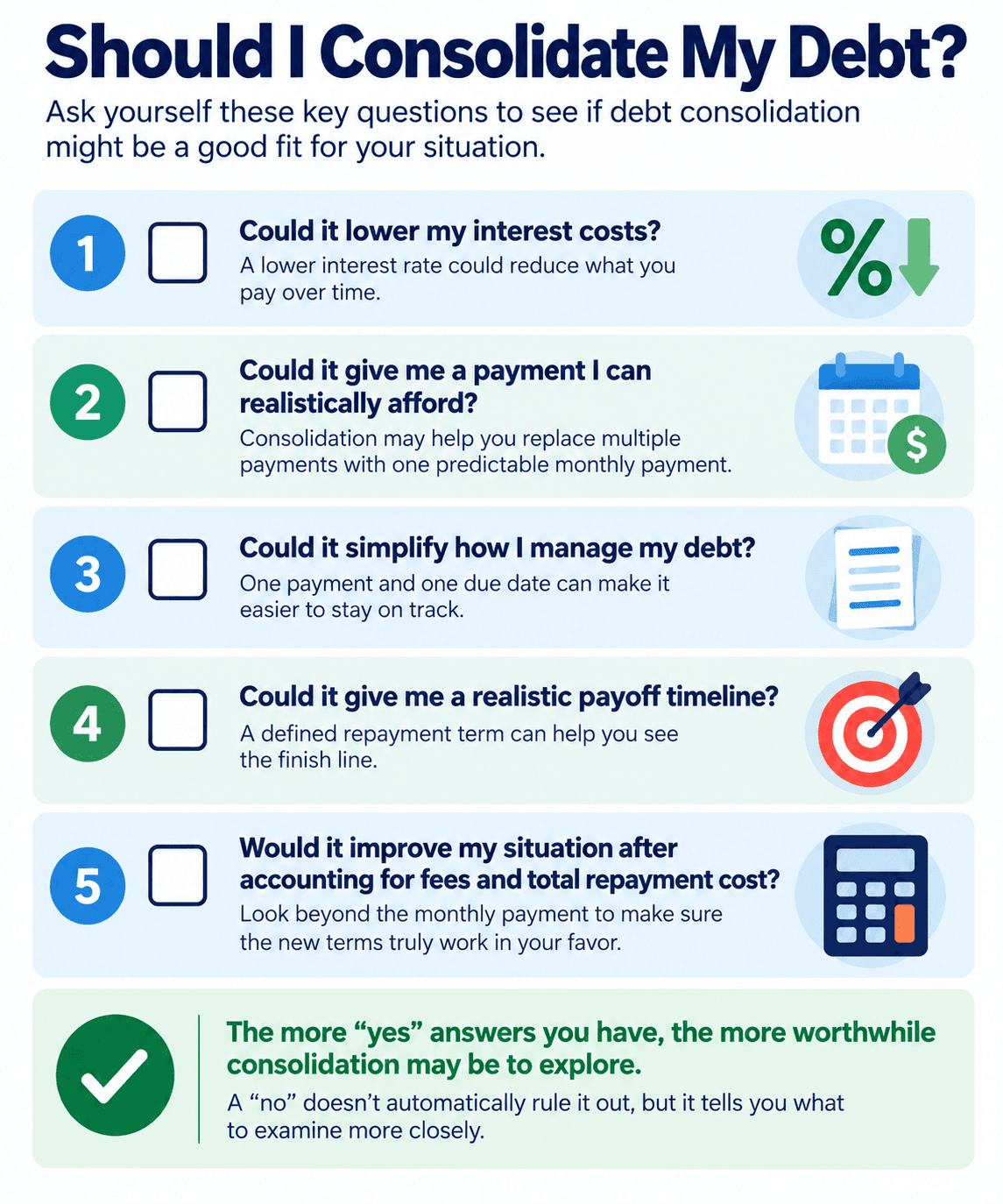
Before consolidating, compare the proposed plan with what happens if you continue paying your existing debts.
At minimum, compare:
Current balances
Current interest rates
New interest rate
Upfront and ongoing fees
Monthly payment
Repayment period
Total repayment cost
Then ask the most important question:
Does the new plan meaningfully improve my situation?
A lower interest rate, affordable payment, and realistic payoff date can make consolidation useful. Moving debt around without reducing its cost or changing the habits that contributed to it may accomplish very little.
Also, research any lender, credit counselor, or debt-relief company before providing personal information or paying fees.
Frequently Asked Questions
Conclusion
Debt consolidation doesn't automatically ruin your credit, eliminate your debt, or fix the financial circumstances that caused it.
What it can do is restructure existing debt in a way that may lower borrowing costs, simplify repayment, or provide a clearer path toward becoming debt-free.
The numbers matter. So do your habits after consolidating.
Before making a decision, compare the complete cost of your current debts with the complete cost of the proposed solution. Read the terms from a reputable lender, account for fees, make sure the payment works within your real-world budget, and have a plan for what happens to newly paid-off credit cards.
Used thoughtfully, debt consolidation can be a useful financial tool. However, also understanding what it doesn't do may be just as important as understanding what it does.
About Author

Deane Biermeier - Certified Financial Educator
Deane Biermeier is a certified financial educator through the University of Minnesota and a respected authority in financial research, writing, and editing, renowned for his in-depth analyses and expert advice. With a distinguished career that previously spanned home improvement, real estate, and finance topics, Deane's role at Trusted Company Reviews focuses exclusively on finance. Deane has contributed to leading publications such as Forbes Home, US News and World Report, Newsweek Vault, and others. Since joining TrustedCompanyReviews.com in 2023, he has solidified his reputation as a crucial resource for clear, factual financial guidance.