
If you’re wondering “What happens if I can’t pay my hospital bill?” you’re not alone. Studies from the National Library of Medicine show that as much as 36% of US households carry medical debt. Fortunately, the short answer is pretty straightforward.
If you cannot pay your hospital bill, the hospital will reach out to you with payment reminders and options before taking any further action.
This provides you with plenty of time to apply for financial assistance, negotiate your balances, or work with your health insurance company to correct any errors.
If, however, you ignore the hospital's attempts to reach you, they may eventually transfer your account to a collection agency.
Related Article: What Happens If I Don't Pay a Medical Bill?
Key Takeaways
- Contact the hospital as soon as you know you may have trouble paying your bill.
- Review your bill and insurance EOB for errors before making payments.
- Ask about financial assistance, discounts, or a payment plan before the account goes to collections.
- Unpaid medical debt may eventually be sent to collections and could affect your credit under applicable reporting rules.
- Medical debt can potentially lead to a lawsuit if it remains unpaid.
What Happens When You Don’t Pay a Hospital Bill?
If you don’t pay a hospital bill, the hospital will start by sending you reminders in the mail and sometimes through your patient portal. This initial statement will show the amount you owe after your insurance payment is received. This amount should match the total on the explanation of benefits (EOB) from your health insurance company.
If the bill remains unpaid, the hospital will generally begin calling you directly and sending more frequent reminders and additional statements. This is an opportune time to dispute incorrect charges, ask questions about your bill, or request additional time to pay.
If you continue to forego payment of your hospital bills, the hospital will move the debt to collections, and you’ll begin receiving requests from the agency that has purchased your debt.
The exact timeline of this process varies depending on the hospital, provider, or state laws.
Can Unpaid Hospital Bills Go to Collections?
If you can’t pay your hospital bill, it may go to collections. Typically, this happens after the facility has made several attempts to contact you regarding the account.
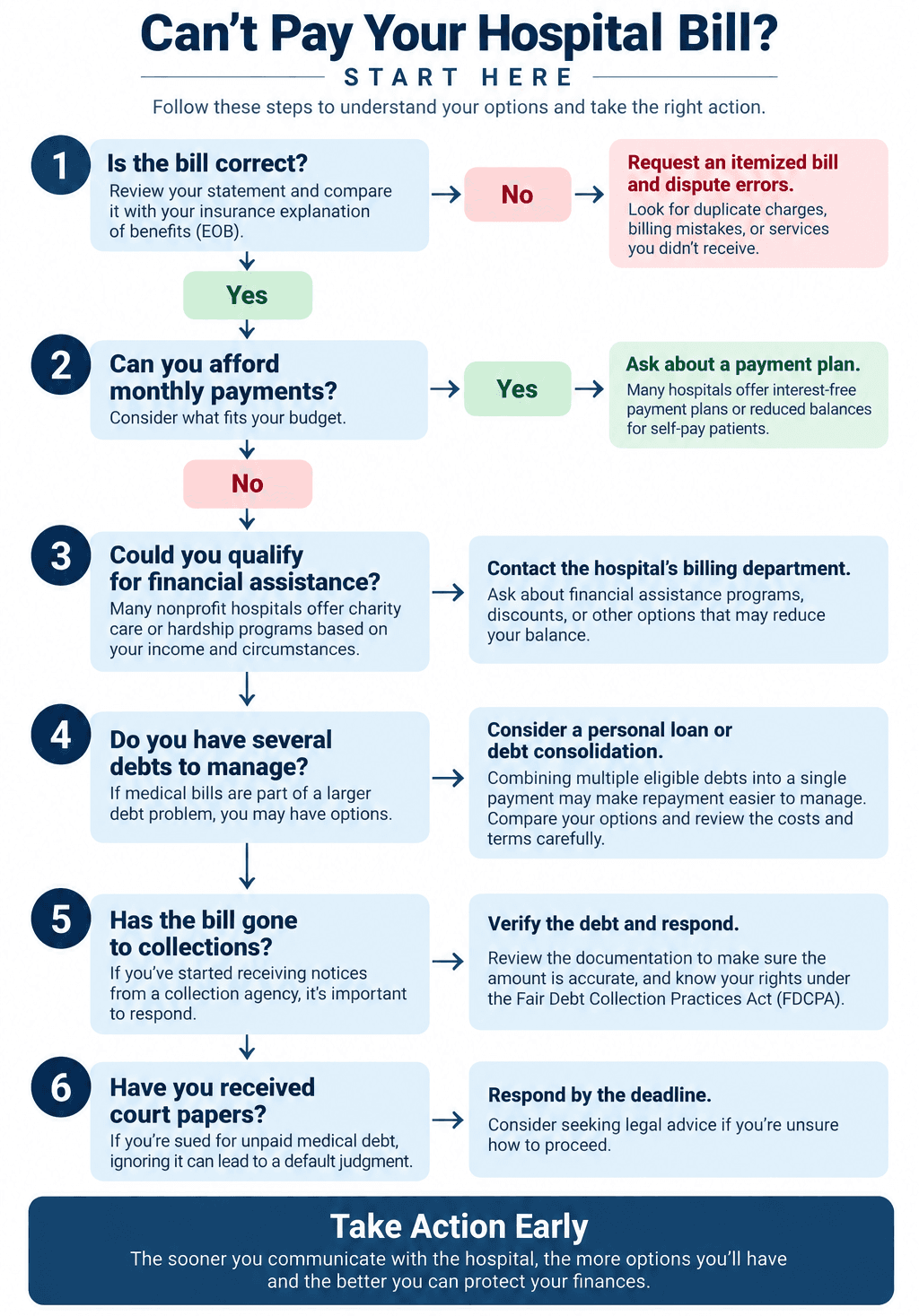
If the hospital sends your unpaid bill to collections, you’ll need to work with the debt collection agency to pay the balance, rather than the hospital itself. However, before paying the balance, review documentation carefully to verify that your total owed is accurate.
If you choose to ignore a collection attempt by the debt collector, your debt may end up affecting your credit score. While rules do change over time, current credit reporting rules allow debtors to report to credit reporting agencies for failure to pay.
For more information about collection agencies and your rights, see our guide on What Happens if I Don’t Pay a Collections Agency?
What Should I Do If I Can’t Afford My Hospital Bill?
If you can’t afford to pay your hospital bill, taking action early generally gives you more options than waiting until the account reaches collections.
To ensure you’re not overpaying, consider these steps:
Review the bill carefully. Compare your statement with your health insurance explanation of benefits (EOB) to make sure the charges are accurate.
Request an itemized bill. Itemized statements can help identify duplicate charges, billing errors, or services you didn’t receive.
Contact the hospital’s billing department. Let them know you’re experiencing financial difficulty before your account becomes overdue.
Ask about financial assistance. Many nonprofit hospitals and providers offer charity care or financial assistance programs based on household income or financial hardship.
Negotiate the balance or request a payment plan. Depending on your circumstances, the hospital may offer self-pay discounts, interest-free payment plans, or reduced settlements.
Get any agreement in writing. Before making payments, ask for written confirmation of the terms to ensure you fully understand the arrangement.
If you still need help covering medical expenses after exploring these options, you might consider utilizing credit or a loan as a way to pay off all your medical debt at once. Then you can repay the money over time with a single monthly payment. Our guide to the best personal loans discusses factors to consider before borrowing.
If medical bills are part of a larger debt problem, debt consolidation may also be worth considering. Consolidation can combine multiple eligible debts into a single payment, potentially making repayment easier to manage. Compare the best debt consolidation companies and carefully review the costs and terms before deciding whether consolidation fits your situation.
Can a Hospital Bill Affect My Credit?
An unpaid hospital bill can affect your credit. However, in most cases, your medical debt won’t land on your credit report unless it’s been sent to collections and meets the current credit reporting requirements.
Current credit reporting policies regarding medical debt remain a strongly debated subject, with potential policy changes on the horizon. Depending on your state, debt under a certain dollar amount or bills from the past year may be excluded. Furthermore, credit reporting agencies sometimes weigh medical debts less heavily than other types of debt, such as loans.
To ensure your debt doesn’t land on your credit report, respond quickly to hospitals requesting payment, and work towards paying down your balance, even if you can only apply a small total each month.
Can You Get Sued for Unpaid Medical Bills?
Unpaid medical debt can potentially result in a lawsuit. Once a medical bill becomes delinquent, a hospital, collection agency, or debt buyer may pursue legal action to collect what you owe, much like a creditor can with unpaid credit card debt.
If you’re sued, responding to the lawsuit is important because ignoring it could result in a default judgment and additional collection options. Our guide explaining whether a credit card company can sue you covers what can happen when unsecured debt, including medical debt, reaches the lawsuit stage.
Can You Negotiate a Hospital Bill?
You can negotiate a hospital bill in some instances, though not all.
If you’re interested in negotiating your hospital bill, it’s best to start the process before the account goes to collections. Contacting the billing department early demonstrates that you’re working in good faith to clear your balance.
Negotiating your hospital bill is a good option if you’re uninsured, underinsured, or experiencing financial hardship. Here are 10 tips for negotiating down your hospital bill:
Always be kind and professional in all of your communications.
If your hospital is a non-profit organization, request a “review of the account under the community benefit obligation.” This will trigger the hospital to provide financial assistance if you qualify.
Ask for an itemized bill and dispute charges for items/services you did not receive.
Ask, “Please confirm the unit price for this medication and the number of doses administered,” for each drug received. At times, this helps to remove markups on medications.
Ask the billing office to provide the credentials and license number for each provider who billed for services. If they were not credentialed at that facility at the time of service, request that the charges be removed.
Request the self-pay or cash rate for your bill.
Request clinical justification for any individual charge over $500.
Send communication via certified letter, and send a copy to the hospital’s compliance officer.
Make a one-time cash settlement offer that you’re comfortable paying.
If you’re not getting anywhere, file a report with your state insurance commissioner.
Frequently Asked Questions
Conclusion
If you find yourself unable to pay your hospital bill, know that you have options. Be sure to contact the hospital promptly and notify them of your situation. From there, you can begin to negotiate your bill, apply for financial assistance, and clear your debt.
The most important thing to remember is to act quickly and avoid letting your debt go to collections and sit for long periods, where it could potentially affect your overall credit score.
More Resources for Managing Bills and Debt
If you’re struggling with a hospital bill, it may be part of a larger financial challenge. These guides can help you understand what may happen when other bills go unpaid, how debt collection works, and what options you have for getting your finances back on track.
Medical Bills and Medical Debt
Collections, Lawsuits, and Unpaid Debt
What Happens When You Can’t Pay Other Bills?
What Happens If I Can’t Pay My Mortgage? Your Options and Next Steps
How Late Can You Be on a Car Payment Before You Lose Your Car?
Late Car Insurance Payment? What Happens and How to Avoid Cancellation
Borrowing, Budgeting, and Getting Back on Track
About Author

Tammy McKinney
Tammy McKinney, RN, is a seasoned registered nurse and accomplished healthcare and personal finance writer. With a background in acute care, long-term care, and hospice & palliative care, Tammy combines her medical expertise with her passion for writing to educate and inform the public on various health and finance-related topics.