
An Insurify survey says drivers are spending $5,851 annually on car ownership – before even making the monthly payment on the car loan.
This figure breaks down into full-coverage auto insurance ($2,237), gasoline ($2,126), and maintenance costs ($1,488). These are stark expenses as Americans continue to face financial headwinds.
For millions of Americans, having a car isn’t optional. It’s how they get to work, run errands, take their kids where they need to go, and handle everyday life. But while owning a car may be necessary, paying more than you have to isn’t.
There are practical ways to push back against rising car costs and keep more money in your pocket. Here’s what you need to know.
Key Takeaways
- Average car costs can add up to thousands of dollars each year, even before a monthly car payment.
- Shopping for insurance regularly can uncover significant savings.
- Small changes to fuel spending and insurance coverage can reduce ongoing ownership costs.
- Staying on top of routine maintenance can help prevent more expensive repairs later.
How Much Does It Cost to Own a Car?
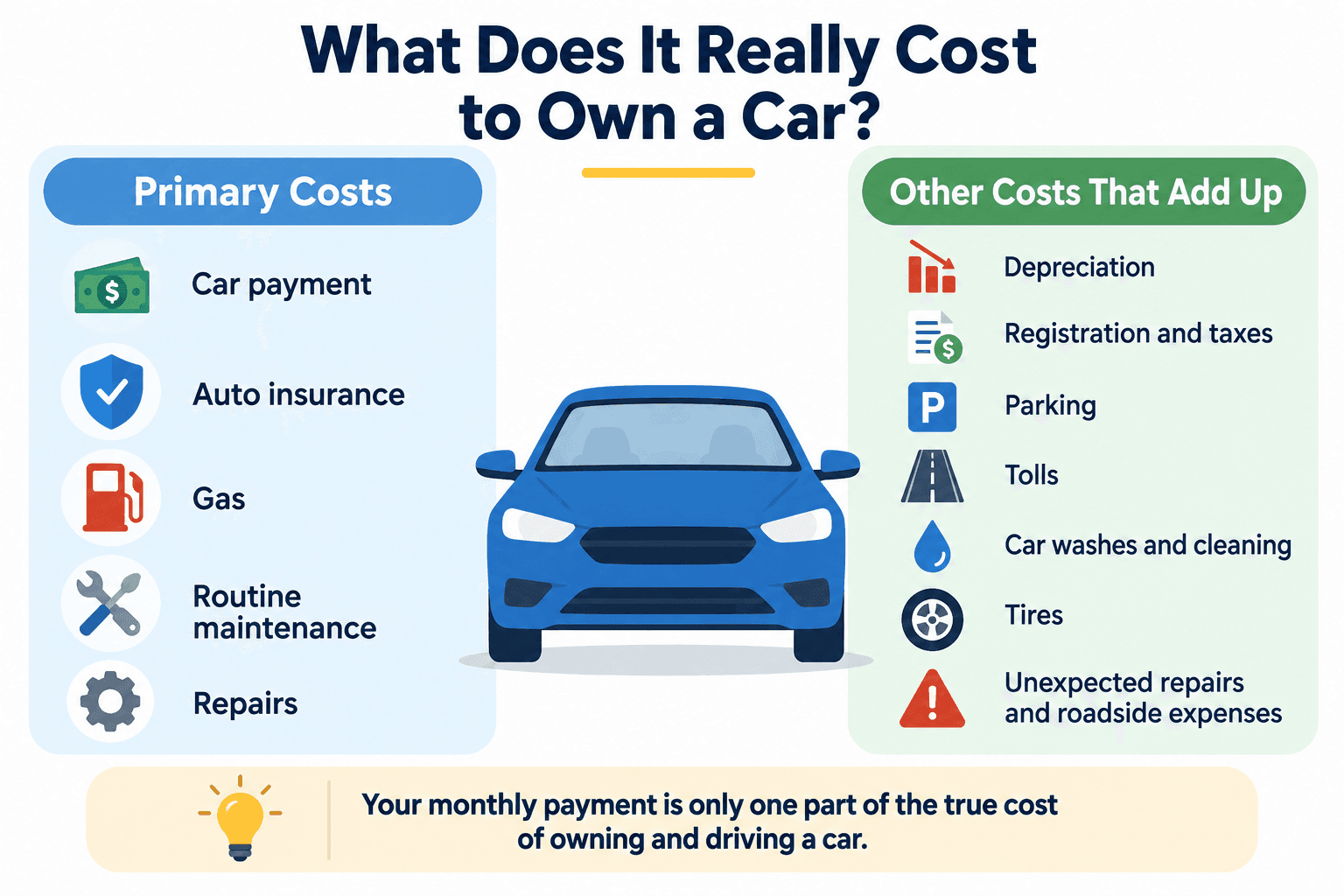
As the numbers above show, basic car ownership costs can approach $6,000 per year before you even account for a car payment, depreciation, parking, tolls, and other expenses.
The cost of owning a car goes well beyond the monthly payment. In addition to the obvious expenses like insurance and fuel, registration, taxes, repairs, and other ongoing costs all contribute to what you actually spend.
Some of these costs are predictable, while others can change significantly depending on your vehicle, where you live, how much you drive, and how you use it. An older paid-off car, for example, eliminates a monthly loan payment but may require more frequent repairs. A newer vehicle may need less maintenance but comes with a payment and typically loses value faster through depreciation.
The vehicle you choose can also make a significant difference in what you ultimately spend. Before buying, researching the typical ownership costs for the specific make and model can help you anticipate expenses beyond the purchase price.
“One practical way to reduce or anticipate total transportation cost is by doing a bit of research on the model or brand,” says Jia Lee, Accountant (CPA) at True Ledger Accounting. “There are many resources online for popular brands that will show the true cost of owning one.”
That makes average car costs useful as a starting point, but your own total cost of ownership is the number that matters most. When looking for ways to save, consider everything you spend to own and operate your vehicle rather than focusing only on the payment.
Once you know where your money is going, you can start looking for expenses you may be able to reduce. Here are five practical places to start.
1. Shop your car insurance at least once a year
Sticking with the same car insurance company may be convenient, but loyalty doesn’t necessarily mean you’re getting the lowest rate. Insurers calculate premiums differently, so another company could charge far less for nearly the same coverage.
One way to keep this in mind is to shop your insurance around at renewal time. For some, that can be every six months or once a year. And this may save you more than you think. A September 2025 Consumer Reports survey found a median annual savings of $461.
As you shop around, be sure to ask about potential discounts or additional ways to save, like:
Bundling auto insurance with other policies like home, renters, or life insurance
Low mileage discounts
Safe driving discounts
Employer or membership-based discounts
2. Raise your insurance deductible, if you can afford it
Another way to potentially lower your car insurance premium is to raise your deductible — the amount you pay out of pocket before your insurance coverage kicks in for a covered claim.
For example, if you have a $500 collision deductible and a covered accident causes $3,000 in damage to your car, you would generally pay the first $500, and your insurer would cover the remaining $2,500.
Choosing a higher deductible, such as $1,000 instead of $500, typically lowers your premium because you're agreeing to take on more of the financial risk yourself. But don't raise your deductible simply to get the lowest possible monthly payment.
A rule of thumb is to keep enough in your emergency fund to cover your deductibles. This way, if you do need to make a claim, you have the money set aside so you don’t have to go into debt.
Ask your insurer to quote your policy at several deductible levels. Then compare how much you'd save annually with how much more you'd have to pay if you filed a claim. That can help you find a deductible that lowers your insurance costs without leaving you scrambling for cash after an accident.
3. Check whether you're paying for coverage you no longer need
New cars typically cost much more to insure because they are more valuable. However, if you drive an older, paid-off car, it may be worth reviewing whether collision and comprehensive coverage still make financial sense. These coverages help pay for damage to your vehicle, but the potential payout is generally limited by what the car is worth.
Compare your car's current value with what you're paying for the coverage and your deductible. For example, paying hundreds of dollars each year to protect a car worth only a few thousand dollars may not always add up. Here’s an example:
Example | Amount |
Car’s current value | $5,000 |
Collision + comprehensive cost | $600/year |
Deductible | $1,000 |
Approx. maximum payout if car is totaled | $4,000 |
Cost of coverage over 3 years | $1,800 |
In this case, you’re spending a large amount to insure something that isn’t worth much more than the cost of insurance. However, that doesn't mean you should automatically drop coverage once your car reaches a certain age. Instead, run the numbers and consider whether you could afford to repair or replace the vehicle yourself if it were totaled.
4. Use apps and memberships to pay less for gas
Gas is now a major expense for many families. According to a Numerator survey, 92% are actively looking for ways to save money on gas, and 80% are trying to reduce their gas use amid rising gas prices.
Here are several ways you can cut down the price you pay at the pump:
Use GasBuddy: The GasBuddy app gives you real-time data on gas prices in your area so you can be sure you’re getting the best price.
Opt for warehouse club gas: Places like Costco and Sam’s Club can save you money compared with retail gas stations in your area. Plus, you don’t need a membership to get gas. Have a friend buy you a gift card, and you can use it to pay.
Use a gas credit card: Several credit cards offer valuable cash-back rewards on gas purchases, with some up to 6% back.
It’s never worth driving far out of your way to save a few cents per gallon, but these small savings tips can add up to real savings over the long term.
5. Don't skip routine maintenance to save money
Putting off maintenance might save you money today, but it can lead to a much bigger repair bill later.
Start with the basics: change your oil at the recommended intervals, keep your tires properly inflated and rotated, replace filters when needed, and don't ignore dashboard warning lights.
A worn tire, overdue fluid change, or dashboard warning that's cheap to fix now could lead to a repair costing hundreds or even thousands of dollars later.
If money is tight, prioritize maintenance that affects your car's safety and prevents damage to major components. Routine maintenance is another expense of owning a car, but it's usually cheaper than paying for a preventable breakdown.
Try Our Free Car Calculators |
Want to see how your own numbers add up? Use our free calculators to estimate how much car you can afford, see what it could take to pay off your auto loan early, or explore whether refinancing could lower your costs. How Much Car Can I Afford Calculator |
Related Article: Does Debt Consolidation Ruin Your Credit? 11 Common Myths Explained
Frequently Asked Questions
Conclusion
It’s a headline we’ve all grown mired in: expenses are rising. And with something like transportation, consumers grow ever more financially frustrated.
With these tips, you can substantially reduce your annual vehicle expenses. However, it may also prompt a conversation with yourself about “how much car” you need. If your vehicle is stretching your budget too thin, it may be worth downsizing.
About Author

Brett Holzhauer
Brett’s perspective is shaped by the realities facing millennials and younger professionals: rising housing costs, student debt, shifting labor markets, and the growing gap between traditional financial advice and modern economic life.
He is particularly interested in opportunity cost, behavioral finance, and how technology is reshaping the way people save, spend, and invest.
A graduate of the Walter Cronkite School of Journalism and Mass Communications at Arizona State University, Brett brings editorial rigor, data fluency, and a strong consumer lens to every piece he publishes. In his off time, he is either traveling or watching college football.