
Learning how to get out of debt took me about five years. At my worst, I had somewhere around $44,000 in credit card debt, most of it charging interest rates higher than 20%.
A debt consolidation loan helped me turn things around, as it was successful in lowering the interest rates associated with nearly half my debt. However, it was only part of the complete solution. Additional steps included no longer using the credit cards I had consolidated, eventually increasing my income, and snowball-budgeting the remaining balances.
About five years after taking the consolidation loan, I was debt-free except for my mortgage.
Today, I'm a Certified Financial Educator who writes about personal finance for a living. But I didn't learn everything I know about debt from a textbook.
Some of it I had to learn the hard way.
Related Article: Does Debt Consolidation Ruin Your Credit? 11 Common Myths Explained
Key Takeaways
- Debt consolidation worked for me by moving about $20,000 of credit card debt from interest rates in the mid-20% range to just over 10%.
- The consolidation loan didn't eliminate all my debt. I still had roughly $24,000 on other credit cards.
- I got rid of the cards I consolidated and eventually snowballed the remaining ones.
- It took about five years from taking the consolidation loan until I was debt-free outside of my mortgage.
- Today, much of the money I once spent on debt and interest goes toward retirement savings and other savings, while some of it pays for the traveling I love.
How I Ended Up $44,000 in Debt
My debt problem didn't start with one big spending spree.
Instead of going to college right after high school, I started something that resembled a construction business instead. I didn't know much, but I learned the trade as I went. Understanding the financial side of running a small business took much longer, and making any significant money took even longer.
Things eventually improved. Then the 2008 financial crisis hit. Here's what happened in a nutshell:
Remodeling work dried up enough to put me out of business. I went to work for someone else, but I was left with roughly $15,000 in credit card debt and $25,000 still owed on my work truck.
For several years, I made only the minimum payments, sometimes a little extra. But eventually, because living is costly, there wasn't enough money to pay everything.
I decided to stop paying one credit card rather than miss payments across all of them. The account went to collections, and the collection agency eventually sued me.
I responded to the lawsuit on time. While I was waiting for my court date, the collection agency lost a separate lawsuit involving its collection practices. Before my case reached court, I received a letter telling me the debt had been discharged. (I wish I could say I'd executed some brilliant strategy. I didn't. I got lucky.)
Unfortunately, that wasn't the end of my debt problem.
I was unhappy working for other people, experienced some pretty legitimate depression, started spending more, and continued using credit cards while making only minimum payments, which, as the CFPB says, can stretch payments out for years. Eventually, I had about $44,000 of debt spread across six cards.
If my memory is correct, each of those cards was charging well above 20% interest.
For perspective, $44,000 at 25% APR represents roughly $11,000 in interest over a year if the balance remained unchanged. That's only an illustration, not a reconstruction of my actual statements, but it shows why making minimum payments wasn't getting me very far.
The Moment I Knew I Had to Get Out of Debt
My work truck eventually became too expensive to keep, so I tried to replace it with a car.
The lender turned me down.
My credit score wasn't terrible. As best as I can remember, it was probably somewhere in the high 600s or low 700s. The bigger problem was that I already had too much debt relative to my income. That was when I learned about the debt-to-income (DTI) ratio.
I had to ask a relative to co-sign for the car.
Then I was late with a payment, and my relative was understandably upset. My financial problems were no longer affecting only me.
I knew I had to do something.
How Debt Consolidation Helped Me Get Out of Debt
I found an online lender willing to give me a $20,000 debt consolidation loan.
The loan allowed me to move nearly half my debt from credit cards charging somewhere in the mid-20% range to a loan charging just over 10%.
The loan term was four years, with a payment of just over $500.
While it didn't cover my whole $44,000 debt, it did accomplish a couple of important things:
It substantially reduced the interest rate on about half my debt.
It gave that portion of the debt a defined payoff date.
For the first time in a long time, I could see some sort of a finish line in the distance.
I also got rid of the credit cards whose balances I'd consolidated. That was important for me. Paying off a card with a consolidation loan doesn't make the debt disappear. It moves the debt somewhere else. If I'd immediately charged those cards back up, I could have ended up with a $20,000 consolidation loan plus another $20,000 in credit card balances.
I knew keeping that available credit around wasn't a good idea for me.
How I Paid Off the Rest of My Credit Card Debt
Debt consolidation worked for me because it was part of a larger debt-payoff strategy, not because the loan magically fixed my finances. In reality, I didn't even know there was a term for it. I was just trying to be less miserable.
I still had roughly $24,000 on other credit cards after consolidating the first $20,000. Initially, I continued to make only the minimum payments because that was all I could afford.
Eventually, my income increased, and I went back into business for myself in construction.
Instead of paying extra toward the lower-interest consolidation loan, I directed the additional money toward the remaining high-interest credit cards. By this time, I had learned about the snowball method and employed it for those balances. As one card payment disappeared, I redirected it to the next.
After paying off the remaining credit card balances, I turned my attention back to the consolidation loan and paid it off, with roughly three months remaining on its four-year term.
My plan wasn't perfect. I still had a car payment and some smaller credit card balances after all of that, but I was learning something.
About five years after taking the consolidation loan, I was debt-free except for my mortgage.
How Long Does Debt Consolidation Take to Work? |
Debt consolidation can lower your interest rate immediately, but getting out of debt can still take years. My consolidation loan had a four-year repayment term, and my entire journey took about five years because I still had significant debt outside the loan. I say that because it's important to note that consolidating debt doesn't mean you've paid it off. You've generally replaced several debts with another form of debt, ideally with a lower interest rate, a more manageable payment, or a simpler repayment schedule. You still have to make the payments. For me, the consolidation loan created enough structure and breathing room to make that possible. |
The 5 Things That Helped Me Get Out of Debt
Looking back, there were five things that had the most impact when I was trying to get out of debt.
Lower interest: Moving roughly $20,000 from rates in the mid-20% range to just over 10% reduced the interest working against me.
No new balances on the consolidated cards: I eliminated those cards rather than treating their newly available credit as spending money.
More income: Once I began earning more, I could attack principal instead of simply paying minimums.
Focusing on high-interest debt: I paid down the remaining expensive credit card balances before aggressively paying down the lower-rate loan.
Time: Paying off $44,000 wasn't quick. I had to keep going even when it was difficult.
Debt consolidation can be a great tool, but for some, it also requires a significant change in spending habits. I was one of those people, and the change had to happen, or I would have been in debt all my life.
What Getting Out of Debt Taught Me About Money
A few years after all of this took place, I started writing for a living as a freelancer.
At first, I wrote about what I knew, including construction, remodeling, home maintenance, and repair. However, it didn't take long to find myself writing about personal finance.
The more I researched and wrote about money, credit, and debt, the more interested I became in financial education. That eventually led me to pursue certification as a Certified Financial Educator.
I didn't become interested in personal finance because I'd always been great with money — quite the opposite.
In fact, I didn't even get out of debt because I suddenly became good at personal finance. I became better at personal finance partly because of what getting out of debt taught me.
How I Use Credit Cards After Getting Out of Debt
I still use credit cards every day. I just don't use them to borrow money anymore. I use them for almost everything I buy.
However, the cards I use now have rewards attached, and I use them responsibly. I have one that I use for cash back and a couple for airline miles.
However, here's where it gets a little strange: I'm well aware it's overkill, but I log in to each of my credit card accounts every single weekday and pay for whatever I charged the previous day or two.
I know. That's nuts. And I agree.
Very few people need to pay a credit card every day. Paying your full statement balance by its due date is enough to avoid interest on purchases when the card's grace period applies.
However, after carrying $44,000 in credit card debt, I will never let that happen again.
My routine prevents me from thinking of available credit as money I have, and knowing that I have to pay for whatever I'm buying on the following day helps keep my daily spending in check.
I also have autopay enabled on everything as a backup in case I can't make the payment myself for some reason.
It's not the right system for everybody.
It works for me, and it keeps me sane and free of debt.
What Being Debt-Free Changed for Me
This may be the biggest difference between my financial life then and now.
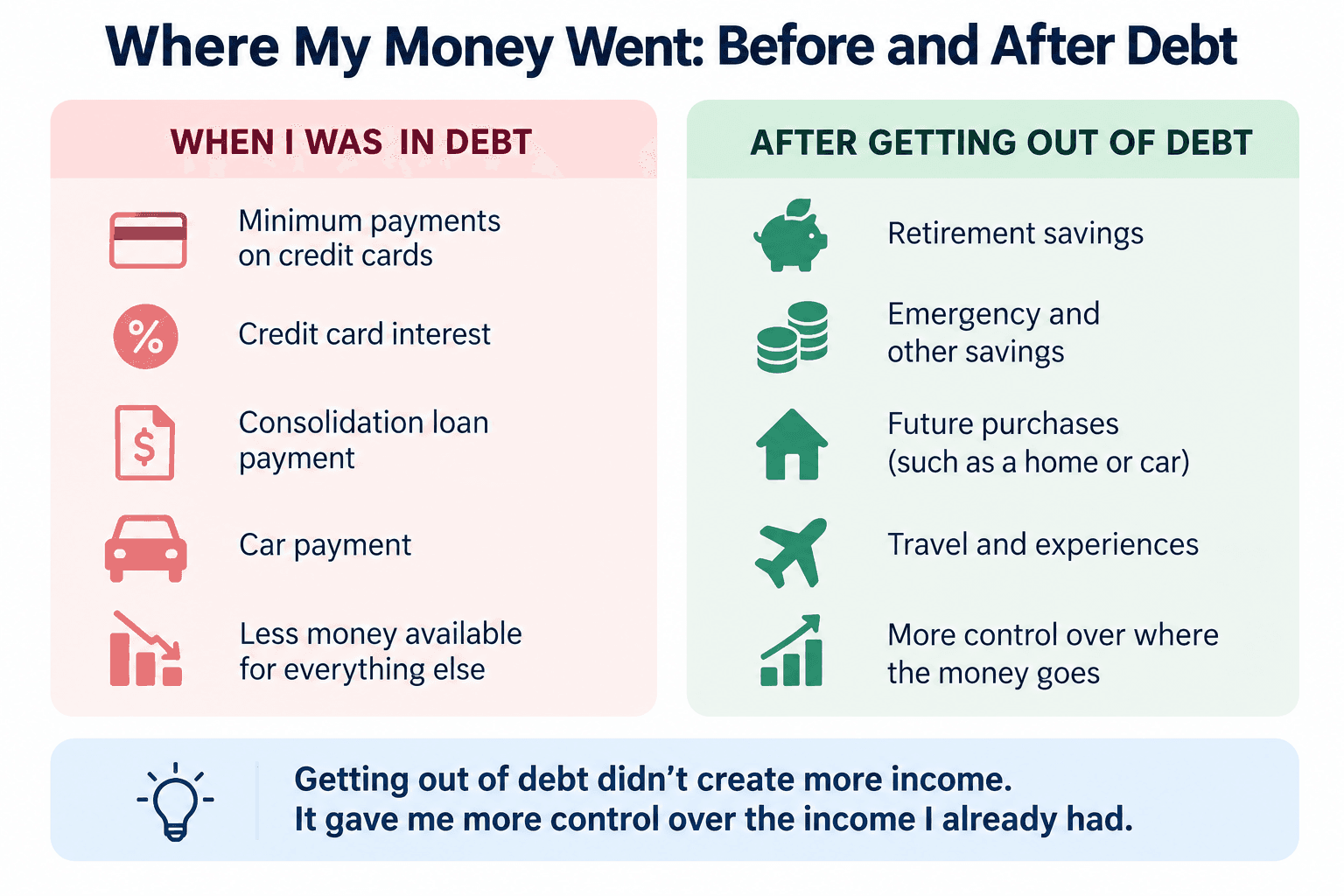
For many years, a significant portion of my income went toward minimum payments, credit card interest, and eventually my consolidation loan.
Today, much of that money goes into my retirement accounts and savings instead.
And some of the money I don't save goes toward travel, which I love.
Getting out of debt wasn't about learning not to spend money. It was about getting control over what my money does.
When I was buried in high-interest credit card debt, a big chunk of my income was committed before I even got my paycheck. Now, I can choose whether that money builds my retirement savings, strengthens my financial cushion, or pays for an experience I value.
Getting out of debt gave me the ability to use my money to build my future and enjoy my present, rather than paying for my past.
Today, while my car isn't brand new, I have no car payment and will pay cash for the next one when I need it. I'm working toward paying off my mortgage within the next few years, and my credit score generally hovers between 823 and 840, depending on which scoring model I look at.
But the credit score isn't the part I value most.
Having the ability to make better choices is.
Can Debt Consolidation Help You Get Out of Debt?
While debt consolidation can and does work for many people, it isn't automatically the right solution for everyone.
A consolidation loan may be useful if you can qualify for an interest rate significantly lower than the ones on your existing debts, you can afford the new payment, and you avoid accumulating new credit card balances.
It's not likely the best fit if the interest rate you qualify for in a consolidation loan isn't much less than your existing rates. Additionally, in some cases, loan fees can significantly reduce your savings, so it's important to shop around for the best deal. Consolidation isn't your best bet either if you simply can't afford the new payment, even after eliminating your unsecured debt payments.
Another consideration is that consolidation doesn't address why the debt accumulated.
For me, some of the debt came from a failed business during a financial crisis, and I used to console myself with that. But, admittedly, I had some bad spending habits that needed to change. Both were real parts of my story.
The consolidation loan addressed the cost and structure of my debt. I still had to address everything else.
What I Would Tell Someone Trying to Get Out of Debt Today
I'm completely okay with the younger version of myself who accumulated $44,000 in credit card debt. After all, we only know what we know when we know it, and we all make decisions using the information, experience, resources, and circumstances we have at the time.
Some of my decisions were good, but many were not. Some circumstances were beyond my control, but most of them absolutely weren't.
Looking back with everything I know today and criticizing myself for not knowing it then wouldn't accomplish much. I just needed some time to figure it out.
Frequently Asked Questions
Conclusion
Learning how to get out of debt wasn't about finding one perfect strategy. Debt consolidation worked for me as a partial strategy, by lowering the interest rate on nearly half my $44,000 credit card debt and giving that portion a defined finish line
However, I don't want my experience interpreted as evidence that taking out a consolidation loan automatically solves a debt problem. While the loan helped, getting rid of my consolidated cards, earning more money, learning about snowball debt repayment strategies, not creating more debt, and continuing the fight when I really didn't want to were the biggest factors.
Today, I write about personal finance and financial literacy for a living. Some of what I know about debt comes from research, professional education, and earning my Certified Financial Educator certification. However, remembering what it felt like to make minimum payments month after month and wonder whether I'd ever get out is what drives my ambition now.
And today, instead of sending all that money to credit card companies and lenders, I get to decide what happens to it and how I run my household budget — Retirement first, savings second, and travel third.
About Author

Deane Biermeier - Certified Financial Educator
Deane Biermeier is a certified financial educator through the University of Minnesota and a respected authority in financial research, writing, and editing, renowned for his in-depth analyses and expert advice. With a distinguished career that previously spanned home improvement, real estate, and finance topics, Deane's role at Trusted Company Reviews focuses exclusively on finance. Deane has contributed to leading publications such as Forbes Home, US News and World Report, Newsweek Vault, and others. Since joining TrustedCompanyReviews.com in 2023, he has solidified his reputation as a crucial resource for clear, factual financial guidance.