
Key Takeaways
- Buying a house first is usually better for long-term wealth, but not always practical.
- A new car loan can reduce your mortgage approval power by raising your DTI.
- Credit score and debt levels matter for both auto loans and mortgages.
- Cars depreciate while homes may build equity over time.
- The right choice depends on income stability, savings, and existing debt.
Should I buy a car or house first?
The Short Answer: Buying a house first is usually the smarter financial move.
In most cases, buying a house before a car is the better long-term financial decision. Homes can build equity and potentially increase in value over time, while cars almost always lose value the moment you drive them off the lot.
That said, “usually” isn’t the same as “always.” If you need reliable transportation to keep your job or your income isn’t stable enough to support a mortgage, buying a car first may be the more responsible choice. The right decision depends on your savings, debt, credit profile, and daily needs, which is why the details matter.
Related Article: What to Do With Extra Money - A Step-by-Step Guide
How Does Buying a Car vs a House Affect Your Credit and Loan Approval?
How does your credit score impact auto loans and mortgages?
Your credit score affects both, but the stakes are higher with a mortgage.
Higher score = lower interest rate
Lower rate = lower monthly payment
Better score = higher borrowing limit
A small rate difference on a mortgage can cost (or save) thousands
Auto loans are shorter, but higher rates still add up fast.
Our car affordability calculator and home affordability calculator can help you gauge costs.
Can buying a car hurt your chances of getting a mortgage?
Yes, and sometimes significantly.
A new car loan adds debt and a monthly payment.
Lenders count that payment against your debt-to-income ratio (DTI) in mortgage approval.
Average auto payments are now high enough to reduce borrowing power
A recent loan inquiry can temporarily lower your credit score
If you’re planning to apply for a mortgage soon, timing matters.
What Is Debt-to-Income (DTI) Ratio and Why Does It Matter?
What does DTI mean for homebuyers?
DTI is the percentage of your income that goes toward debt payments.
Lenders use it to decide:
How much you can borrow
Whether you qualify at all
What interest rate you receive
Higher DTI = higher risk in the lender’s eyes.
How does a new auto loan change your DTI?
Every monthly car payment increases your DTI.
That means:
You may qualify for a smaller mortgage
You could receive worse loan terms
The lender could deny your loan application altogether
Even a “manageable” car payment can reduce home affordability.
Also Read:5-Point Financial Contract Trust Checklist: How to Know If a Company Is Legit
Car Payment vs Mortgage Payment: What Costs More Long Term?
What are the real monthly costs of owning a car?
It’s not just the loan payment. Additional costs, though not DTI factors, all impact your budget and how much home you can afford.
Add:
Insurance
Fuel
Maintenance
Registration
Parking
Cars also depreciate, meaning they lose value over time.
What are the real monthly costs of owning a home?
Beyond the mortgage payment:
Property taxes
Home insurance
Repairs and maintenance
Utilities
HOA fees (if applicable)
Homes require cash reserves. Repairs have a way of not waiting for your finances to improve.
How Do Interest Rates and Market Conditions Change the Decision?
They can.
How do higher interest rates affect car loans and mortgages?
Higher rates mean:
Bigger monthly payments
Slower equity growth
More total interest paid
Reduced affordability
On cars: less trade-in value equity.
On homes: slower wealth-building.
Do market conditions matter when deciding?
Yes.
For homes:
Local prices vary widely
Timing can affect affordability
For cars:
Popular models may have dealer markups
Inventory levels impact pricing
Flexibility helps in both markets.
Should You Save for a Down Payment or Finance a Car First?
Why does saving for a down payment improve mortgage options?
A larger down payment can:
Lower your monthly mortgage payment
Reduce interest costs
Help avoid PMI
Increase approval odds
But don’t ignore high-interest debt to save aggressively.
Balance matters.
The amount you need to save before buying a home depends on several factors, including the down payment, closing costs, moving costs, and early investments, if applicable.
When does buying a car first make sense?
Buying a car first may be smarter if:
You need transportation to earn income
Your current vehicle is unreliable
Public transportation isn’t a realistic option for you
Homeownership is several years away
Just avoid overbuying. Depreciation is real.
When Is Buying a House First the Smarter Long-Term Move?
If you:
Have stable income
Have manageable debt
Have savings for down payment + emergency fund
Already have reliable transportation
A home may help build long-term equity and financial stability
What are the risks of buying a car before a house?
Higher DTI
Reduced mortgage approval odds
Worse interest rate on your home loan
Less monthly flexibility
Timing matters more than most people realize.
Also Read:5-Point Financial Contract Trust Checklist: How to Know If a Company Is Legit
How Do You Decide Based on Your Financial Situation?
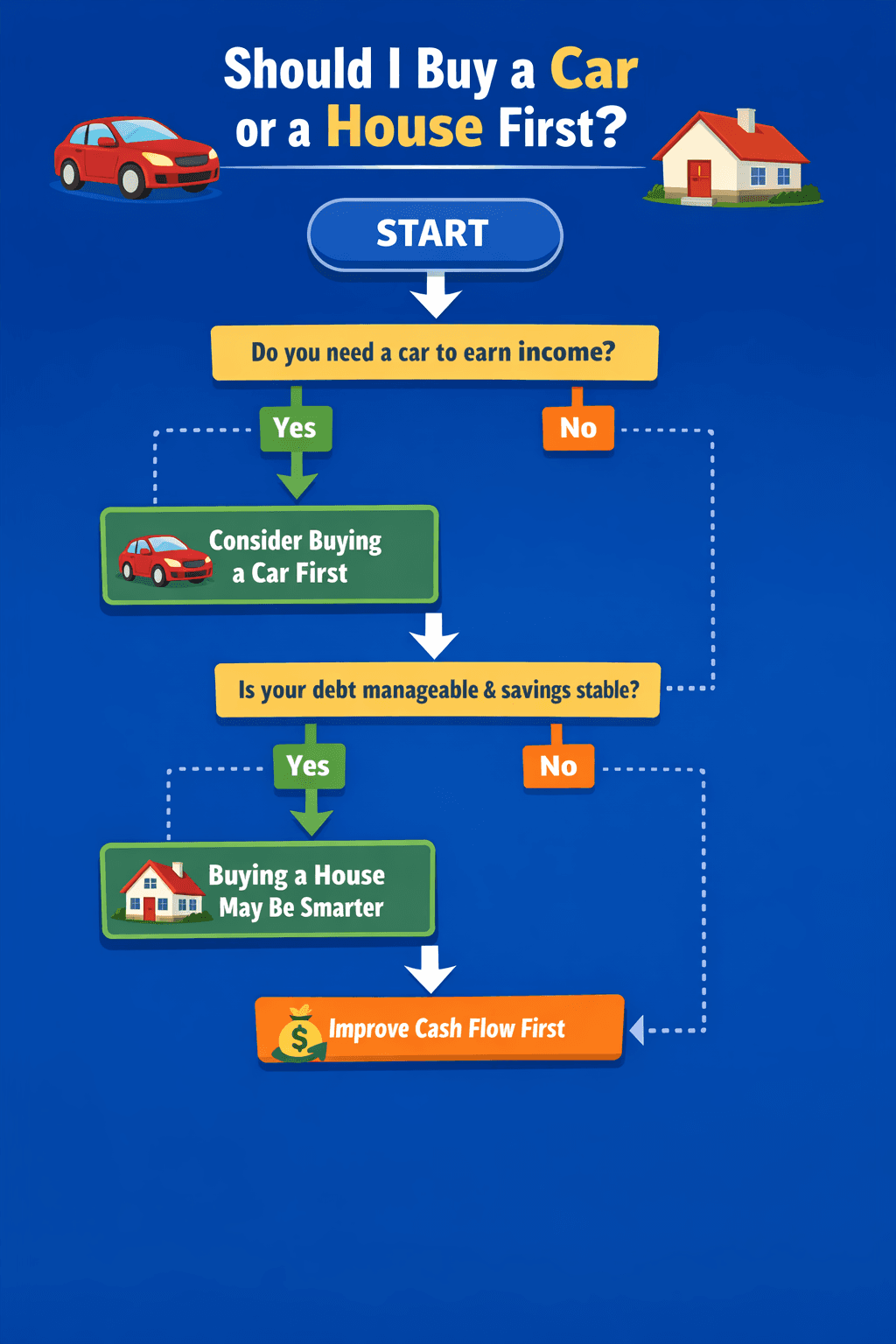
Questions to ask before buying a car or a house
Is my job stable?
Do I have an emergency fund?
Is my current car reliable?
How much debt do I already carry?
Would one loan make me financially stretched?
Be honest. The best tactic is to try to leave emotion out of the decision.
Pro TipFrom our on-staff Certified Financial Educator Just because a lender approves you for a certain loan amount doesn’t mean you should borrow that much. Buying below your maximum budget gives you breathing room for repairs, insurance increases, job changes, and other unexpected expenses. Approval is based on formulas, but affordability is based on real life. Leave yourself flexibility so neither purchase creates long-term financial stress. |
How should this decision align with long-term goals?
Think in 5 to 10-year terms.
Do you want to build equity?
Is transportation limiting income?
Will this purchase increase or reduce stress?
Short-term comfort vs. long-term growth is the real trade-off.
Where to Get More Information Before You Decide
If you’re still weighing whether to buy a car or a house first, the best next step is to get clarity and make decisions based on real numbers.
Use the resources below to research your options, compare providers, and run realistic numbers before committing to either loan.
Learn More About the Financial Tradeoffs
Use educational resources to understand how debt, credit, and loan structures affect your decision.
Compare Trusted Loan and Mortgage Providers
Before applying, review lender options to understand rates, requirements, and approval criteria.
Run the Numbers With Budget and Loan Calculators
Numbers reduce emotion and reveal risk. Model both scenarios before you commit.
Frequently Asked Questions
Conclusion
From a financial perspective, buying a house first is often the smarter move, as homes can build equity while cars lose value. However, if you need reliable transportation to earn income, buying a car is likely the more practical choice.
Questions to ask yourself when deciding include: Is my job stable? Is my debt manageable? Do I have savings?
If debt feels heavy, you may consider exploring debt consolidation options before taking on either loan.
Make the decision strategic and not emotional.
About Author

Chris Teague
After earning an MBA, Chris began writing about tech and finance as part of his work as a bank analyst and consultant. Wanting to pursue his first love in life, Chris jumped ship and turned his focus to the automotive industry, first as a freelance writer for Forbes, J.D. Power, The Drive, and U.S. News & World Report, before starting YourTestDriver.com and the America on the Road Radio Show. Chris brings more than ten years of experience in product reviews, in-depth analyses, and news, and has been recognized as a significant contributor in building the future of the automotive media field.